









Legislative intelligence you can check in a minute.
An illustrated summary of the PolicyAI Domain Atlas for school leaders and boards.

Australian education law is not a list anyone hands you.
It is hundreds of instruments across nine jurisdictions, most of which say nothing about schools and some of which say everything. This page explains why that is true, and why nobody else can say it.

What we keep hearing
Somebody demonstrates an AI tool that answers a compliance question fluently, with a citation, and the room nods. Then a business manager asks where a particular number came from, and the answer is a paraphrase of a paraphrase. The question underneath is not whether the tool is clever.
It is whether anyone can check it before the board is told.
The problem
A citation is not a verification
A model can produce a section number as fluently as a sentence, and the two look identical on the page. Unless the provision at that address was fetched and the duty's own words found in it, the citation is a claim about the law, not a reading of it.
Most extracted education law is somebody else's duty
Acts about schools mostly bind ministers, regulators and systems. A corpus that cannot say which side a duty falls on frightens a principal with obligations that were never theirs, and a school that discovers one such error stops trusting the rest.
Unknowns get rounded
A penalty the statute does not express in dollars is either dropped to zero or inflated to a maximum, and either way a dollar total then reads as the whole picture. It is not, and a procurement reviewer who works that out unaided concludes the number was built to mislead.
Eight views, one reconciled picture. Each one drills to the record it came from.
 01
01Every document accounted for
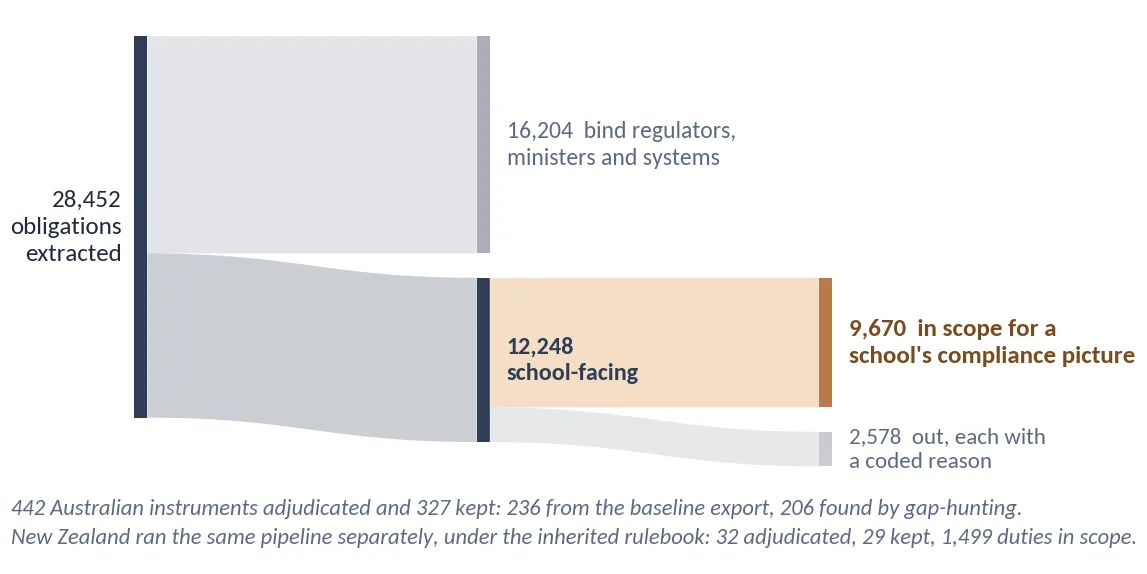
28,452 obligations were extracted from 442 adjudicated Australian instruments. 16,204 bind regulators, ministers and systems; 12,248 are school-facing; 9,670 are in scope for a school's compliance picture and 2,578 are out, each with a coded reason. Nothing is discarded: every row that falls away can be walked back to the verdict that removed it.
 02
02Why a duty is in, or out
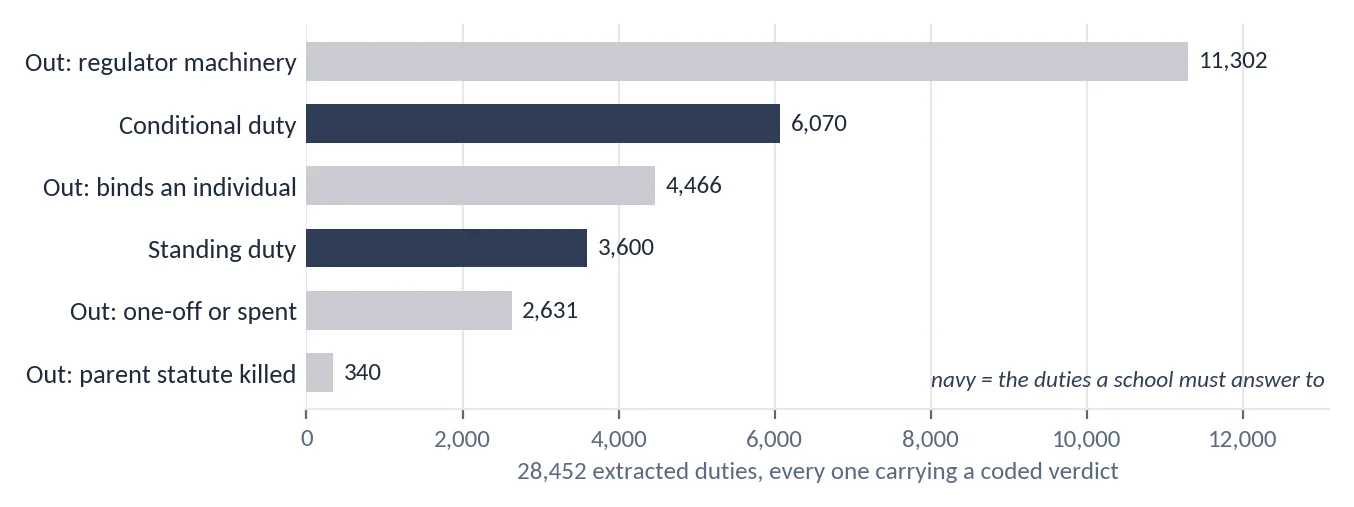
Every extracted duty carries a coded verdict rather than a silent exclusion. Regulator machinery, duties that bind an individual, one-off or spent duties and duties whose parent statute was killed are out, with the reason on the row; standing and conditional duties are in.
 03
03The law is concentrated
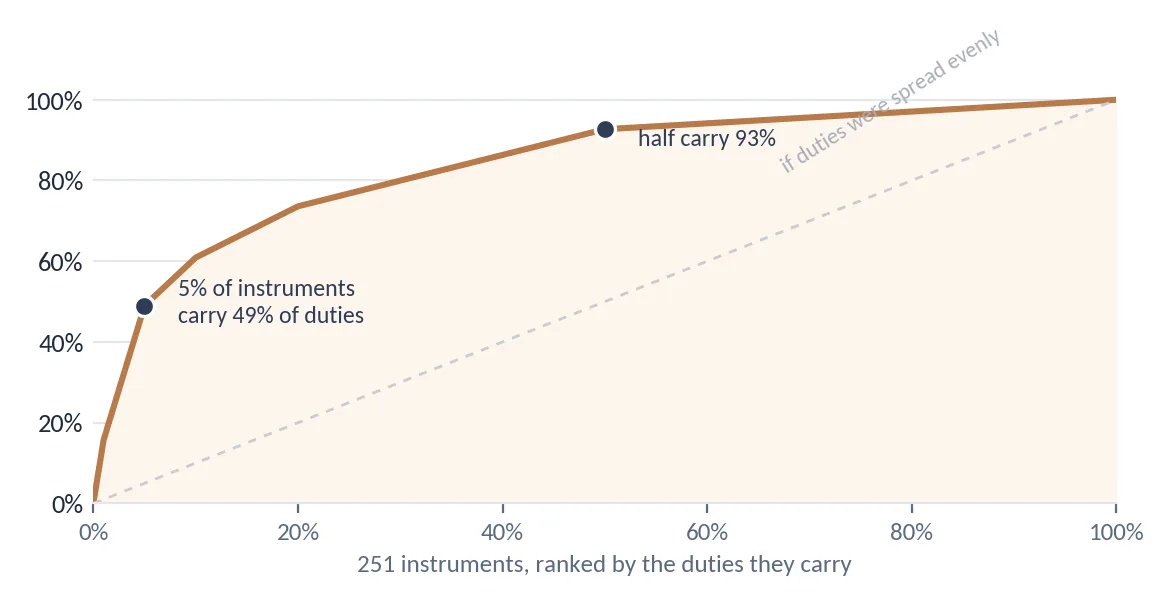
251 instruments carry 11,169 duties across Australia and New Zealand, and they carry them very unevenly: thirteen instruments, five per cent of the register, carry 49 per cent of every duty in the corpus, and half the instruments carry 93 per cent. Concentration is a fact about drafting, not about risk; a single duty in an obscure regulation can still be the one that closes a school.
 04
04Concentrated by subject too
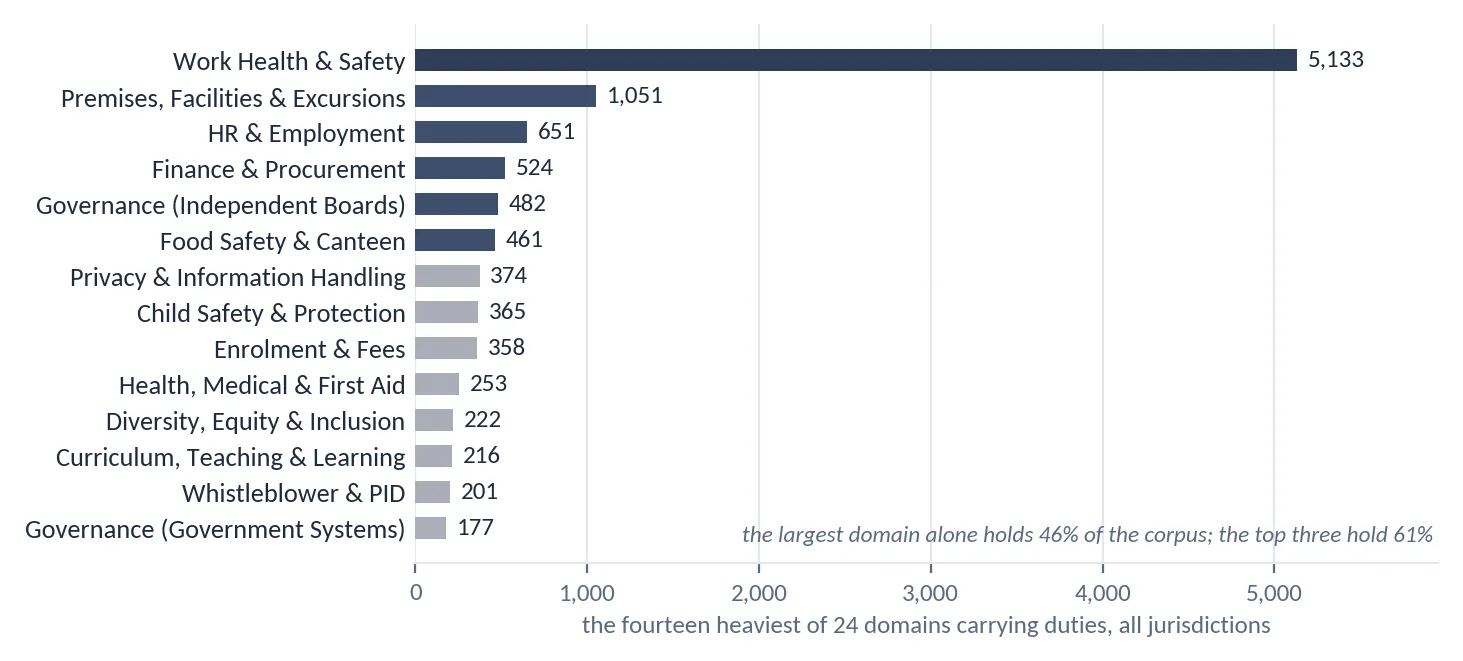
The fourteen heaviest of 24 domains carrying duties. Work health and safety alone holds 46 per cent of the corpus, because it is drafted as long lists of specific duties, and the top three domains hold 61 per cent.
 05
05When the instruments were last amended
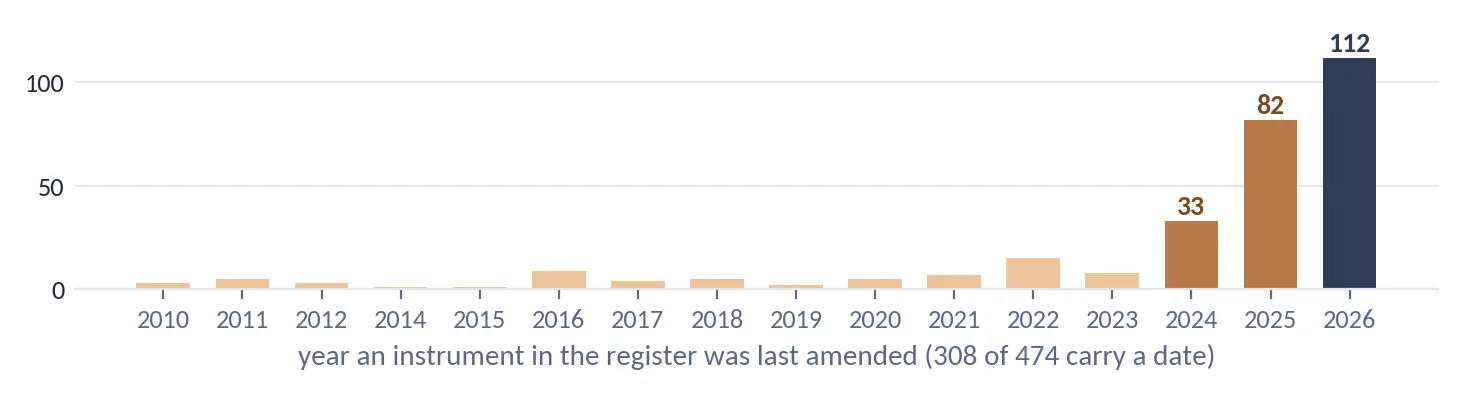
308 of the 474 instruments in the register carry a last-amended date, and the distribution is heavily recent: 112 were amended during 2026 and 194 in the last two years. This is the measure of how much of a school's legal landscape moved while nobody was watching.
 06
06The confidence behind every domain tag
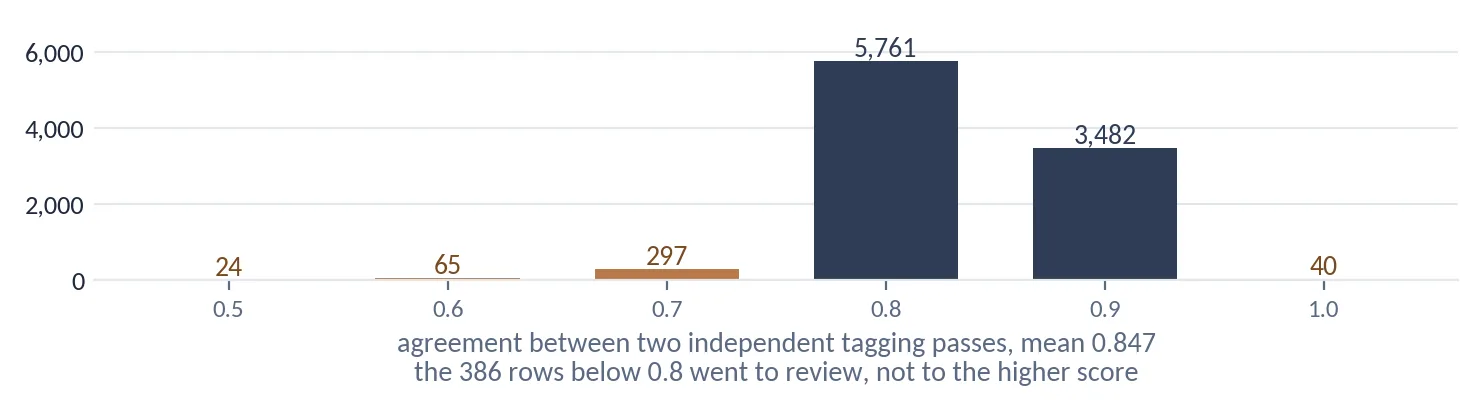
Each in-scope duty was tagged to a domain by two independent passes, and the agreement between them is scored, mean 0.847. The mass sits at 0.8 and above; the 386 rows below it were routed to a person rather than resolved by taking the higher score.
 07
07Verified against the law, row by row
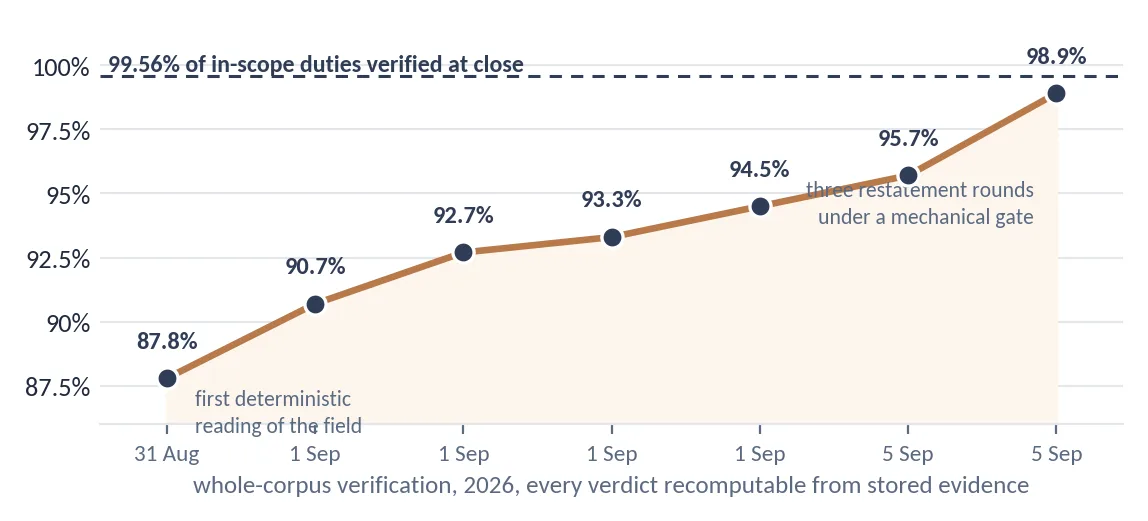
The provision at each row's address was fetched from the store, the duty's own words were found in it at a fixed threshold, and the instrument's identity was confirmed separately by citation. The climb runs from the first deterministic reading on 31 August, 87.8 per cent, through a tokeniser correction, a repair pass over 559 anchors, re-derived pins and three gated restatement rounds, to 99.56 per cent of in-scope duties verified at close.
 08
08What happens on breach
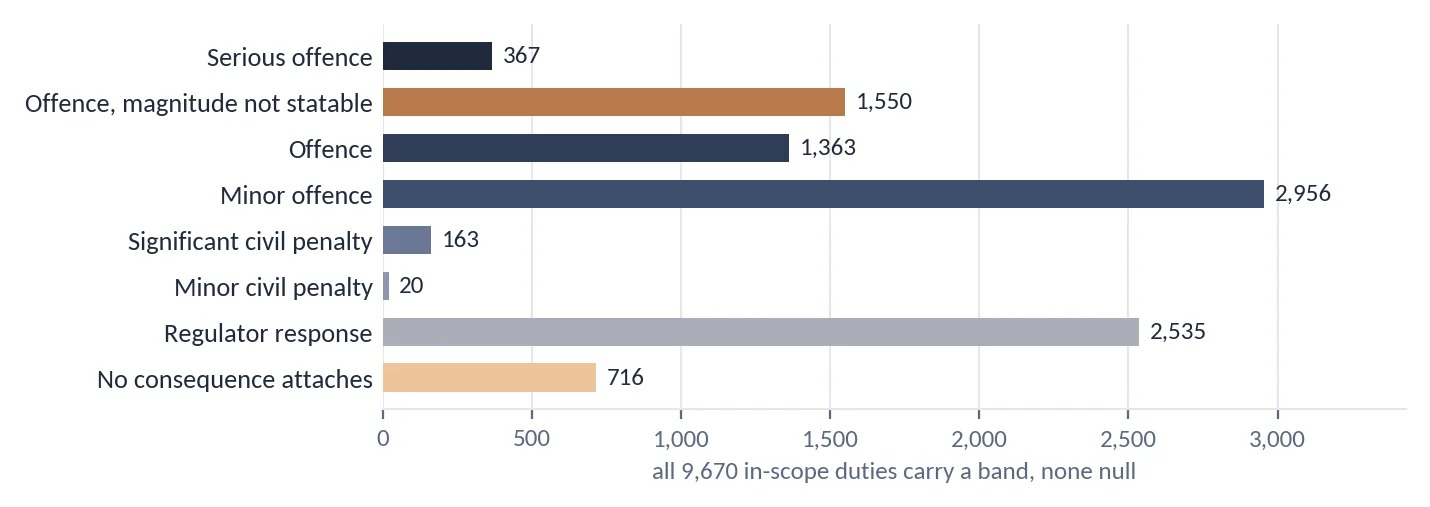
All 9,670 in-scope duties carry one of eight severity bands, with the statutory text quoted on the row: serious offence 367, offence 1,363, minor offence 2,956, offence with a magnitude the statute does not state 1,550, significant civil penalty 163, minor civil penalty 20, regulator response 2,535, no consequence attaches 716. Two of the eight are honesty devices rather than rungs.
Run at any scale. From one campus to a diocese, with every entity reporting the same way.
- Switch
- from your existing platform, for a low cost
- 25
- policy domains help you make sense of the policies you have, and the ones you need
- Every regulator
- in Australia and New Zealand supported
- Safe
- data, processing and AI based in Sydney and Melbourne via AWS
Coverage spans the eight Australian states and territories, with Commonwealth law applying across all of them, and separately New Zealand. Domain figures come from the PolicyAI Research Atlas, refreshed weekly.
Where this comes from, and why only we have it
PolicyAI is built on AccuFind, a sovereign Australian legal-data store holding 801,178 primary-source documents: the consolidated legislation of the Commonwealth, every state and territory, and New Zealand, as versioned, addressable data, exposed through a self-describing interface that a fleet of AI agents can query at scale. EthosOne holds the exclusive partnership on the school-facing legislative landscape built from that store. The obligation corpus described here does not exist anywhere else, and it cannot be reconstructed from a search engine, a PDF library or a legal practice's precedent files, because the property that makes it trustworthy is the one those sources lack: every row points back to a versioned provision that can be fetched and compared.
The practical consequence is simple. A law firm can give a school an opinion on the instruments it was asked about, at the date it was asked, from a sample of the law. A managed-policy vendor can give a school an asserted list of policy areas and promise it is complete. PolicyAI gives a school the whole school-facing landscape, one duty per row, with the provision, the consequence, the reason it applies, and the date it was last checked against the source. Any adviser who could get their hands on this data would use it. They cannot, and EthosOne can.
Narrowing without error
Figure 1, every document accounted for. The path from an adjudicated register to the duties a school must answer to. Nothing is discarded: each row that falls away carries a verdict code and a stated reason, so the narrowing can be walked backwards as easily as forwards. It does not trace New Zealand, which ran its own extraction and adjudication under the inherited rulebook and is counted separately.
Roughly 57 per cent of extracted education law turns out to be somebody else's obligation. Duties on regulators, ministers and system authorities read exactly like duties on schools, and a corpus that cannot tell the two apart will frighten a principal with the wrong half of the statute book. Every one of the 28,452 rows carries a verdict code saying which side it falls on and why.
Figure 2, why a duty is in, or out. Every extracted duty carries a coded verdict rather than a silent exclusion. The two navy bars are the duties in scope for a school; the rest are kept, coded and excluded for a stated reason. It does not show the actor-side gate that ran first: a duty binding a regulator never reaches this measure at all.
The shape of the landscape
The law is not spread evenly, and knowing where it concentrates is the difference between a compliance programme aimed at the right instruments and one aimed at all of them equally. Figure 3, the law is concentrated, and by how much.
- 251instruments carry
- 11,169duties
- 24domains carrying duties
Is any of it current?
A corpus of education law is not a static thing. The register is re-pinned against the consolidated source, and the amendment record is published rather than assumed.
Figure 5, when these instruments were last amended. 308 of the 474 instruments in the register carry a last-amended date, and the distribution is heavily recent: 112 were amended during 2026, and 194 in the last two years. This is the measure of how much of a school's legal landscape moved while nobody was watching it. It does not cover the 166 instruments with no amendment date recorded: an absent date means the source did not carry one, not that the instrument is unamended.
How sure are we?
Three separate measures answer that question, and each is a distribution rather than a headline. Subject tags were assigned by two independent passes and scored on their agreement. Consequences were compiled from the statutes themselves. And every row was finally checked against the words of the law at its own address.
Figure 6, the confidence behind every domain tag
Each in-scope duty was tagged to a domain by two independent passes, and the agreement between them is scored. The mass sits at 0.8 and above; the 386 rows below it were routed to a person rather than resolved by taking the higher score. It does not prove a tag is right. Two passes agreeing is evidence, not proof, which is precisely why the contested rows were adjudicated by a human.
Figure 7, verified against the law, row by row
The provision at each row's address was fetched from the store, the duty's own words were found in it at a fixed threshold, and the instrument's identity was confirmed separately by citation. The climb runs from the field's first deterministic reading on 31 August through a tokeniser correction, a repair pass over 559 anchors, a calibrated section-field tie-break, re-derived pins, recovered stem windows and three gated restatement rounds. It does not treat unverified as clean. Verified, failed and unverified are three states, and every row that is not verified is named with its class and its reason in the corpus verification record.
Figure 8, what happens on breach
All 9,670 in-scope duties carry one of eight severity bands, with the statutory text quoted on the row. Two of the eight are honesty devices rather than rungs: an offence whose maximum the statute does not state in dollars, and a nil consequence assigned only under a human ruling with the supporting authority quoted. It does not rank duties by importance. The band prices the stated consequence of breach; a duty with no consequence can still be the one a school must not skip.
Five reasons this deserves your confidence
Nothing rests on memory or opinion
Every claim about the law traces to a stored retrieval from the legal store. Severity bands quote the penalty sentence they were read from; where a regulator's power is the consequence, the power is quoted. Where we assert a duty does not exist, the assertion cites the express statutory carve-out, because an absence claim is only as good as its last chase.
Unknowns are never dressed as answers
Every row is verified, failed or unverified, never silently assumed fine. A duty whose penalty cannot be stated in dollars says so on its face, placed beside the most serious band so an unknown can never read as small. A plain-language reading that fails a gate is withheld with its evidence, not published with a caveat.
Humans made the judgement calls, and each one is on file
Where the law does not settle a question, the call was made by a named person, numbered, dated and recorded with what it changed. The log corrects itself in new entries rather than by editing old ones, so it shows what was known when.
The corpus was attacked before it was trusted
Sixty-nine named quality passes across twelve frozen cuts: dual-blind tagging, tie-break passes, five adversarial lanes, hostile framework review, profile walks with constructed schools, a line-by-line corroboration of the partnership whitepaper against the live data, and a verification programme that made correctness a property of every row. Defects found in the upstream store were referred back with reproduction evidence rather than worked around silently.
The mistakes are in the record
An overstated claim of national parity, a published coverage finding that proved 64.8 per cent false positive, an absence corroborated three ways and still wrong: each is preserved beside its correction. A record that admits its errors is the strongest evidence that the numbers which survived are real.
What this corpus cannot tell you
A research record that only reports what worked is not a research record. The thin places are measured and published rather than omitted.
| Limit | Measure | |
|---|---|---|
| Duties carrying a penalty of their own | 343 of 11,169 | 3.1 per cent |
| Instruments with no amendment date recorded | 166 of 474 | 35.0 per cent |
| Domain tags below 0.7 confidence | 89 | routed to review |
| In-scope duties that resist verification | 43 of 9,670 | each named with its reason |
Penalty capture is the sparsest of these and the least surprising: most duties in Australian education law carry no monetary penalty of their own, because the consequence sits in a parent provision. It is reported per jurisdiction in the acceptance report rather than smoothed into one number.
This is legislative intelligence, not legal advice. Verification is against pinned consolidations, with drift detectable by fingerprint but not prevented. Policy-side expectations that schools meet without a statute underneath (uniforms, mobile phones) are presented as policy-evidenced views, never dressed up as legislation. New Zealand ships without consequence reads, so any exposure figure is Australian unless it says otherwise.
How the register is kept
The register is versioned. Every row carries the instrument, the provision at its own address, the consolidation date of the source it was read from, and the date of the last check. When a consolidation moves, the row is re-read against the new text and either reconfirmed or routed to a person; a row that fails is marked unverified and drops out of every authoritative claim until it is resolved. The refresh runs annually. Each page that makes a regulatory claim lists its sources with the day they were read, and a page's last-reviewed date sits in its footer.
- Stored in AustraliaAWS Sydney and Melbourne, one database per school
- AI stays in the country tooAmazon Bedrock; never trained on your content
- Published, not describedTrust Centre · ISMS policy · How we handle your data
PolicyAI answering the prompt “Draft me an AI Acceptable Use Policy.”, then working through: Reading the AI-engaged obligations; Matching privacy, records, child safety; Drafting against your existing library.
Solutions for every school’s AI challenge.
There is no AI-specific legislation in force in Australia or New Zealand. The duties your school already carries are the ones AI engages.
Governing AI, before your board asks again.
“The board asked what our position on AI is, and we did not have one.”
An AI policy is not a new rulebook, it is a lens over duties your school already carries: privacy, records, discrimination and child safety, engaged by an AI-shaped set of facts. Which is why a downloaded template does not survive contact with a regulator.
We have tagged the duties AI activity in a school engages, so the conversation starts from the obligations you already hold rather than from a blank page. Almost none of them say “AI”.
Try Draft with AI.Five paragraphs against the obligations of your State, with the provision beside each. Free, no login.
What this is not
EthosOne, PolicyAI and every page on this site describe obligations and draft words against them; they do not give legal advice. The register is built from the consolidated law at its own address and checked row by row, and it is still a register, not a lawyer. Where a decision turns on how a provision applies to your school, take it to your legal adviser with the source this site names, and let the register be the thing you bring, not the thing you rely on. EthosOne is here to help. It's not legal advice. AI can make mistakes.
The numbers, as they stand
policyai-corpus-v3.1.3, 5 September 2026.
| Measure | Value |
|---|---|
| Instruments adjudicated / kept | 442 / 327 (AU), 32 / 29 (NZ) |
| Obligations extracted | 28,452 (AU) |
| School-facing | 12,248 |
| In scope for a school's compliance picture | 9,670 (AU), 1,499 (NZ) |
| Verified against source | 99.56 per cent of in-scope duties |
| Carrying a severity band | 100 per cent, none null |
| Acceptance suite | 15 of 15 checks pass |
| Review queue | zero, seventh consecutive cut |
How to check us
Pick any duty in the product
Its row names the instrument, the pinpoint provision, the date it was checked, and the severity with its quoted authority.
Ask the statute
Open the provision at the official publisher. The duty's own words are there, at the consolidation the row names.
Give it a minute
The whole design goal is that this check takes a minute, because a corpus you can spot-audit in a minute is one you do not have to take on faith, and one no adviser can match from memory.
Why this data holds up
Legislative intelligence is not the same trade as legal advice, and the difference is the whole argument. A law firm answers a question: it reads the instruments it was asked about, at the date it was asked, and gives a considered opinion signed by someone who carries the risk of being wrong. That opinion is worth what it costs. It is also a sample, taken once, silent about everything outside the question, and re-done from the beginning next year.
PolicyAI answers a different question, and answers it continuously: what is the whole set of legal duties that binds this school, right now, and where does each one live. That is a data problem rather than a judgement problem, and data problems can be made to prove themselves in ways an opinion never can. Four properties do the work, and no adviser we know of has all four.
It is bounded, and the boundary is examinable
Every candidate instrument was adjudicated keep or kill with a coded reason, and 206 of the 327 kept instruments were found by hunting rather than handed over. Nobody publishes the list of Australian instruments that bind a school. We built one, and because every exclusion carries its reason, a sceptic can argue with the boundary instead of guessing at it. A firm's boundary is the scope of the retainer, and it is not written down anywhere the client can inspect.
Every row is addressed, so every claim is falsifiable
A duty is not a sentence about the law; it is a pointer to a versioned provision in a store of 801,178 primary-source documents, which can be fetched and compared on demand. Nothing rests on recall, and nothing rests on our good name. A claim that cannot be checked is worth less than one that can be, even when both are true, because only one of them survives an argument.
It was tested adversarially, and the failures are published
Sixty-nine named quality passes, five hostile review lanes, dual-blind subject tagging with the disagreements escalated to people, and a verification programme that turned correctness into a property of every row rather than a claim about the whole. When our own review found a national work-health-and-safety extraction gap behind a confident claim of parity, it was closed inside the day and the overstatement left in the record beside its correction. An opinion that has never been attacked is not a stronger opinion. It is an untested one.
It is current, and currency is measured rather than promised. 112 of the instruments in this register were amended during 2026 alone. Any picture of school compliance assembled by hand begins ageing the moment it is finished, and no one can tell you by how much. Here the amendment distribution is a published figure, the pins are re-derived against the source, and drift is detectable by fingerprint.
| A legal opinion | A managed-policy vendor | PolicyAI | |
|---|---|---|---|
| Scope | the instruments you asked about | an asserted list of policy areas | the adjudicated school-facing register, with coded exclusions |
| Evidence per claim | professional judgement | the vendor's assurance | a pinpoint provision, fetched and compared |
| Checkable by you | not practically | not practically | in about a minute, on any row |
| Kept current | re-engage and pay again | on the vendor's cycle | re-pinned against source, currency published |
| Errors | private | private | recorded beside their corrections |
None of this makes PolicyAI a substitute for a lawyer, and it is not offered as one. When a duty is contested, or something turns on how a court would read a provision, a school needs advice from someone who will stand behind it. What PolicyAI removes is the larger problem underneath: not knowing what the duties are, where they live, which apply to this school, what happens if one is missed, and whether the answer is still true this term. A lawyer briefed from this data starts days ahead of one briefed from a filing cabinet, which is why any adviser who could get their hands on it would use it.
Not legal advice. Legislative intelligence: the whole set of duties, each one addressed, each one checkable in a minute, and each one current.

EthosOne is the ASBA Risk and Compliance Branch Partner 2026. This is a commercial sponsorship, not an endorsement.
The eight we are asked every time.
Still weighing something up? Thirty minutes with us, on your own registers, answers the rest.
Book your school a demo01Is this legal advice?
No. It is legislative intelligence: what the law says and where it says it. What to do about it in your school is a decision for your leadership, and where it is genuinely contested, for your lawyer.
02What does 99.56 per cent verified mean?
For each in-scope duty, the provision at its address was fetched from the legal store, the duty's own words were found in it, and the instrument's identity was confirmed separately. The remainder is named individually with reasons rather than hidden in a rounding.
03Who decided which duties apply to schools?
Two independent passes tagged every duty, disagreements were escalated, and the contested ones came down to human boundary calls, each numbered, dated and logged by a named person.
04What happens when the law changes?
Legislation is refreshed weekly from the official publishers. When an instrument changes, the affected duties and the policies connected to them are flagged in the Change Monitor.
05Could the AI invent an obligation?
No duty exists in the corpus without a pinpoint provision in a named consolidated instrument, and every row is re-verified against that provision. A row that cannot be verified is marked, not published as fact.
06Does our policy text train the model?
No. AccuFind is trained only on official legislation and regulations, never on user queries, and customer policy text is not used to train models by either party.
07Were the drafter's paragraphs checked the same way?
Yes. Every statutory row in the bench behind Your next five edits was resolved and read at the provision before it was written, the reads are recorded with the consolidation they were made at, and a row that relies on guidance rather than legislation says so.
08PolicyAI, in full: what does it cover?
PolicyAI holds the 9,670 legal duties that bind an Australian education provider, distilled from 28,452 obligations extracted from 442 adjudicated Acts, regulations and codes, with a New Zealand volume beside it. Every duty is keyed to the exact provision of the exact consolidated instrument it comes from, 99.56 per cent are verified against the text of the law, and every one can be re-checked by anyone in about a minute.
What are the AI paragraphs you are currently missing from your policies? Watch how we do it.
Free, under ten minutes, and yours to keep whether or not you talk to us.
“It meets all of the real frustrations of business directors in one place.”


“School governance and risk is a complex area without a clear solution.”


See it on your own policies: five paragraphsdrafted against the obligations of your State
The illustrated executive summary of the PolicyAI corpus, as a page. Where the data comes from and why only EthosOne has it, the narrowing from 28,452 obligations to a school's 9,670 with every row accounted for, the shape of the landscape, how current it is, how sure we are, what happens on breach, five reasons it deserves confidence, what the corpus cannot tell you, the numbers as they stand, how to check us, and why this data holds up against a legal opinion or a managed-policy vendor.