









School registration and review for independent schools
School registration and review, with the evidence already linked
The review is on the calendar and the day is full of other things. Activate the framework your regulator uses, set the exact review date.
Real captures · Focus module · demo school.
EthosOne's Regulatory Readiness module is school registration and review software for independent schools in Australia and New Zealand.
Alongside it, the Legislation module holds the Acts and obligations beneath those criteria, with an authoritative source and effective date on every record.

What we keep hearing
It is 8:40 and the first call of the day is about a bus. By ten there is a parent email, a contractor at the gate and a WWCC that lapsed last week. The registration review is in eleven weeks, and the only complete map of the school's evidence is in the business manager's head. Somewhere in that day, the evidence for it still has to be found.
This is the room where it already is.
Registration and review readiness is not a document-collection exercise.
It is the ongoing work of knowing which criteria apply, who owns them, what evidence demonstrates them and where a gap still requires action. EthosOne connects each criterion to its owner, current status, evidence and remediation work.
Your regulator's framework, already loaded.
Each authority has its own page, with the framework loaded and a readiness consult form of its own.
- NSWNSW Education Standards Authority
- VICVictorian Registration and Qualifications Authority
- QLDNon-State Schools Accreditation Board
- SASouth Australia Education Standards Board
- TASOffice of the Education Registrar (Tasmania)
- NTNT Department of Education
- ACTACT Education Directorate
- WAWA Department of Education
- NZNew Zealand Ministry of Education







Six views, one picture. Each one reads from the same live records.
 01
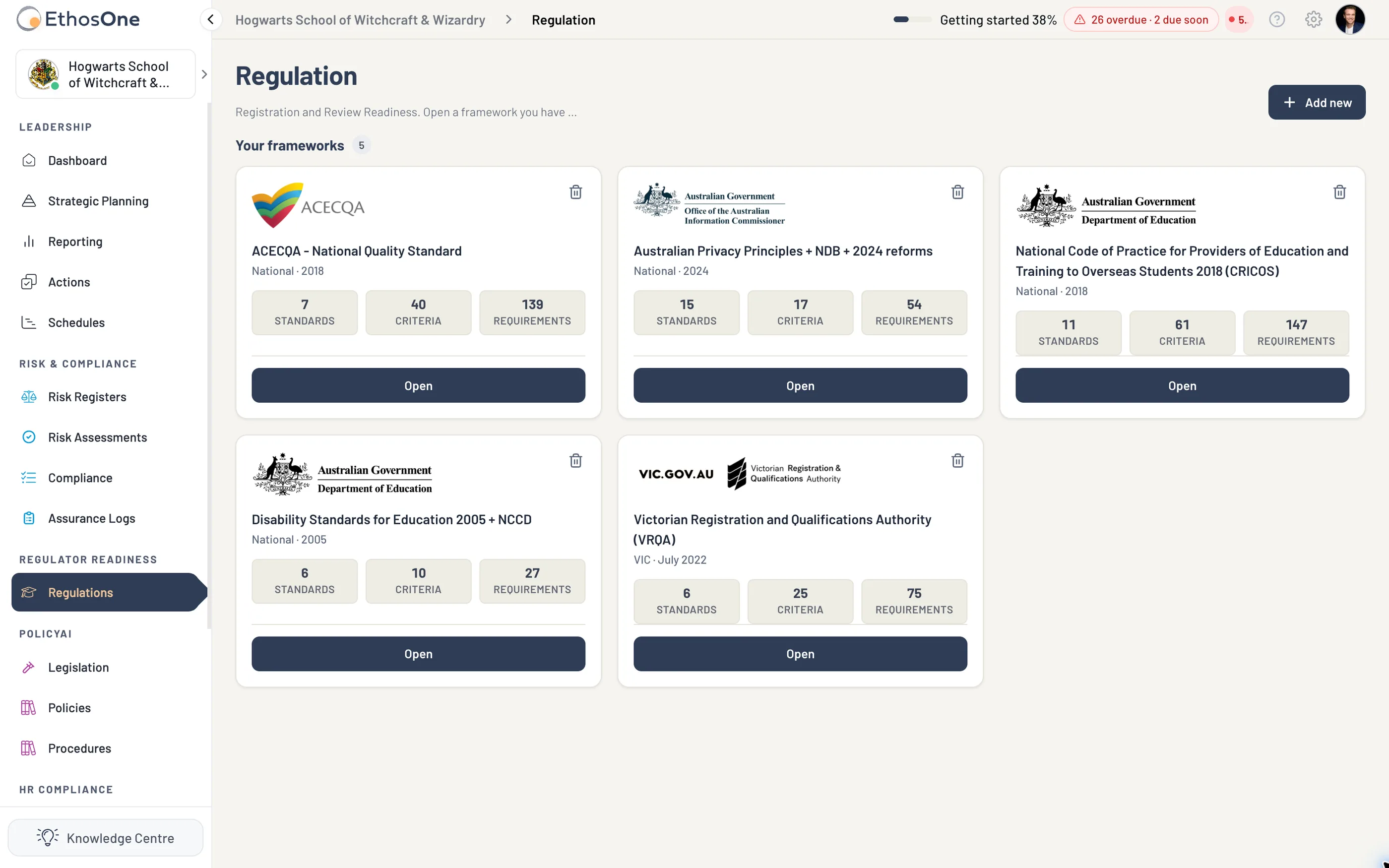
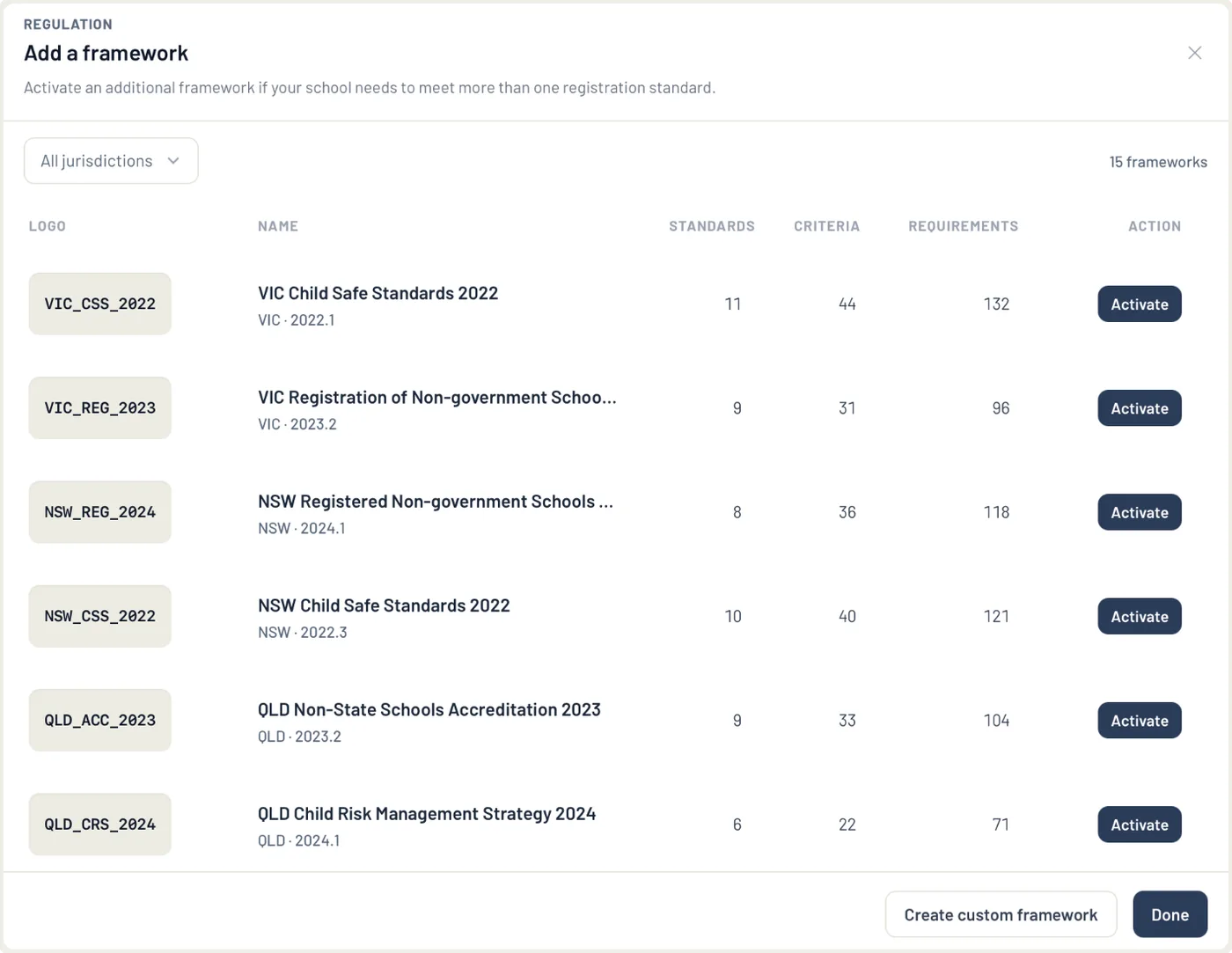
01Regulation home: the right framework, activated
Every framework the school answers to sits on one screen, each with its standards, criteria and requirements counted. When the school opens an ELC or enrols overseas students, it adds that framework and tracks it the same way.
 02
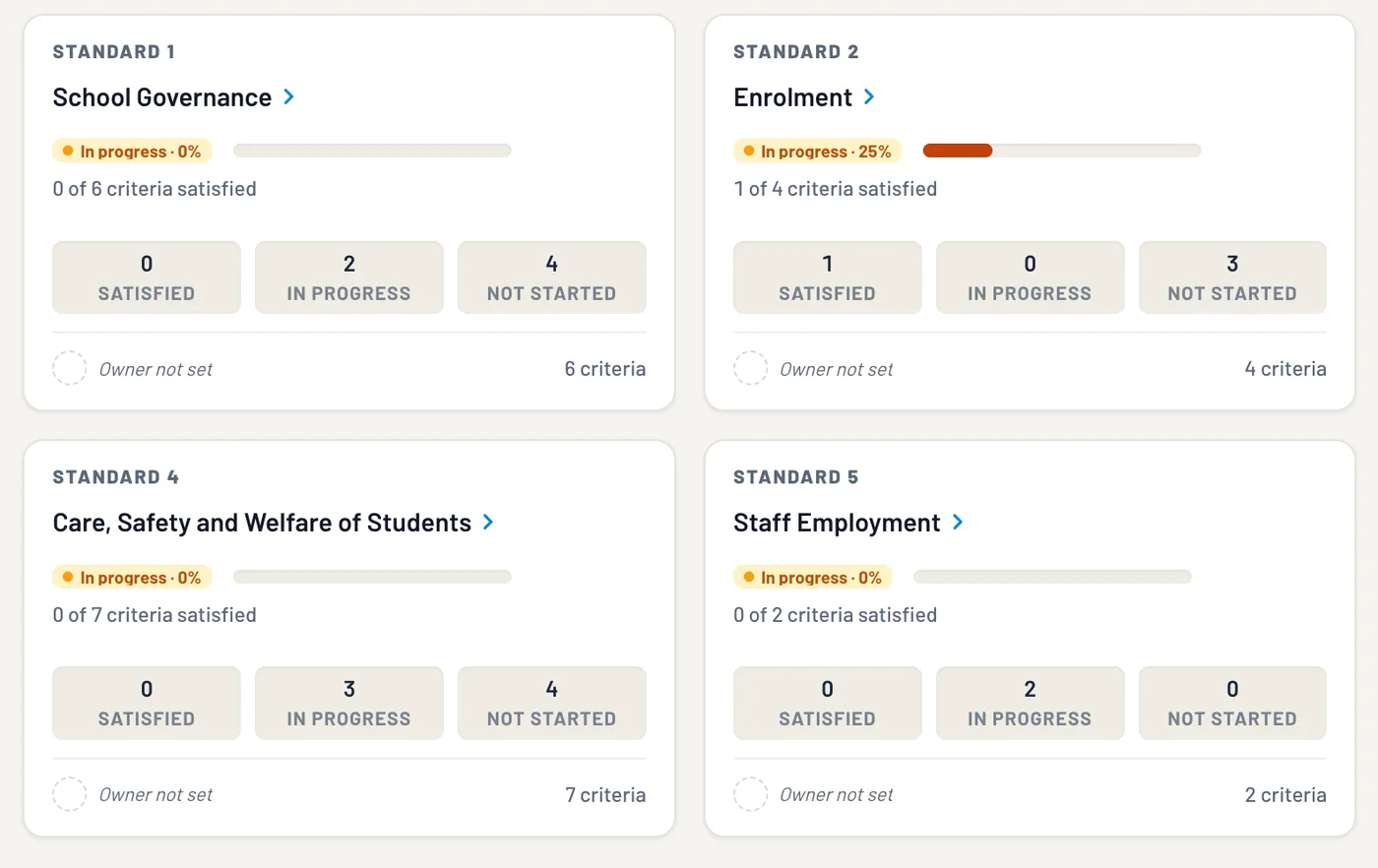
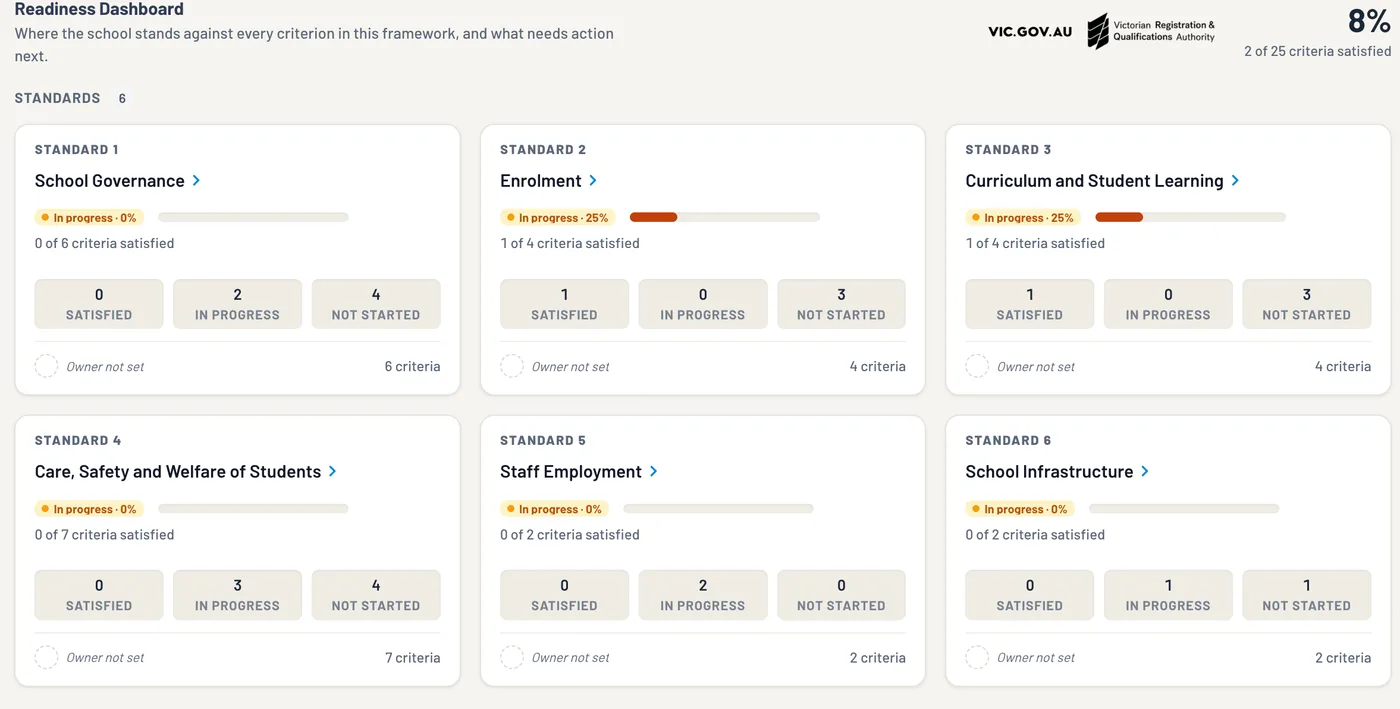
02Readiness Dashboard: where every standard stands
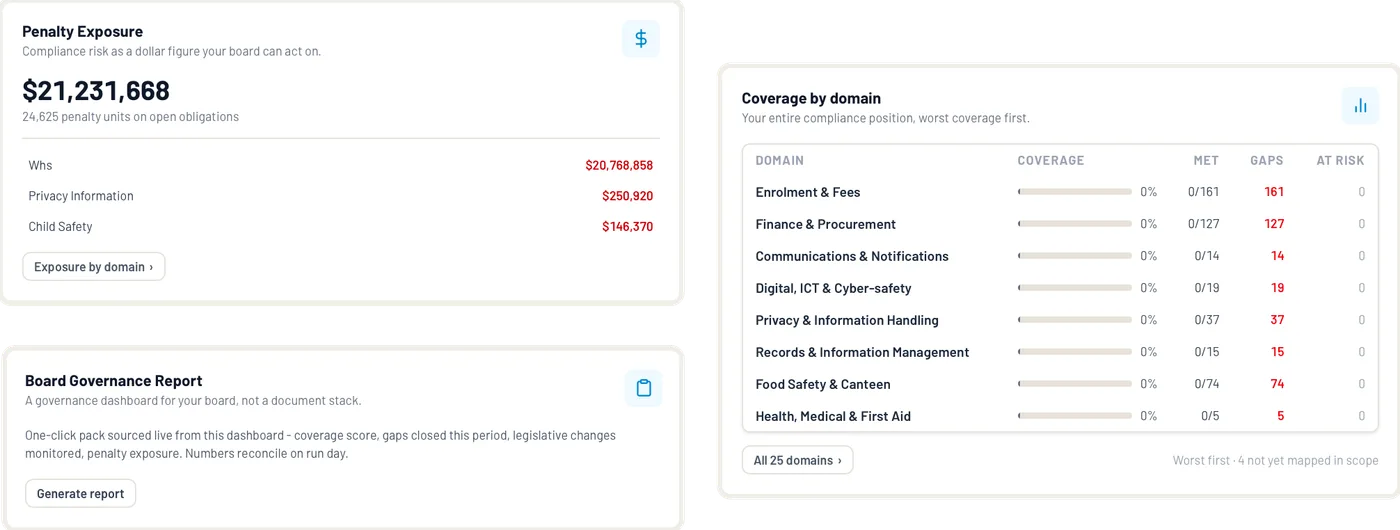
The dashboard opens on one figure, the share of criteria satisfied, and then shows each standard with its satisfied, in progress and not started criteria and the person accountable for it. Below it sit the criteria that need action, the evidence linked most recently and the pack that exports it for the board.
 03
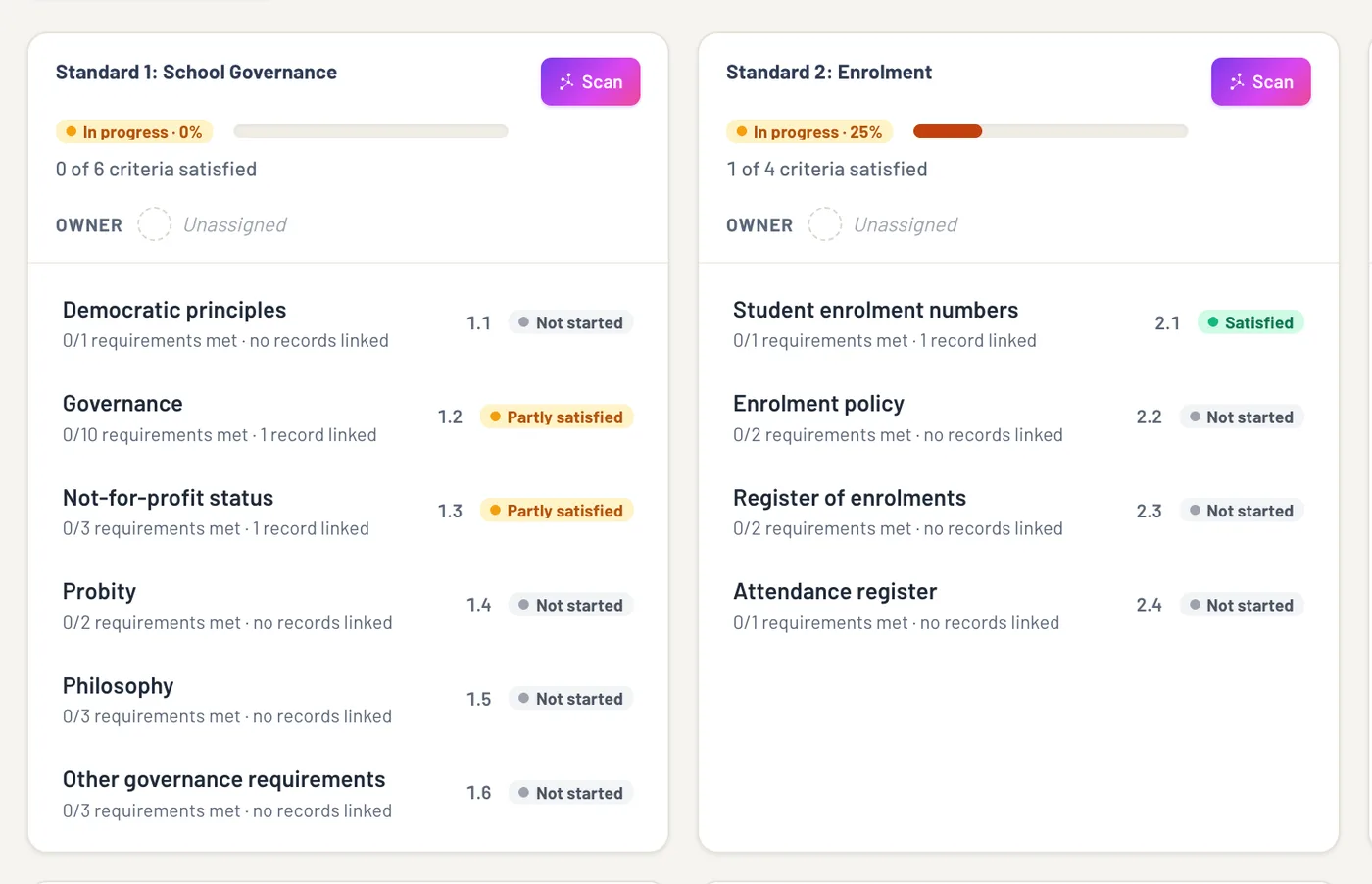
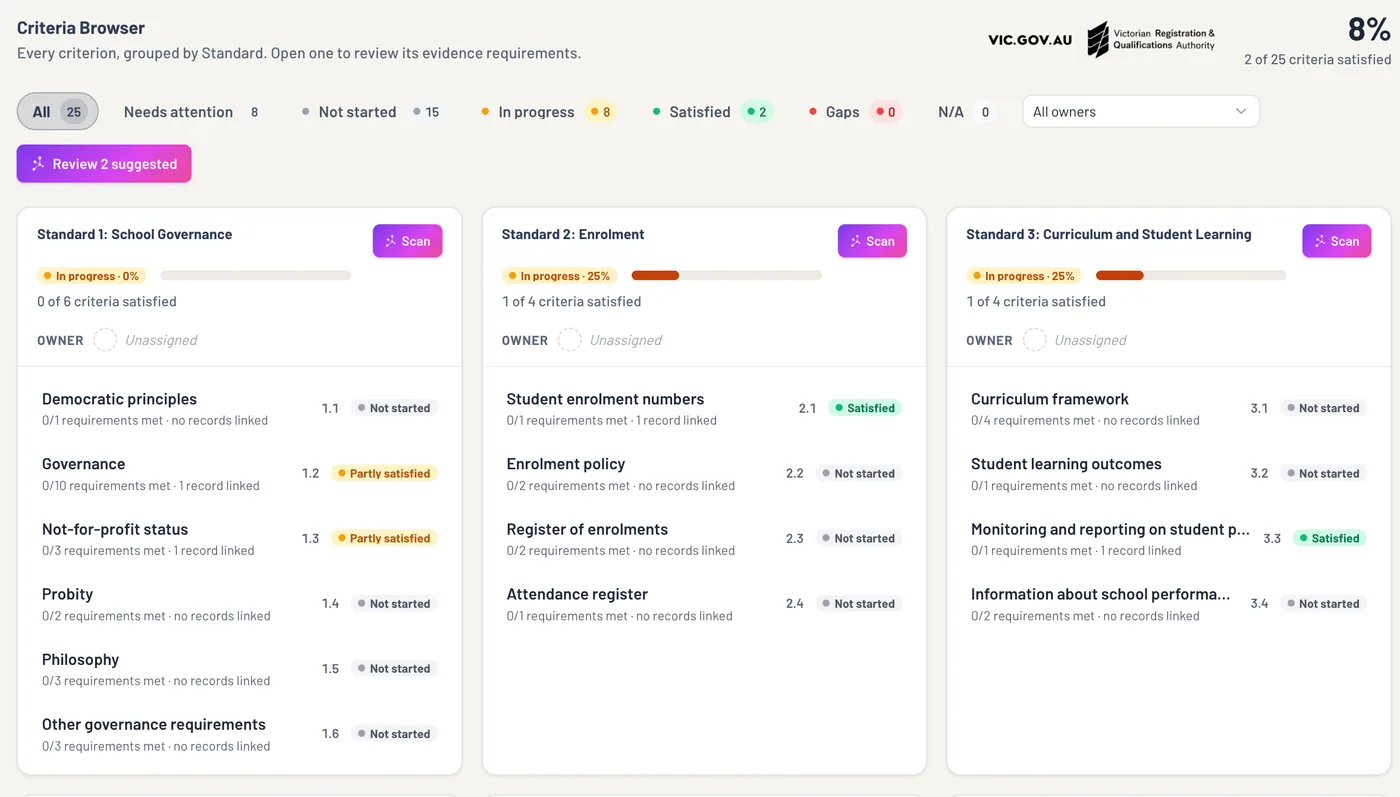
03Criteria Browser: the framework in its own hierarchy
Standards, criteria and requirements appear exactly as the regulator structures them, with a status on every criterion and a count of the records linked to it. Filter to what needs attention, to what has not started or to one owner, and open any criterion from there.
 04
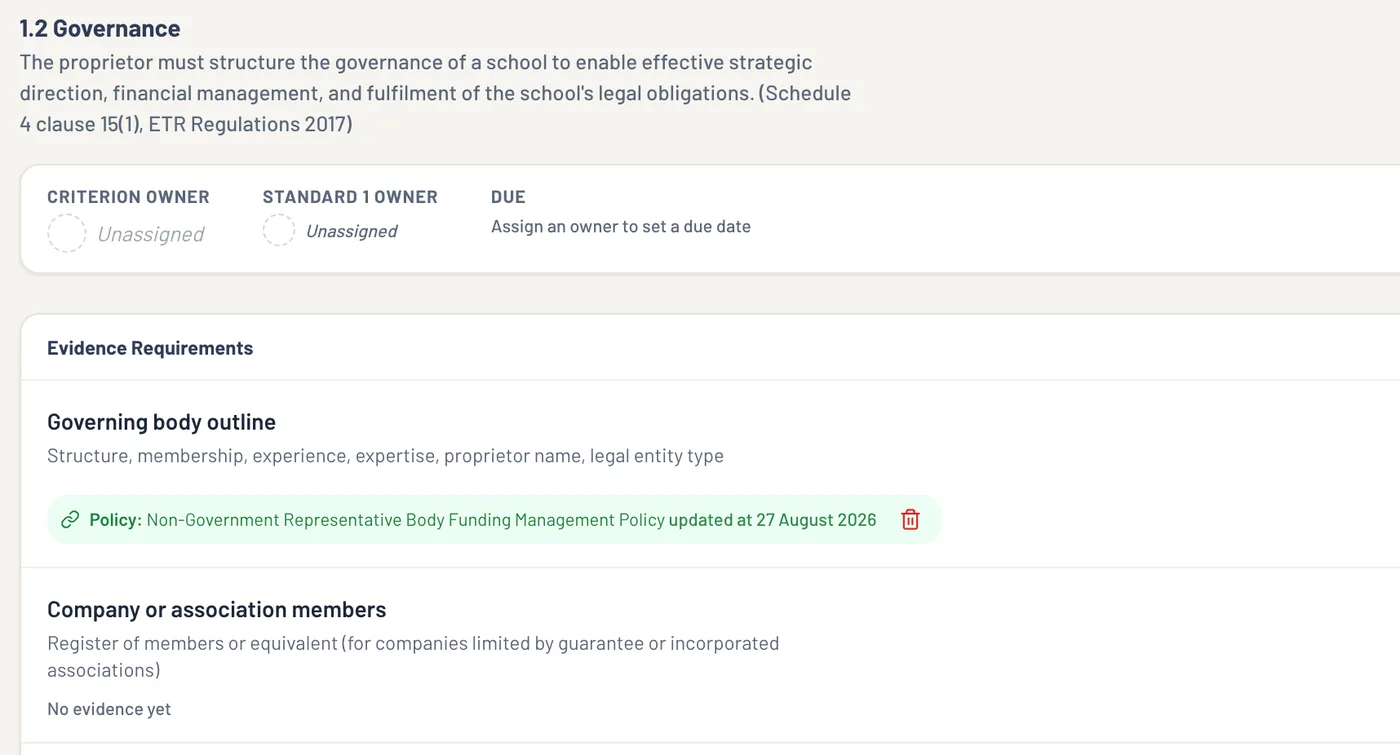
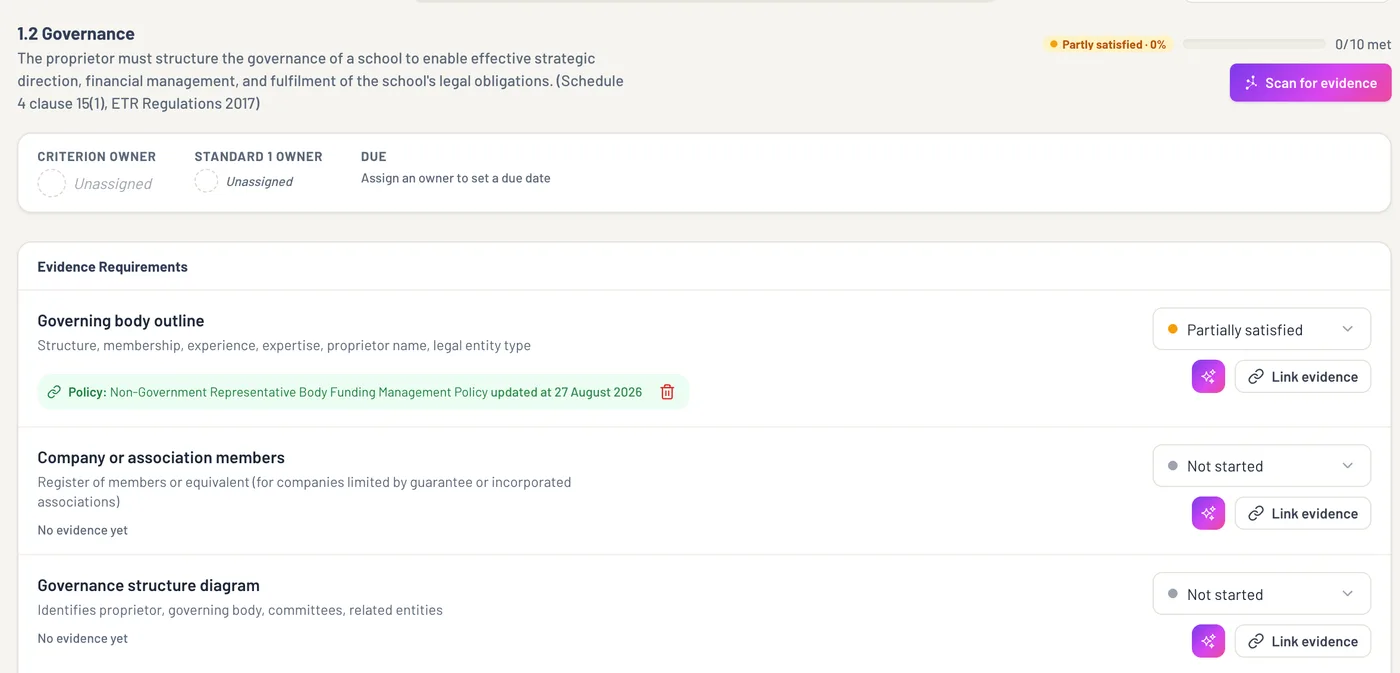
04Criterion detail: the requirement and its evidence
Open a criterion to read the requirement in the regulator's own words, with its clause, and work through the evidence it asks for one requirement at a time. Link a policy, a compliance record or a document to each, set its status, and name the criterion owner so a due date follows.
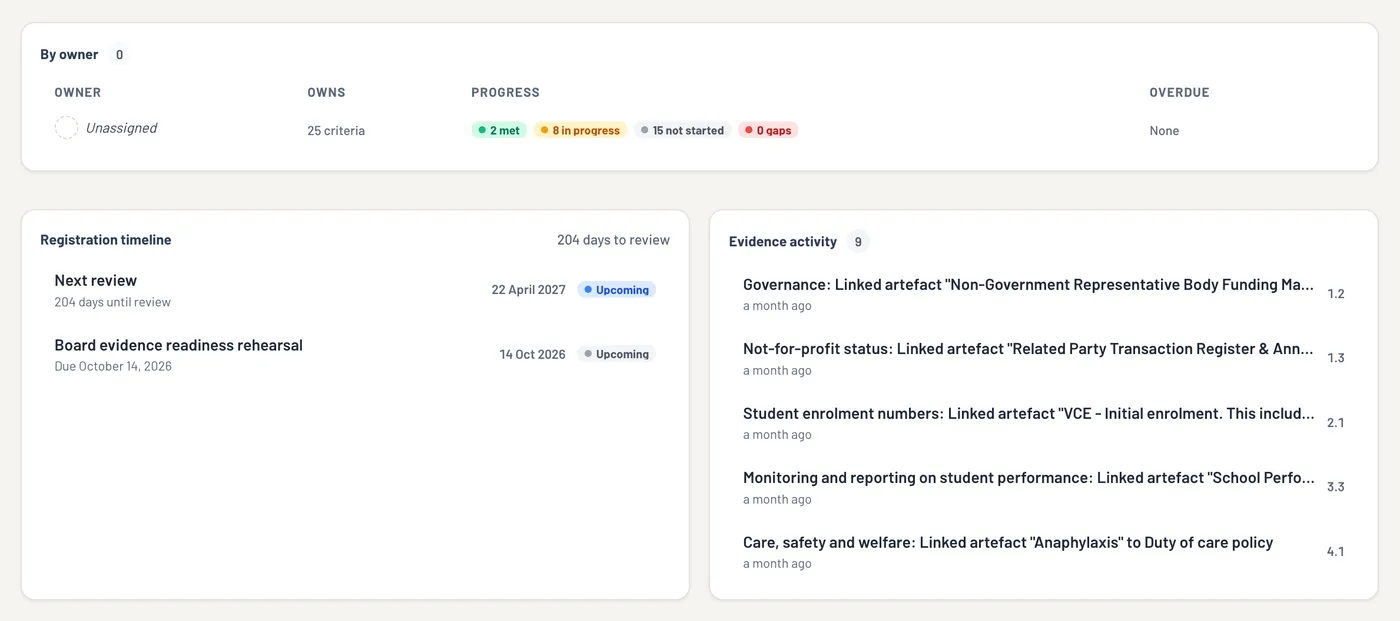 05
05Registration timeline: the runway to the review
The review date is set once and the dashboard counts down to it, with the rehearsals and milestones before it listed in order. Beside it, every piece of evidence linked to a criterion is logged against the criterion's number, so the runway and the work done on it read together.
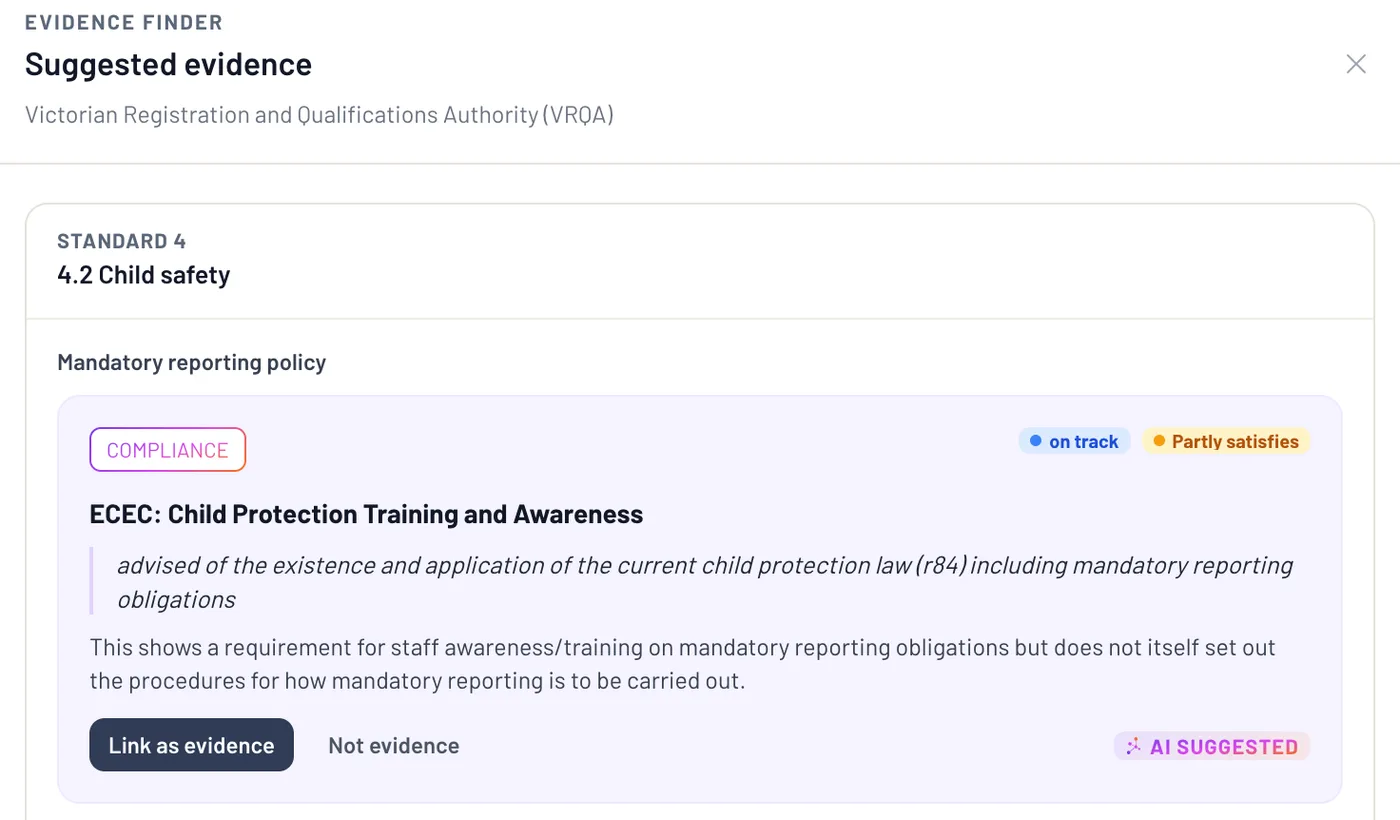 06
06Evidence Finder: suggestions you accept or reject
The Evidence Finder reads the school's compliance items and risk controls against each criterion and proposes candidates, each with the passage it relied on and why it only partly satisfies. A person links it as evidence or marks it not evidence, and a suggestion never satisfies a criterion on its own.
What it does not do
- It does not treat a framework catalogue entry as proof of compliance.
- It does not give legal advice, invent legal interpretations or make up registration dates.
- It does not duplicate the compliance occurrence workflow inside Regulation; the recurring work stays in the compliance calendar and is linked from the criterion.

It meets all of the real frustrations of business directors in one place.
Nick MillerDirector of Business, Blackfriars Priory School
School governance and risk is a complex area without a clear solution.
David RuggieroPrincipal, Blackfriars Priory School
Demo to live in under a month. One South Australian school, one term, board-ready.
Blackfriars Priory SchoolCase study
The seven we are asked every time.
Still weighing something up? Thirty minutes with us, on your own registers, answers the rest.
Book your school a demo01Can it help with school registration?
Yes. Regulatory Readiness loads the framework your regulator uses, criterion by criterion; you set the exact review date, and evidence is linked to each standard so the readiness dashboard shows what is satisfied, what is partial and what is a gap, with the runway to the review. Frameworks cover the eight Australian states and territories and New Zealand. Readiness is a traceable preparation posture, not a guarantee of compliance.
02How long does setup take?
Blackfriars Priory School went from demo to live in under a month. Activating your framework and setting the review date is the work of a session; linking evidence is incremental from there, with auto-mapping proposing candidates so the first pass is not a blank page.
03Can we keep our policies in SharePoint or Google Drive?
Yes. A criterion links to an uploaded file, an existing EthosOne artefact or an external URL, so evidence that already lives elsewhere is linked rather than migrated, and one artefact can serve every criterion that relies on it.
04Does the readiness dashboard tell us we are compliant?
No. Readiness is a traceable preparation posture, not a guarantee of compliance, and every status traces to a requirement, a compliance item and accepted evidence. Where a framework's source is unverified, EthosOne says so.
05Is any of this legal advice?
No. The Legislation module records law from an authoritative source with its version and effective date; applicability is an accountable review by your school, recorded with the reviewer, the rationale and the next review date.
06What does it cost, and where does the data live?
Regulatory Readiness is a Focus module at $5,000 a year on top of Core at $15,000 a year, with no per-user fees and every module $45,000 a year all in, licenced from January 2027. Data stays in EthosOne's Australian environment in AWS Sydney, and no school data trains any model.
07Focus module, in full: what does it cover?
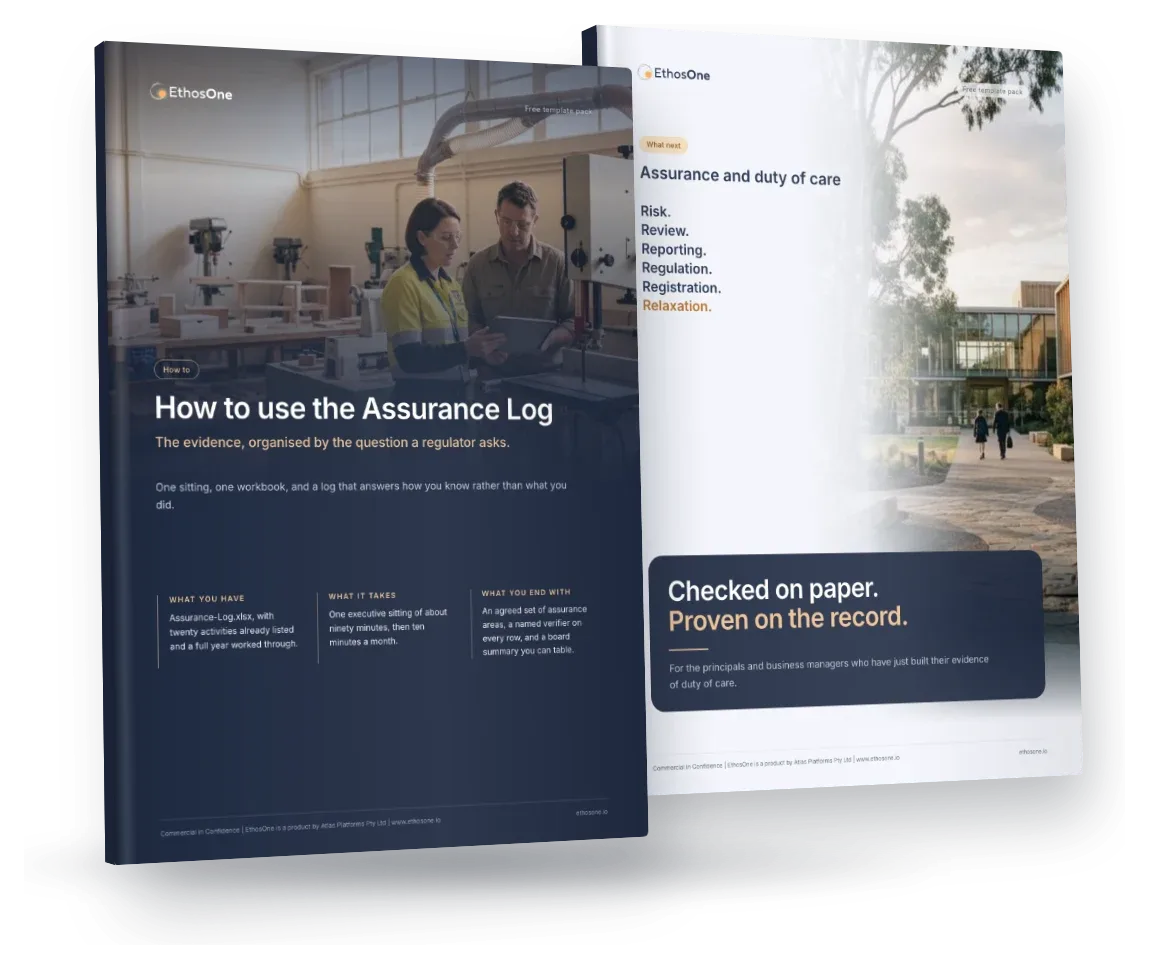
Activate the framework your regulator uses, set the exact review date, and link compliance work and evidence to each standard and criterion so the readiness dashboard shows what is satisfied, what is partial and what is a gap, with the runway to the review. It is built for the business manager, the compliance lead and the principal. Regulatory Readiness is a Focus module. The frameworks loaded are the nine a school registers under: NESA for New South Wales, the VRQA for Victoria, the Non-State Schools Accreditation Board for Queensland, the Department of Education for Western Australia, the Education Standards Board for South Australia, the Office of the Education Registrar for Tasmania, the Education Directorate for the ACT, the Department of Education for the Northern Territory, and the Ministry of Education and ERO for New Zealand. Whatever the State, a reviewer asks for the same five things against each standard: the policy, evidence it is applied, the person accountable, when it was last reviewed, and how the board oversaw it.
Run at any scale. From one campus to a diocese, with every entity reporting the same way.
- Switch
- from your existing platform, for a low cost
- 25
- policy domains help you make sense of the policies you have, and the ones you need
- Every regulator
- in Australia and New Zealand supported
- Safe
- data, processing and AI based in Sydney and Melbourne via AWS
Coverage spans the eight Australian states and territories, with Commonwealth law applying across all of them, and separately New Zealand. Domain figures come from the PolicyAI Research Atlas.
- Stored in AustraliaAWS Sydney and Melbourne, one database per school
- AI stays in the country tooHosted in Sydney and Melbourne; never trained on your content
- Published, not describedOur policies in the Trust Centre · How we handle your data
PolicyAI answering the prompt “Draft me an AI Acceptable Use Policy.”, then working through: Reading the AI-engaged obligations; Matching privacy, records, child safety; Drafting against your existing library.
Solutions for every school’s AI challenge.
There is no AI-specific legislation in force in Australia or New Zealand. The duties your school already carries are the ones AI engages.
Governing AI, before your board asks again.
“The board asked what our position on AI is, and we did not have one.”
An AI policy is not a new rulebook, it is a lens over duties your school already carries: privacy, records, discrimination and child safety, engaged by an AI-shaped set of facts. Which is why a downloaded template does not survive contact with a regulator.
We have tagged the duties AI activity in a school engages, so the conversation starts from the obligations you already hold rather than from a blank page. Almost none of them say “AI”.
Try Draft with AI.Five paragraphs against the obligations of your State, with the provision beside each. Free, no login.
Registration readiness becomes sustainable when it is connected to the school's live compliance management system.