









School board governance software for independent schools
Sign off on what is actually happening, not on last term's pack.
You are accountable for governance you can only see through the reports you are given.
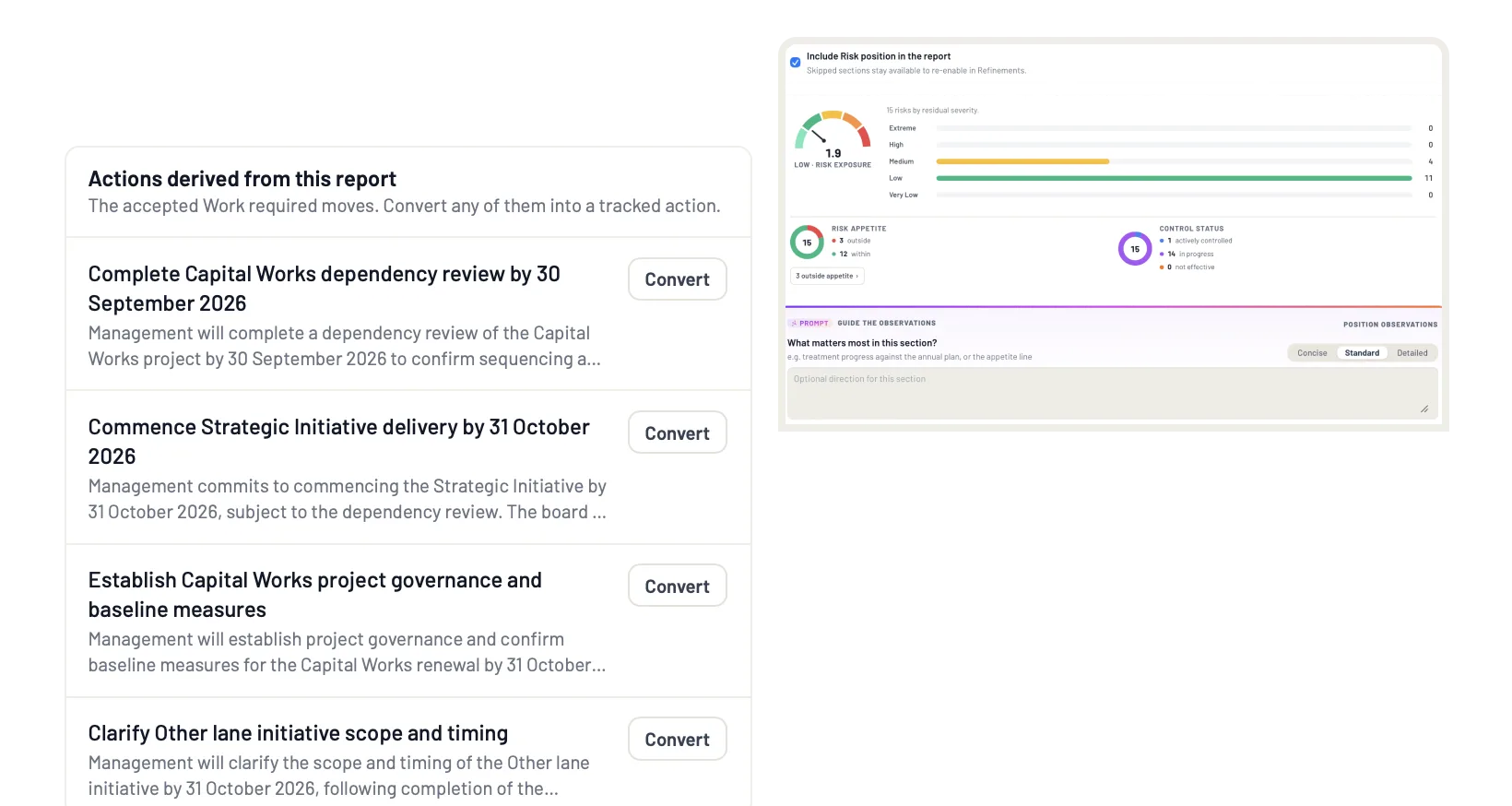
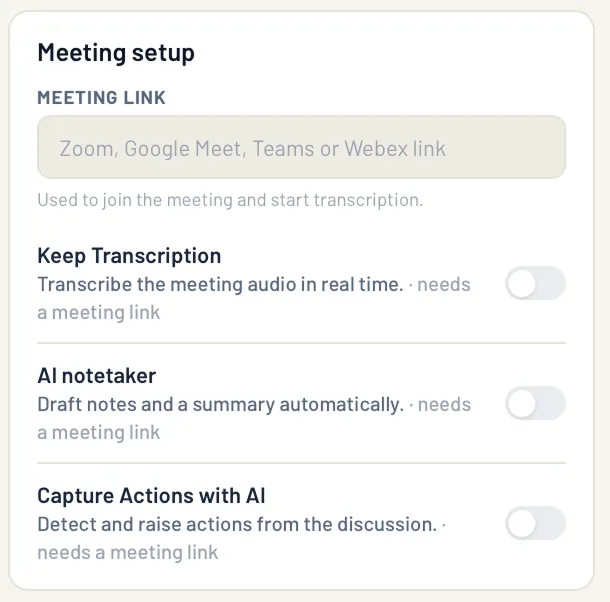
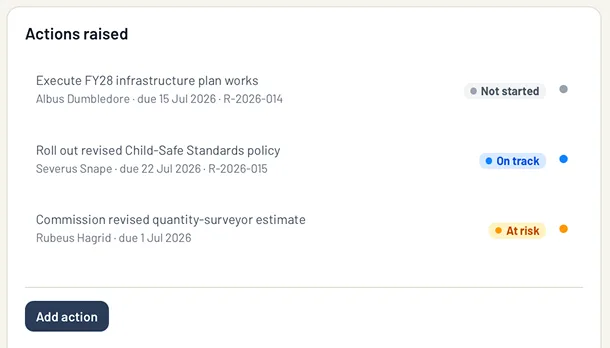
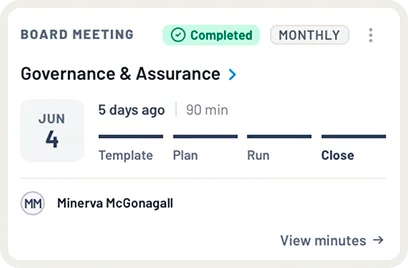
Real captures · Premium module · demo school.
EthosOne Board Engagement is school board governance software for independent schools.
Meetings, resolutions, a file vault and committee structure sit alongside it. It is built for board secretaries, chairs, principals and business managers.
The problem
The board pack is rebuilt by hand every cycle
Someone collects extracts from the risk register, the compliance calendar and the strategic plan, pastes them into a document, and sends a file that was current the day it was assembled. The chair reads a number and cannot ask where it came from, because nobody can say.
Decisions live in minutes, and minutes live in folders
A resolution carried in March is a paragraph in a PDF. The action it created has an owner until that owner moves on. Six months later the question is not what the board decided but whether anyone can find it, in its exact words, with what happened next.
Committees govern on memory
Terms of reference, quorum, dated memberships and declared conflicts sit in an email thread from the year the committee was formed. A volunteer board should not have to carry the constitution in its head.

What we keep hearing
It is Sunday afternoon, eleven days before the meeting. The principal is at the kitchen table with last term's pack open beside this term's, copying the risk section across and checking whether the register has moved since May. The secretary has three sections still with their owners and a resolution from February whose exact words are in a minute nobody can find. On Thursday the chair will read whatever arrives, on the train. Somewhere in that fortnight, the pack still has to be true.
This is the room where it builds itself.
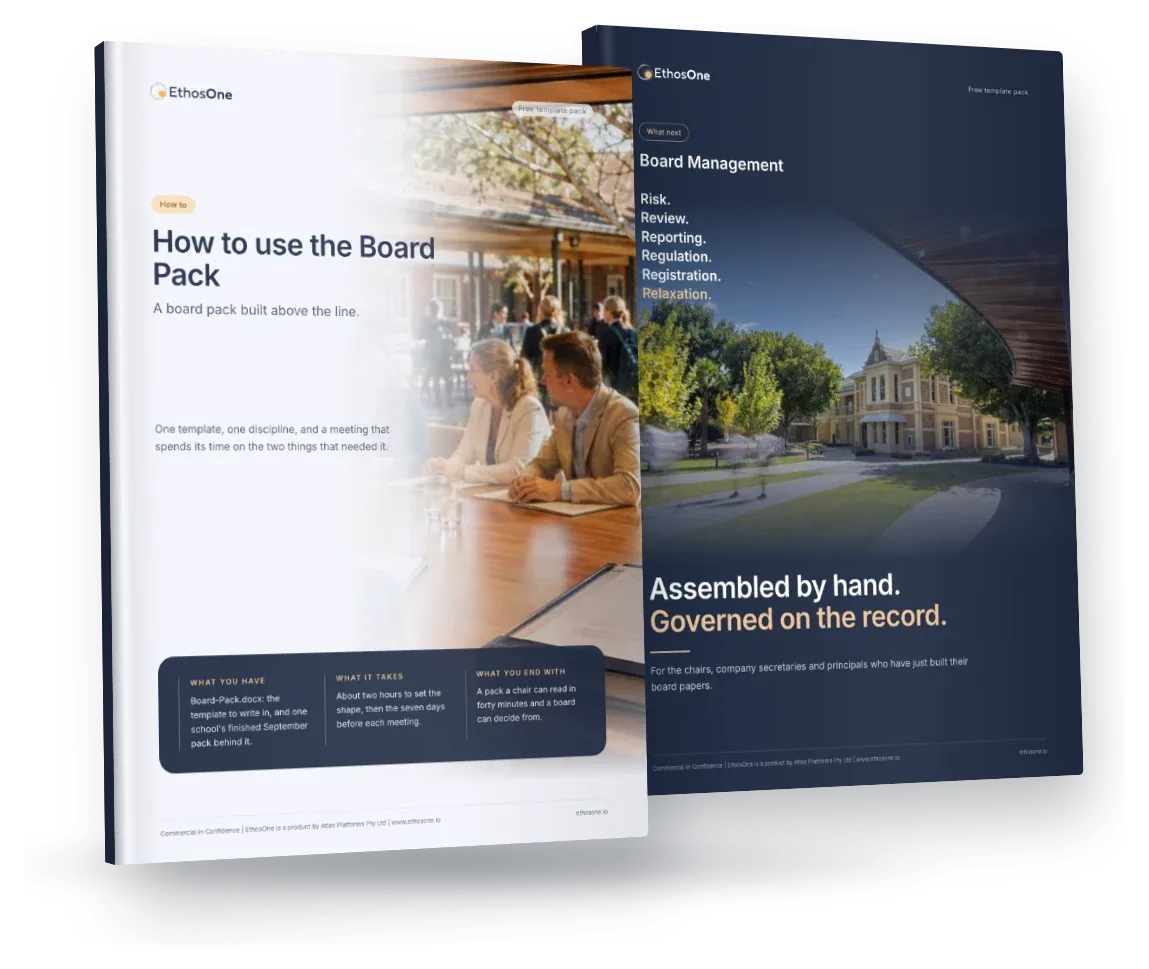
Six views, one picture. Each one reads from the same live records.
 01
Reports
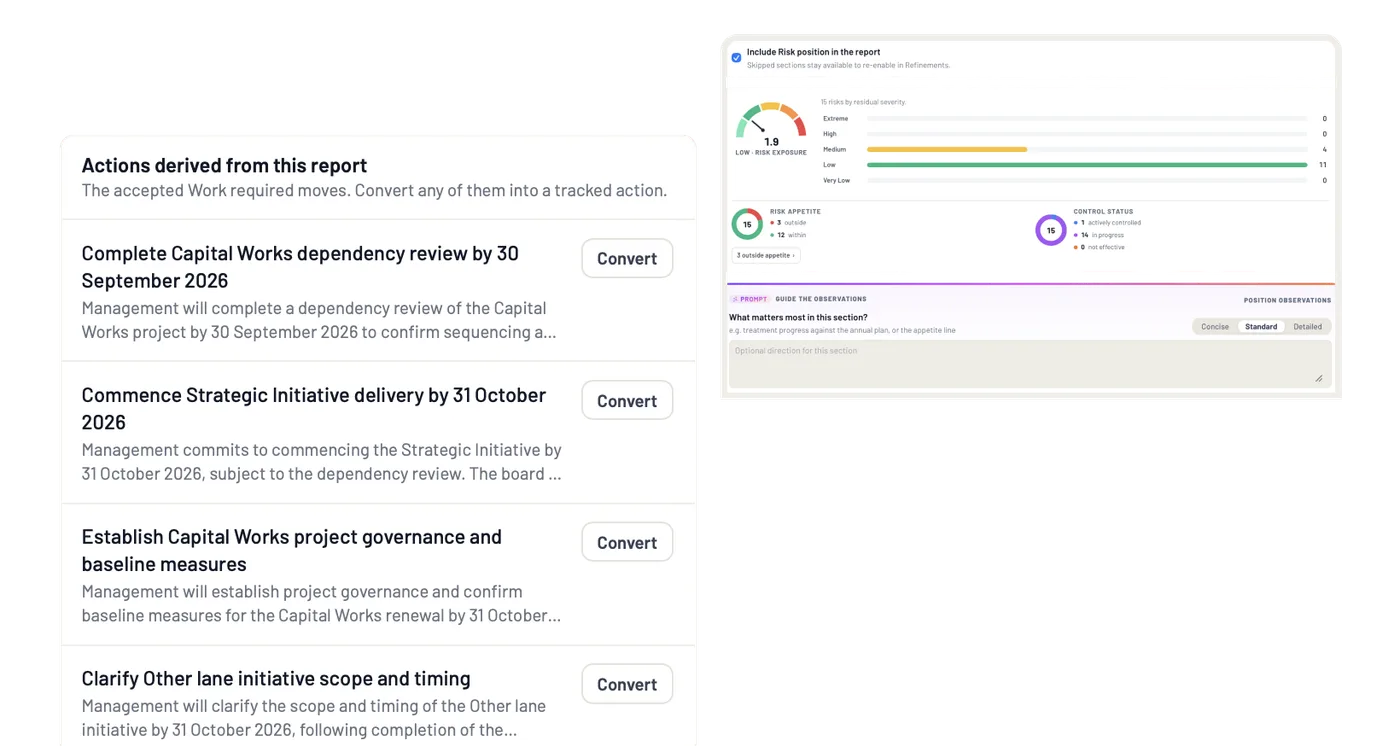
A report binds one governing body, one reporting period and one organisation scope, and the report type sets the sections. Every section has an owner, a status and a due date, and the helper drafts narrative from the sources chosen.
 02
Meetings
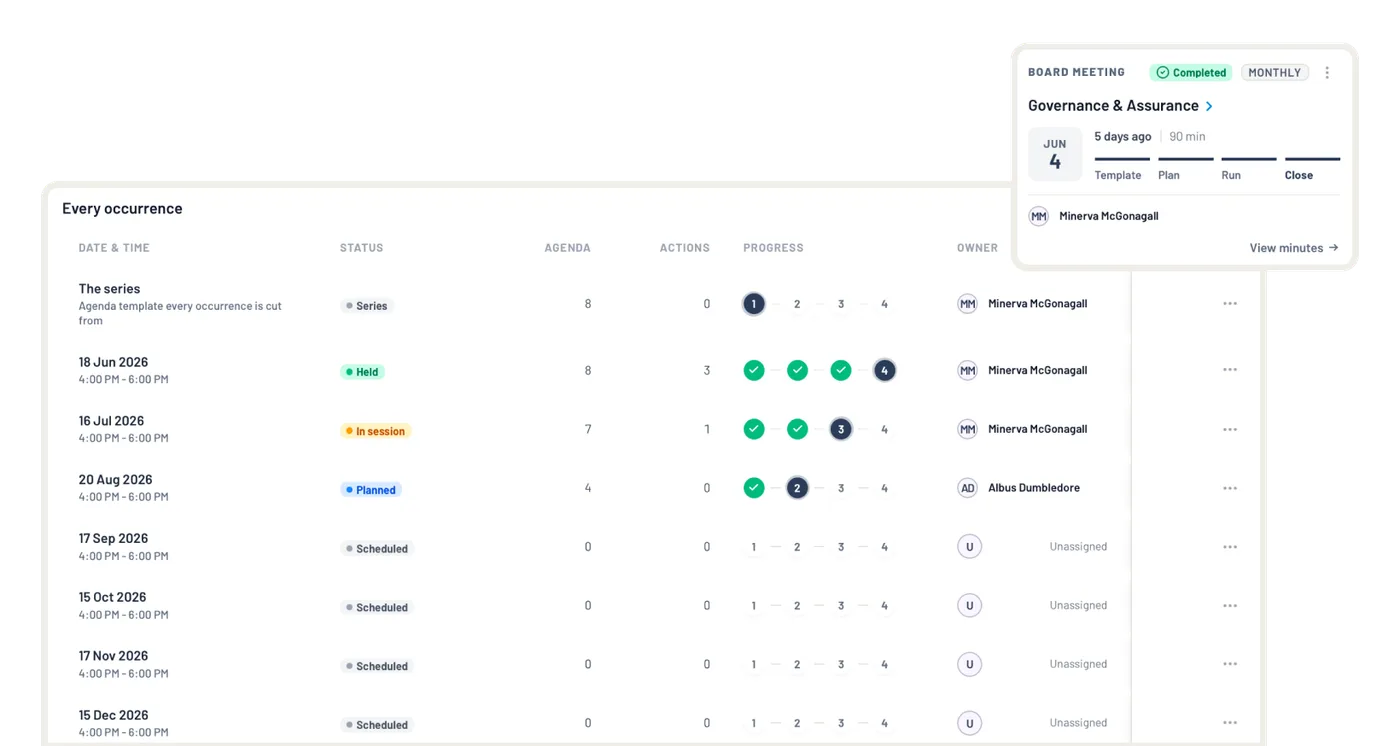
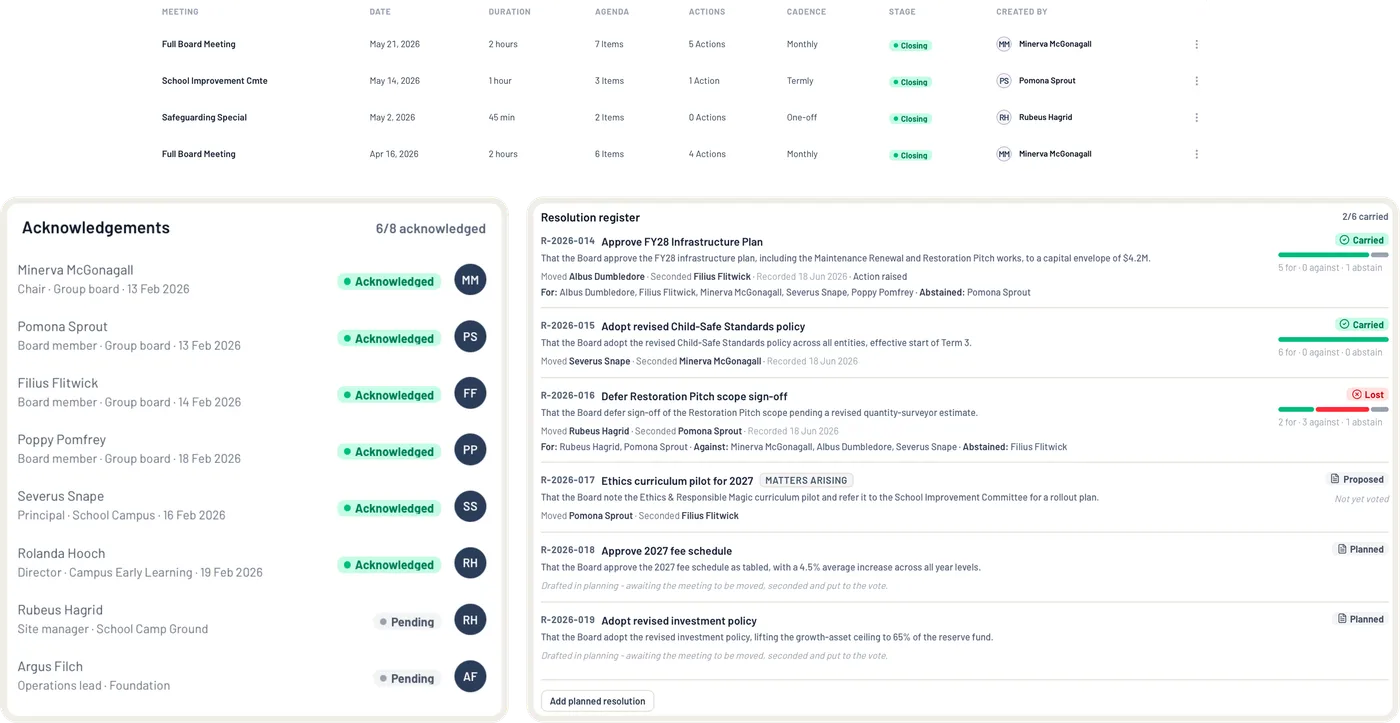
Schedule a governed meeting with governing body, date, chair, secretary and recurrence. Publish an agenda with presenters, time allocations and attached papers; record attendance, declared conflicts and quorum before formal voting opens; record resolutions once and create source-linked actions from agenda items; and take minutes through draft, review and approval.
 03
Resolutions
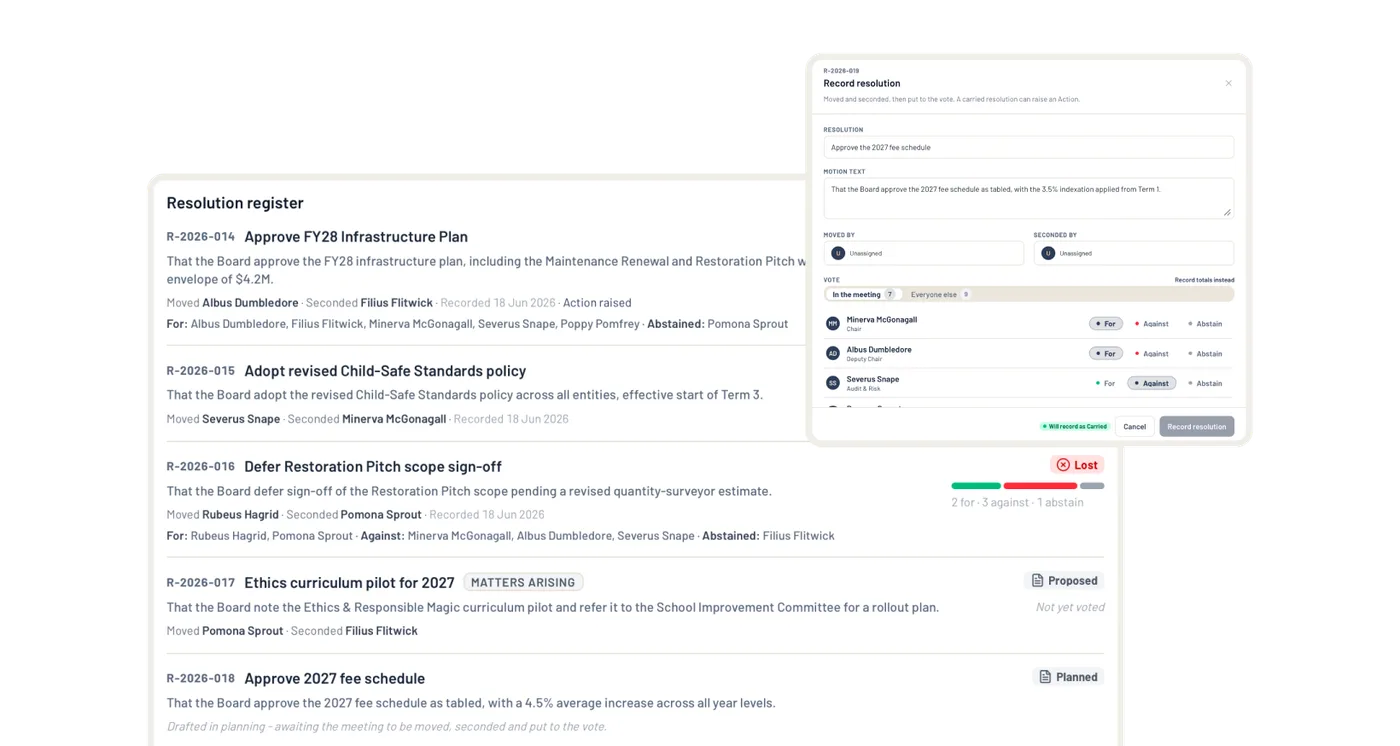
The resolution register is the authoritative decision ledger, filtered by year, governing body and outcome. A proposed resolution captures the exact text, mover and seconder before the vote; the detail shows the source meeting, the vote, the outcome (Carried, Lost, Withdrawn or Rescinded) and the linked actions; amendments and rescissions keep the history intact; and review dates keep time-bound decisions live.
 04
File vault
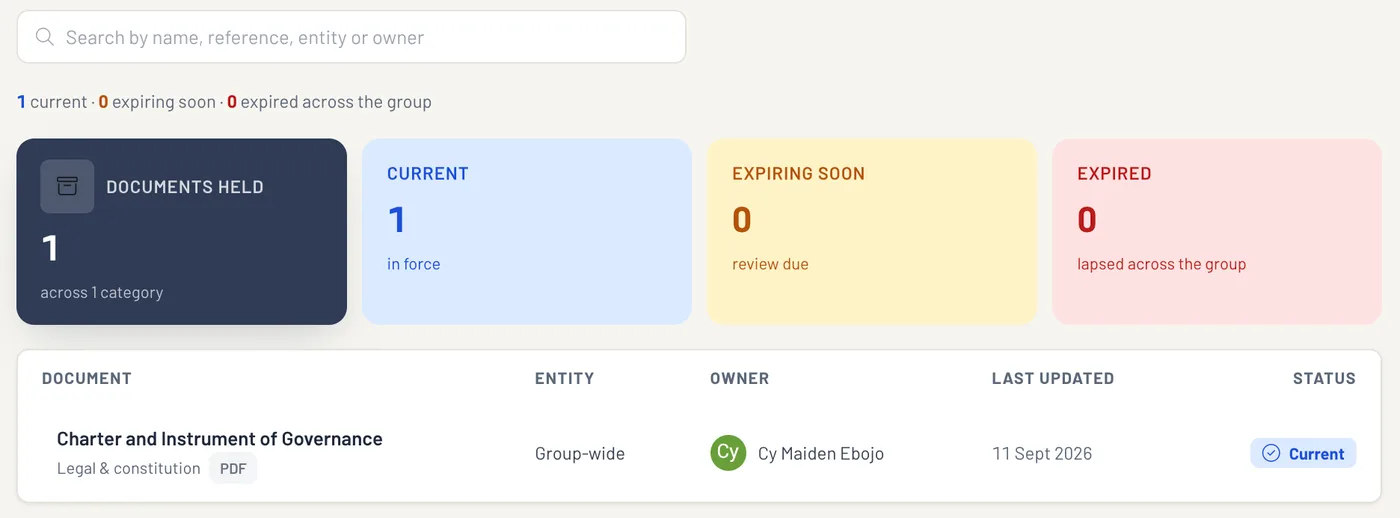
Organisation-scoped controlled storage for board papers, policies and evidence. Upload a file with title, category, version, status, scope and note; search and filter by metadata and classification; and download what you are authorised to see.
 05
History
A published pack stays as the board received it, and the next period gets a pack of its own. Institutional decision context survives a change of chair.
 06
Committees
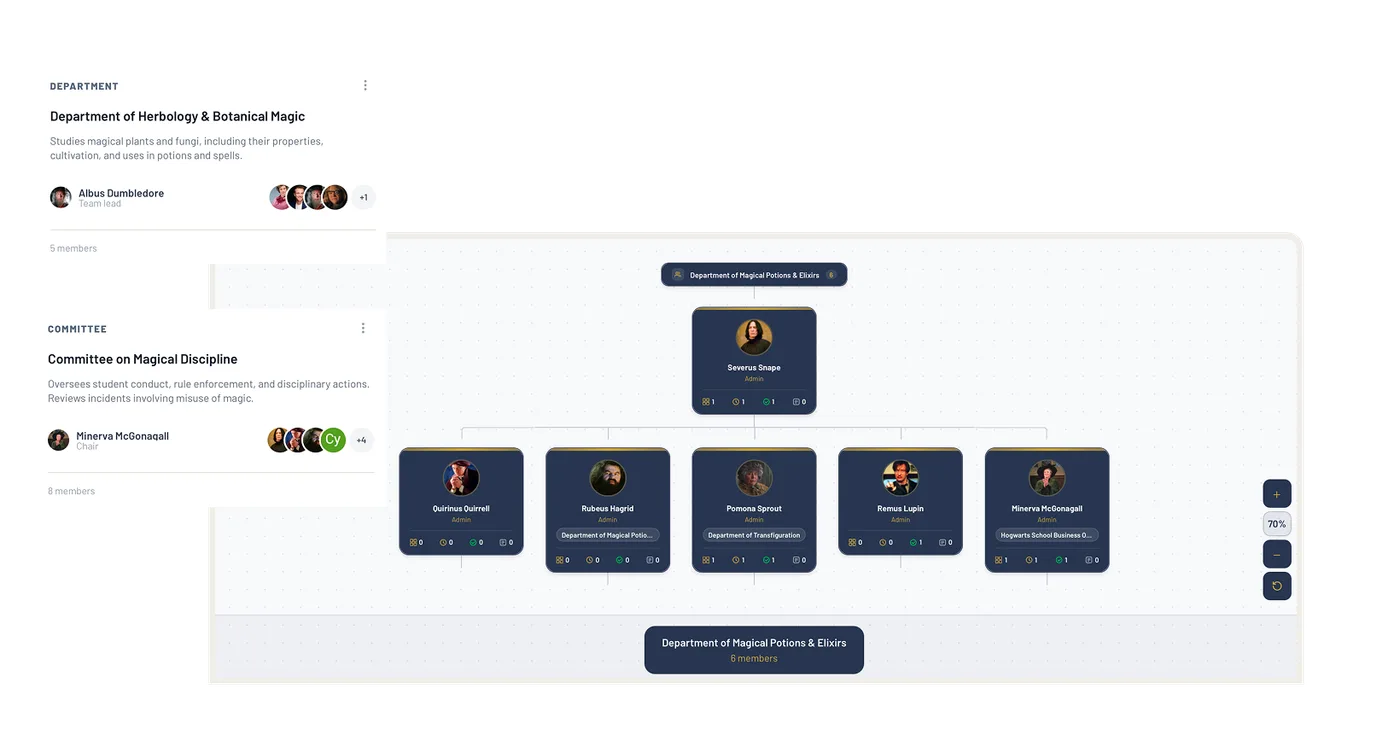
Departments and committees are kept as separate governed units. A committee has a mandate, a chair, a secretary, dated memberships and terms, a quorum rule and versioned terms of reference with responsibilities; a department has a team lead, members and purpose.
What it does not do
- It does not present generic demo narrative as organisation-specific evidence.
- It does not conflate an operational dashboard with an approved board pack.
- It does not silently refresh a report once it is published.

It meets all of the real frustrations of business directors in one place.
Nick MillerDirector of Business, Blackfriars Priory School
School governance and risk is a complex area without a clear solution.
David RuggieroPrincipal, Blackfriars Priory School
Demo to live in under a month. One South Australian school, one term, board-ready.
Blackfriars Priory SchoolCase study
The seven we are asked every time.
Still weighing something up? Thirty minutes with us, on your own registers, answers the rest.
Book your school a demo01Can it generate board reports?
Yes. Board reports are created against a named governing body, reporting period and organisation scope, with sections allocated to owners for contribution, and a published pack is a fixed version rather than a live dashboard, exported to Word and PDF on the school's own branded document template. Core's Reporting produces the report; Board Engagement adds the governed pack with its owners and contributions.
02Does it manage board meetings and minutes?
Yes. Schedule the meeting with its governing body, chair, secretary and recurrence, publish the agenda with papers, record attendance, conflicts, quorum and resolutions, create actions from agenda items, and take minutes through review to approval, all beside the pack, the file vault and the committee structure.
03Can we track resolutions and actions?
Yes. Resolutions are recorded in the meeting against the agenda item they came from, actions are created from agenda items with a named owner and a due date, and both sit in the register beside the meeting rather than only in the minutes, so the next meeting opens on what was decided and what is still open.
04What is school board governance software?
Software that runs the board's reporting, meetings, decisions and records as one governed system rather than a set of attachments. In EthosOne the pack is built from live risk, compliance, policy and strategy sources, approved as an exact version and published once.
05How is a board pack different from a dashboard?
Where a dashboard is live and changes under you, a published board pack is a fixed version: it records its as-at time, and the next period gets a new pack rather than this one being refreshed.
06Can EthosOne manage board meetings for schools?
Yes. Schedule the meeting with its governing body, chair, secretary and recurrence, publish the agenda with papers, record attendance, conflicts, quorum and resolutions, create actions from agenda items, and take minutes through review to approval.
07Premium module, in full: what does it cover?
Board reports are created in the Group Boardroom against a named governing body, reporting period and organisation scope; sections are allocated to owners for contribution, and a published pack is a fixed version rather than a live dashboard. Board Engagement is a Premium module at $10,000 a year on top of EthosOne Core, with no per-user fees and every module $45,000 a year all in.
Run at any scale. From one campus to a diocese, with every entity reporting the same way.
- Switch
- from your existing platform, for a low cost
- 25
- policy domains help you make sense of the policies you have, and the ones you need
- Every regulator
- in Australia and New Zealand supported
- Safe
- data, processing and AI based in Sydney and Melbourne via AWS
Coverage spans the eight Australian states and territories, with Commonwealth law applying across all of them, and separately New Zealand. Domain figures come from the PolicyAI Research Atlas.
- Stored in AustraliaAWS Sydney and Melbourne, one database per school
- AI stays in the country tooHosted in Sydney and Melbourne; never trained on your content
- Published, not describedOur policies in the Trust Centre · How we handle your data

PolicyAI answering the prompt “Draft me an AI Acceptable Use Policy.”, then working through: Reading the AI-engaged obligations; Matching privacy, records, child safety; Drafting against your existing library.
Solutions for every school’s AI challenge.
There is no AI-specific legislation in force in Australia or New Zealand. The duties your school already carries are the ones AI engages.
Governing AI, before your board asks again.
“The board asked what our position on AI is, and we did not have one.”
An AI policy is not a new rulebook, it is a lens over duties your school already carries: privacy, records, discrimination and child safety, engaged by an AI-shaped set of facts. Which is why a downloaded template does not survive contact with a regulator.
We have tagged the duties AI activity in a school engages, so the conversation starts from the obligations you already hold rather than from a blank page. Almost none of them say “AI”.
Try Draft with AI.Five paragraphs against the obligations of your State, with the provision beside each. Free, no login.