









School governance software for multi-entity groups
One governance view across every campus
Groups that run several schools carry the same governance load, multiplied, and usually in parallel spreadsheets.
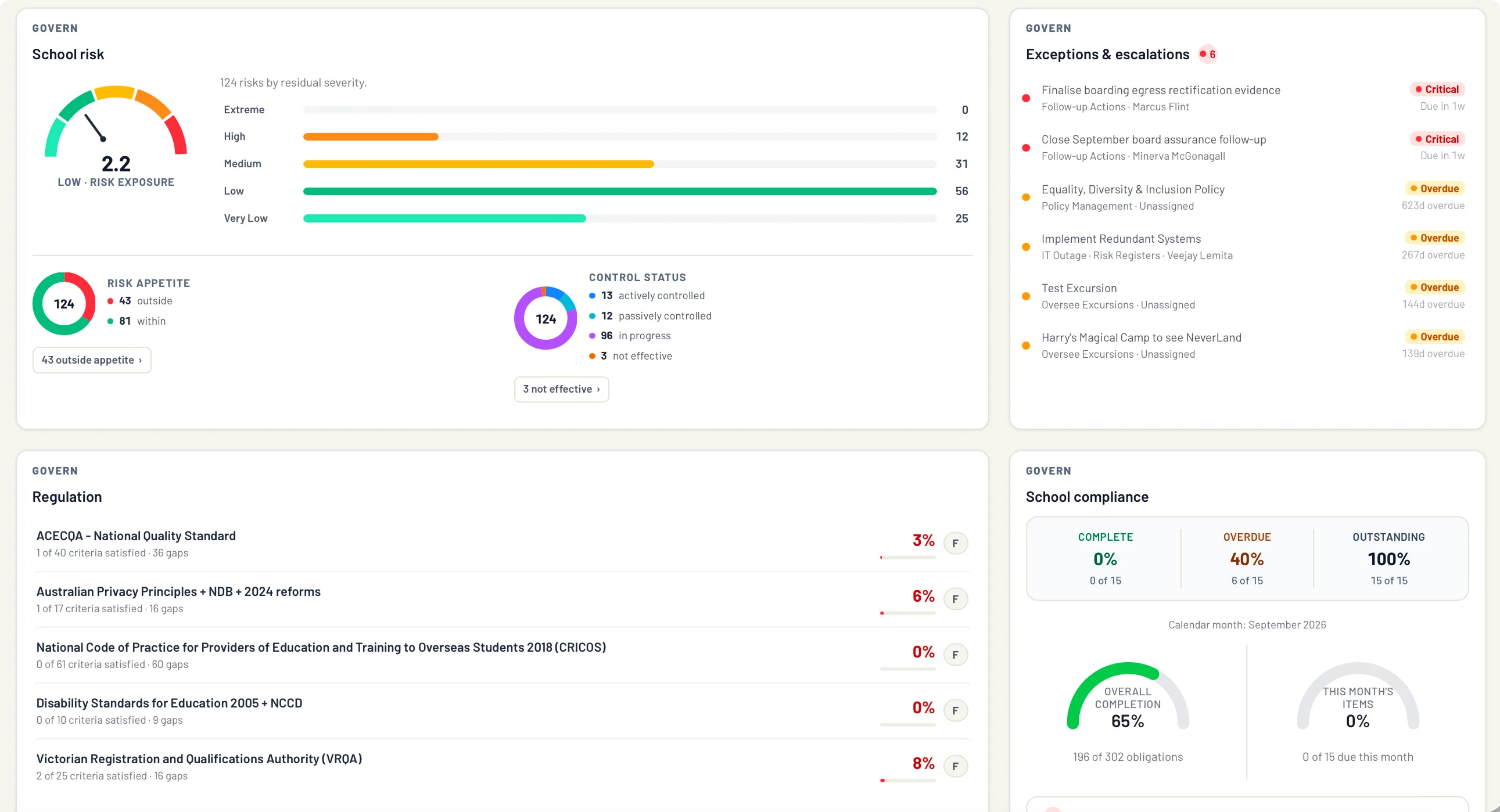
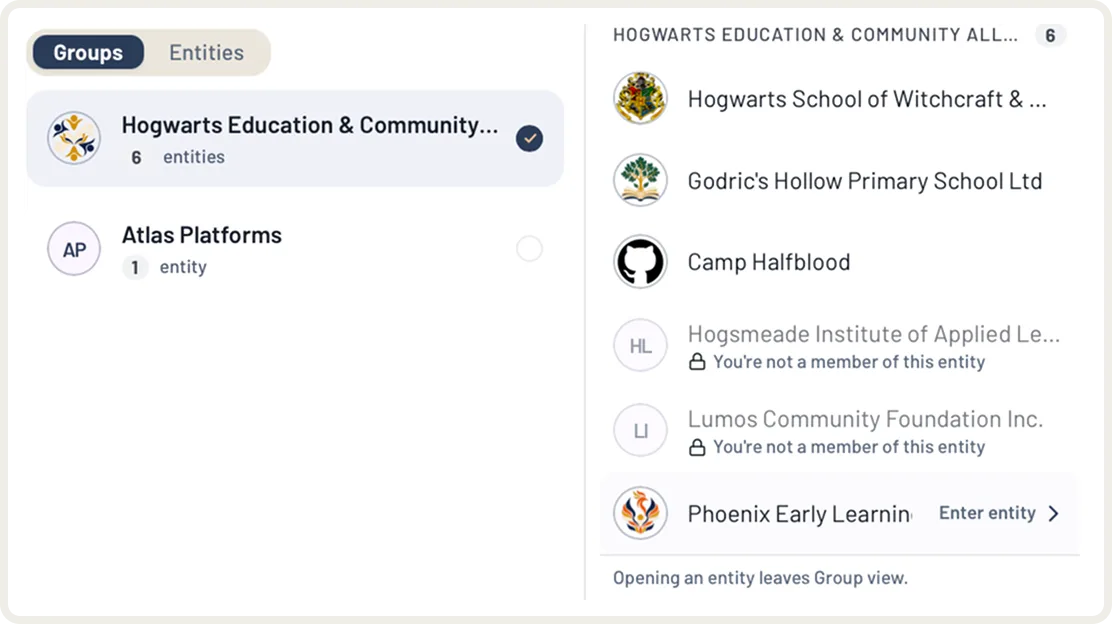
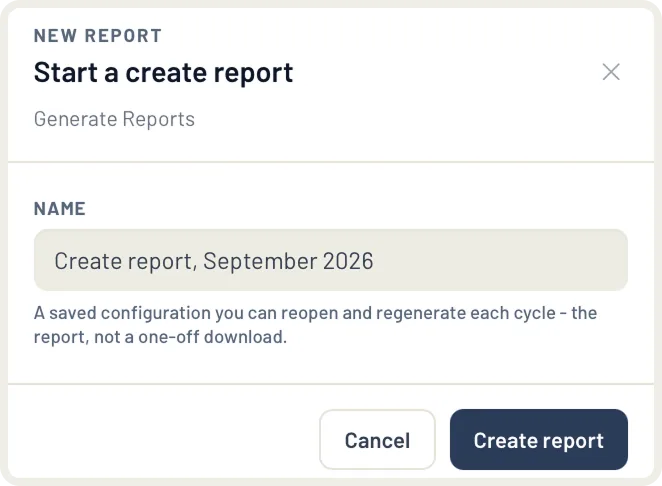
Real captures · Premium module · demo school.
Group Management is the EthosOne module for school groups, dioceses and multi-campus boards, in EthosOne, governance, risk and compliance software built only for schools.
Group Projects, Group Actions and the Group Boardroom carry delivery, work and decisions at the same altitude.
The problem
The load multiplies and the system does not
A group running five schools carries five risk registers, five compliance calendars and five board cycles. Each campus does good work. The group office then reconstructs the consolidated picture by hand, and the reconstruction is the least trusted document in the group.
A consolidated score hides the school that needs help
Roll five populations of risks into one number and the number says nothing. The chair wants to know which entity is outside appetite, which exception has been open longest and who at that school owns it, and a single total cannot say.
Consistency is a hope, not a system
A shared policy is updated centrally and emailed to five business managers, who adopt it on five timelines. There is no place to see which entity has adopted what, so the group's real position on a policy is whatever the last email said.

What we keep hearing
It is the week before the group board meets. Five schools have sent five risk registers in five formats, two of them as last term's file with the date changed. The group office builds the consolidated picture in a spreadsheet that is out of date before the meeting opens, and the question the chair will ask, which school is carrying the exposure, cannot be answered from it.
This is the room where the picture is already built, and the school's name is on every line.
Five views, one picture. Each one reads from the same live records.
 01
Multi entity dashboard
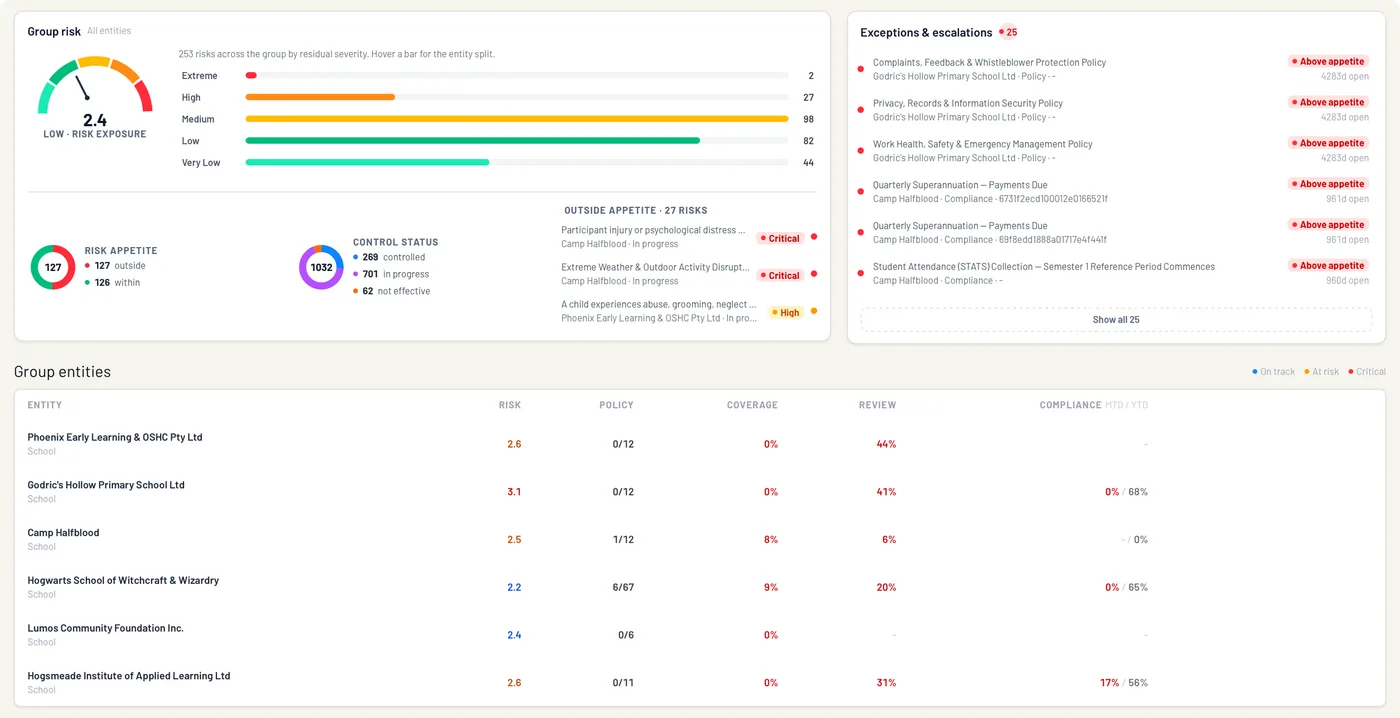
The entity comparison table exposes each school's contribution to the group picture without flattening unlike populations into a single score, and an entity-level breakdown explains the contribution behind the consolidated exposure. Where one school carries most of the group's outside-appetite risk, the breakdown says so and opens it.
 02
Group-level dashboard
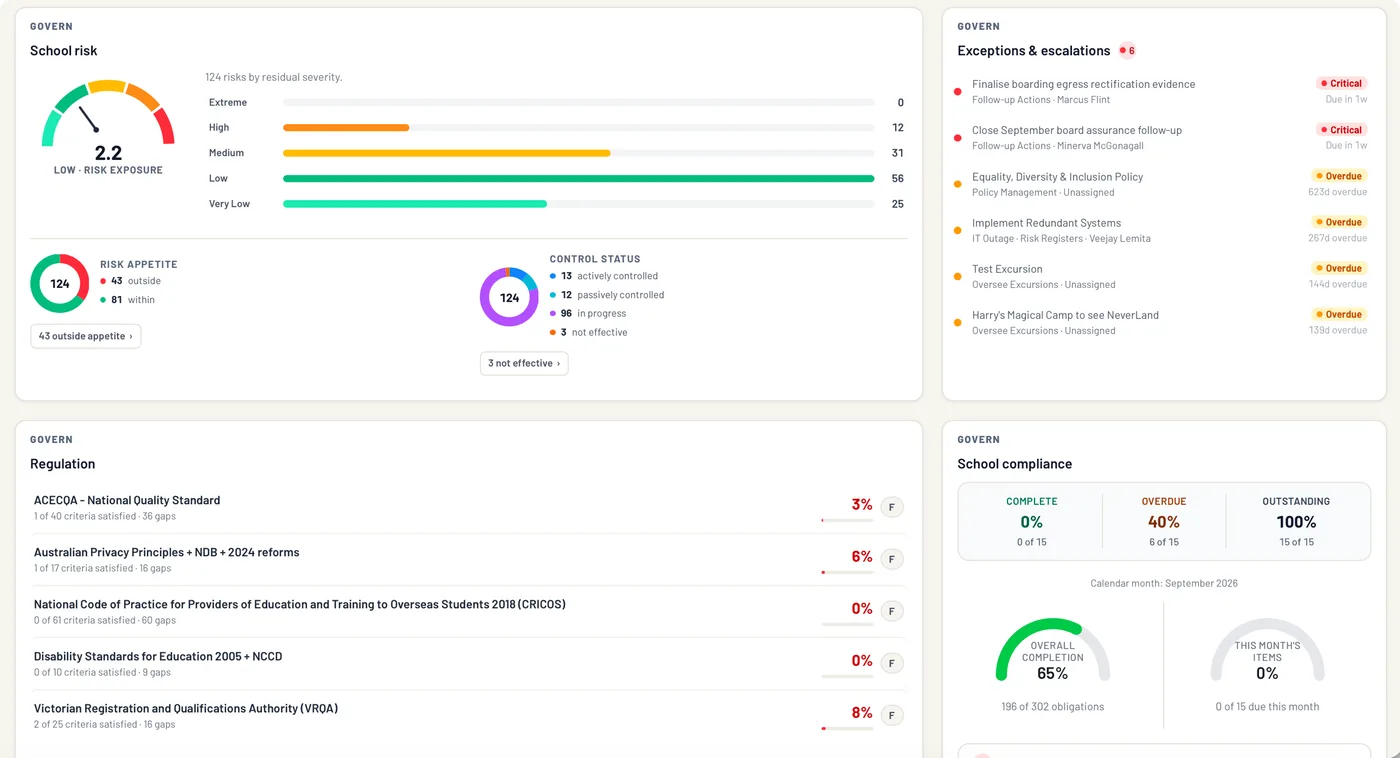
One disclosed group view consolidates risk, compliance, assurance and policy status across every entity while keeping each entity's source identity. The Boardroom Overview shows a portfolio summary and an entity performance table, group risk by level, category and entity, and group compliance as each entity's own due work rather than one blended score.
 03
Multi-entity reporting
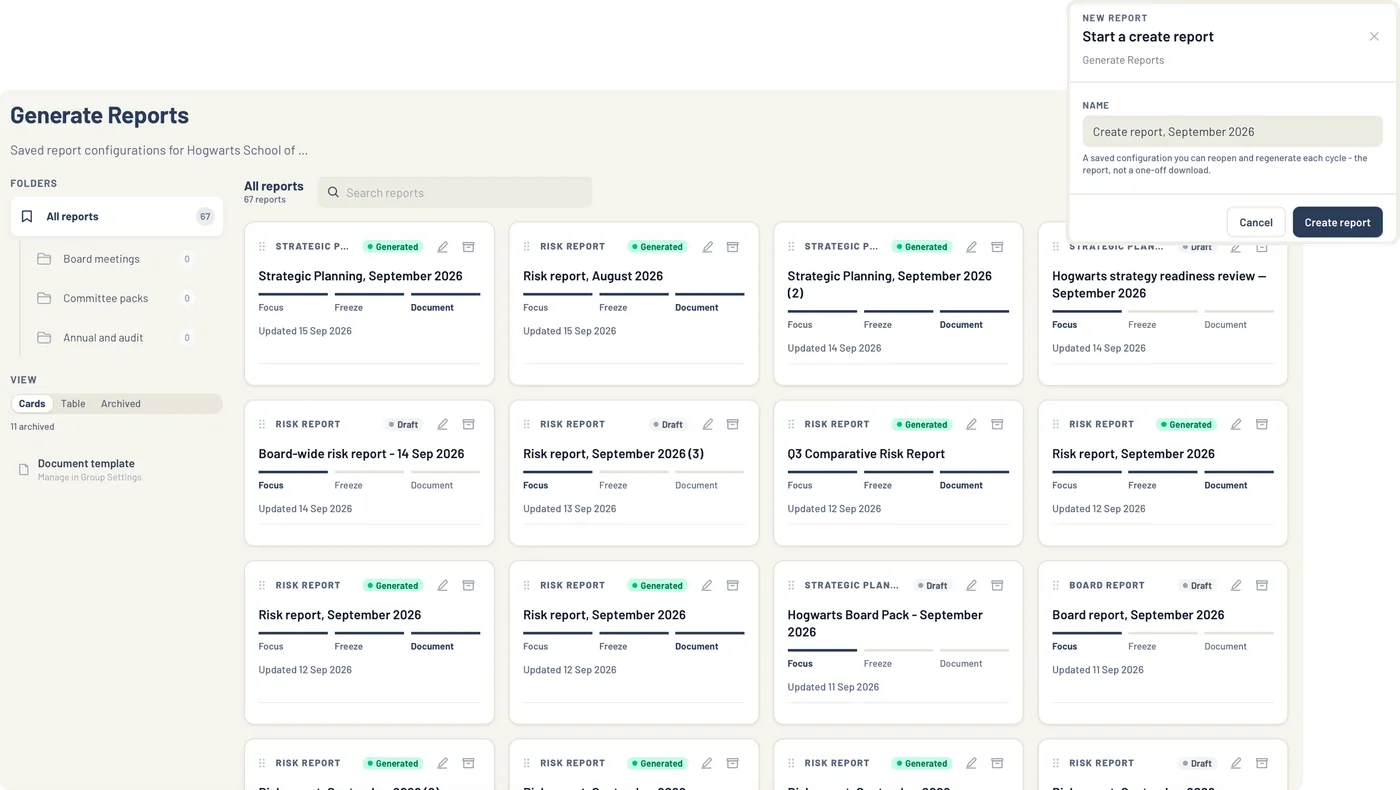
The Group Boardroom builds the group's board report from every entity's live records: risk against appetite, compliance exceptions, assurance status and policy adoption, consolidated with each school's name kept on the line. Contributions come from the people who own the sources at each school, the pack is reviewed for placeholders and contradictions, approved as an exact version and published once.
 04
Exceptions and escalations
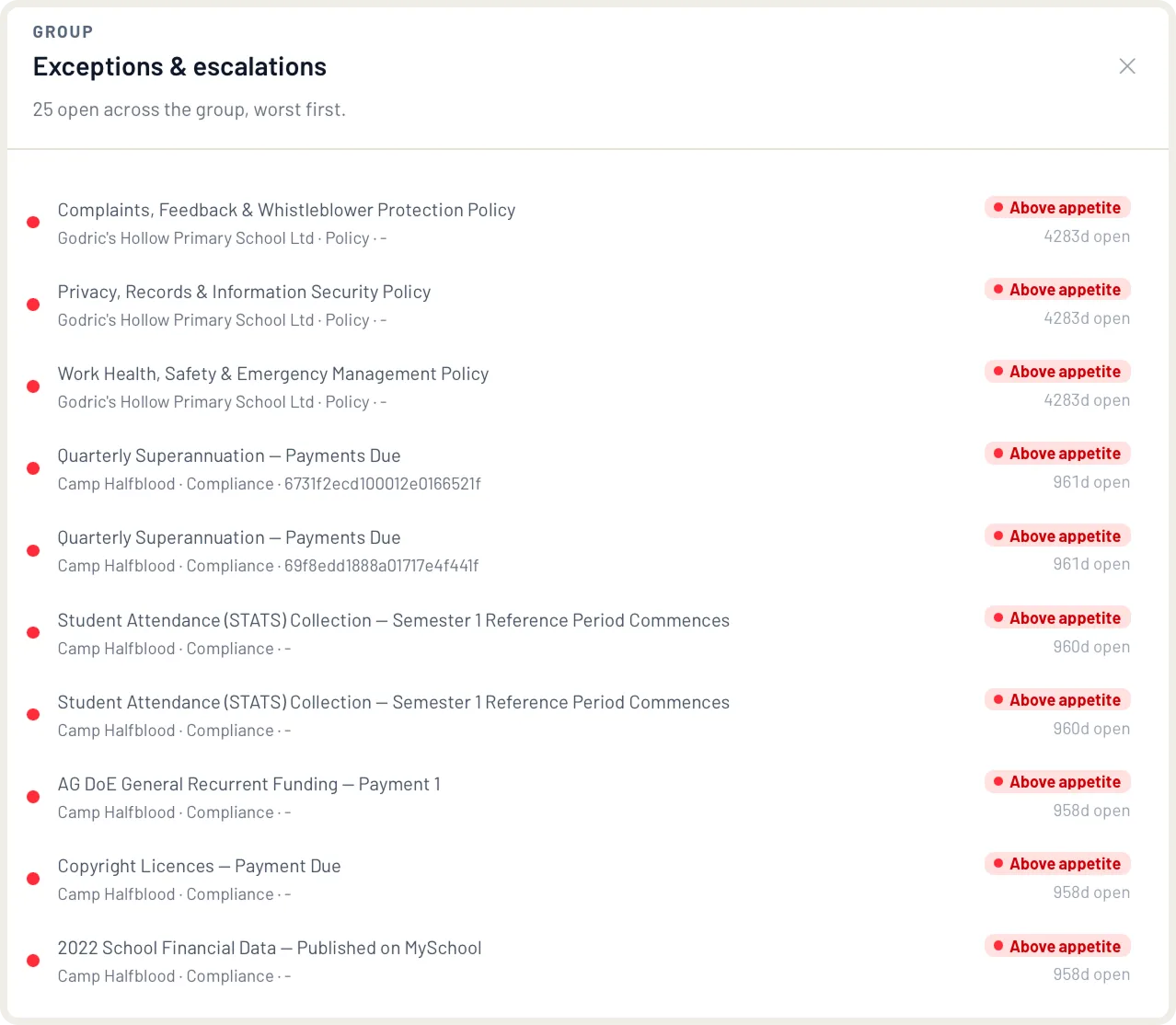
Group leaders see the exceptions that need attention, the entity that owns each source record and how long it has remained open. An exception is closed where it was raised, by the person who owns it.
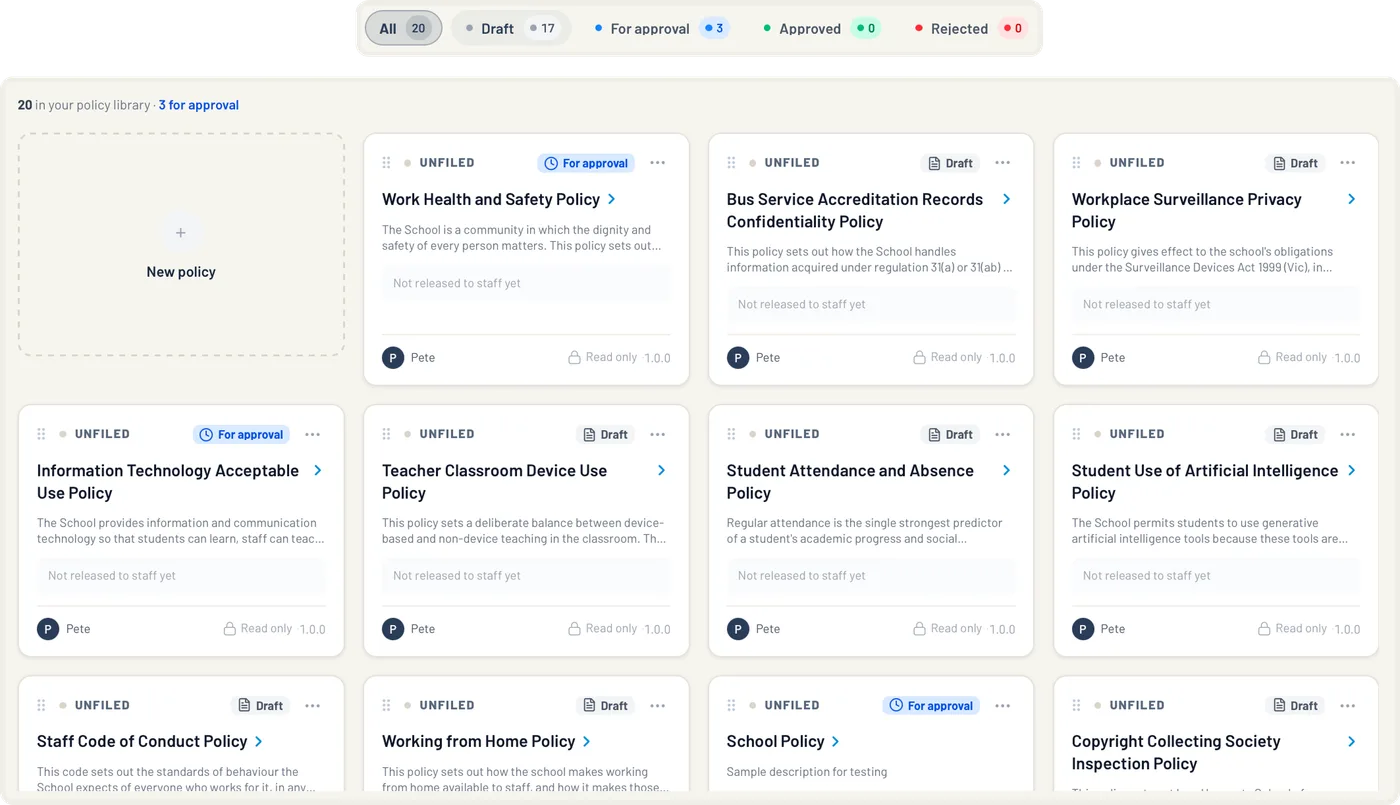 05
Policy library and adoption monitoring
Shared policies and obligations distribute from the group library to every entity in one action, and the group sees which campus has adopted what, at which version, and who acknowledged it. A diocesan policy updated centrally is no longer five emails on five timelines; it is one release with an adoption map beneath it, and PolicyAI reads each entity's library against its own obligations.
What it does not do
- It does not replace a school's own workspace, owners or reporting. The group view sits above them.
- It does not roll unlike populations into one score. Every consolidated figure keeps the entity beside it.
- It does not let the group close a school's exception. The owner at the school closes it, and the group sees that it closed.

It meets all of the real frustrations of business directors in one place.
Nick MillerDirector of Business, Blackfriars Priory School
School governance and risk is a complex area without a clear solution.
David RuggieroPrincipal, Blackfriars Priory School
Demo to live in under a month. One South Australian school, one term, board-ready.
Blackfriars Priory SchoolCase study
The seven we are asked every time.
Still weighing something up? Thirty minutes with us, on your own registers, answers the rest.
Book your school a demo01Does it support multiple schools?
Yes. Group Management is the module for school groups, dioceses and multi-campus boards: each school runs in its own workspace with its own owners, registers and reporting, and the group view consolidates risk, compliance, assurance and policy status across every entity with each school's name kept on every figure. It is a Premium module at $10,000 a year on top of Core, and each additional entity is $5,000 a year.
02Can we report across the whole group?
Yes. The group view is a portfolio summary of risk, compliance, assurance and policy status across every entity: group risk against a group appetite with each material risk linked back to the school that holds it, the open exceptions with their local owners and how long each has stood, and an entity performance table, with a focus that drops into one school without leaving the boardroom.
03Can each school have its own policies?
Yes. Each school keeps its own library, owners and approvals. Shared policies and obligations distribute from the group library to every entity, with visibility of which campus has adopted what, and PolicyAI reads each entity's library against its own obligations.
04Can we control who sees each school's information?
Yes. Each school runs in its own workspace with its own owners and roles, so a school's people see their school. The office sees the roll-up and each entity's status, and does not edit a school's register from the centre.
05Can each campus keep its own governance?
Yes. Each school keeps its own workspace, owners, registers and reporting. The group view consolidates their status and keeps each entity's identity on every figure; it does not replace how a campus governs.
06How do shared policies work across entities?
Shared policies and obligations distribute from the group library to every entity, with visibility of which campus has adopted what, so consistency is a system rather than a round of emails. PolicyAI reads each entity's library against its own obligations.
07Premium module, in full: what does it cover?
Each school runs in its own workspace with its own owners, registers and reporting, and the group view sits above them: a portfolio summary of risk, compliance, assurance and policy status across every entity, group risk against a group appetite with each material risk linked back to the school that holds it, the exceptions that need attention with the local owner and how long each has stood open, an entity performance table that shows each school's contribution without flattening unlike populations into one score, and a focus that drops a group leader into one entity's governance and back out again. Group Management is a Premium module at $10,000 a year on top of Core, with each additional entity at $5,000 a year and arriving fully equipped.
Run at any scale. From one campus to a diocese, with every entity reporting the same way.
- Switch
- from your existing platform, for a low cost
- 25
- policy domains help you make sense of the policies you have, and the ones you need
- Every regulator
- in Australia and New Zealand supported
- Safe
- data, processing and AI based in Sydney and Melbourne via AWS
Coverage spans the eight Australian states and territories, with Commonwealth law applying across all of them, and separately New Zealand. Domain figures come from the PolicyAI Research Atlas.
- Stored in AustraliaAWS Sydney and Melbourne, one database per school
- AI stays in the country tooHosted in Sydney and Melbourne; never trained on your content
- Published, not describedOur policies in the Trust Centre · How we handle your data

PolicyAI answering the prompt “Draft me an AI Acceptable Use Policy.”, then working through: Reading the AI-engaged obligations; Matching privacy, records, child safety; Drafting against your existing library.
Solutions for every school’s AI challenge.
There is no AI-specific legislation in force in Australia or New Zealand. The duties your school already carries are the ones AI engages.
Governing AI, before your board asks again.
“The board asked what our position on AI is, and we did not have one.”
An AI policy is not a new rulebook, it is a lens over duties your school already carries: privacy, records, discrimination and child safety, engaged by an AI-shaped set of facts. Which is why a downloaded template does not survive contact with a regulator.
We have tagged the duties AI activity in a school engages, so the conversation starts from the obligations you already hold rather than from a blank page. Almost none of them say “AI”.
Try Draft with AI.Five paragraphs against the obligations of your State, with the provision beside each. Free, no login.