









School registration and review in NSW
Your NESA review, with the evidence already linked
The NESA review is on the calendar and the day is full of other things. EthosOne loads the NESA Registration and Accreditation Manual, sets the exact review date.
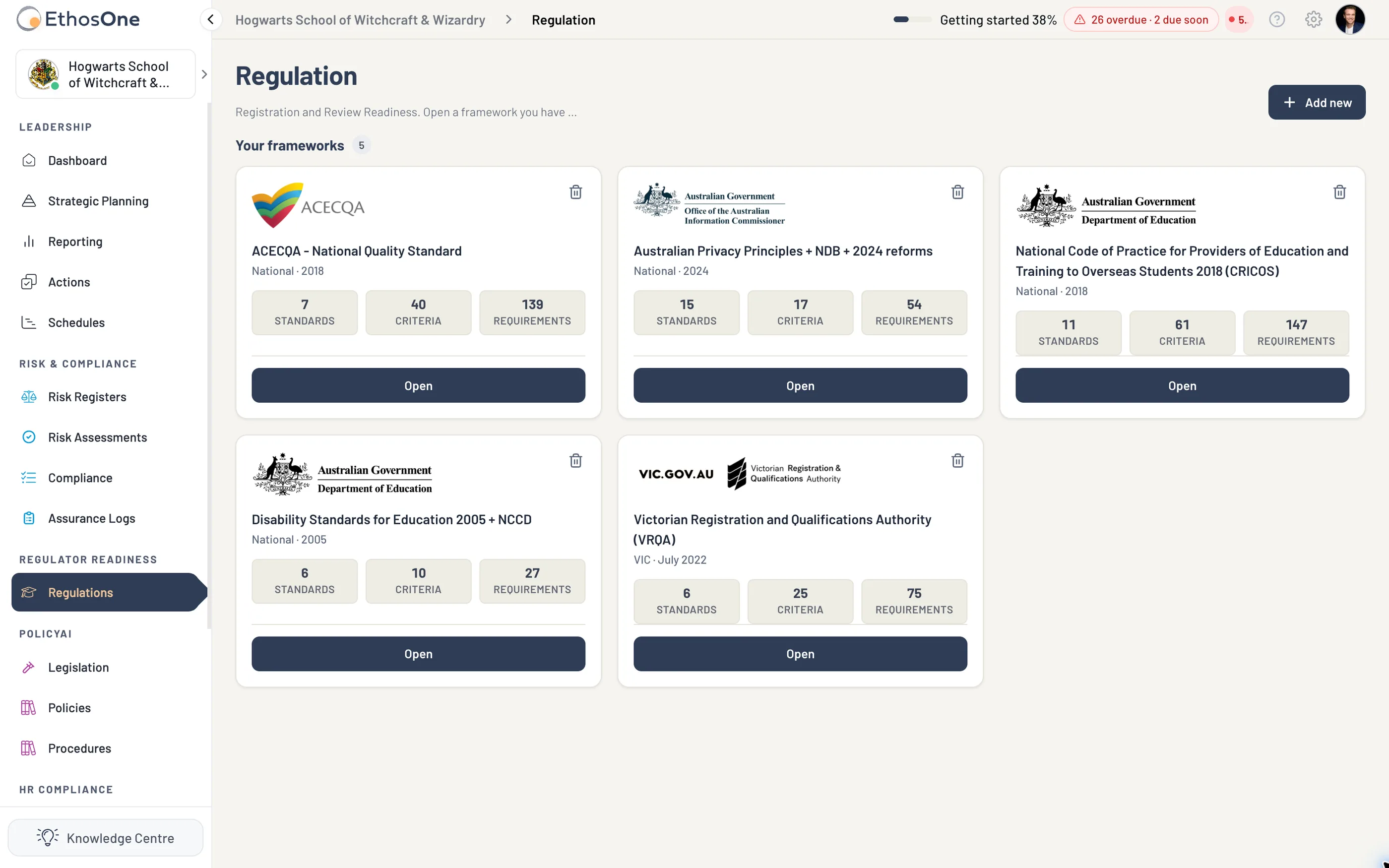
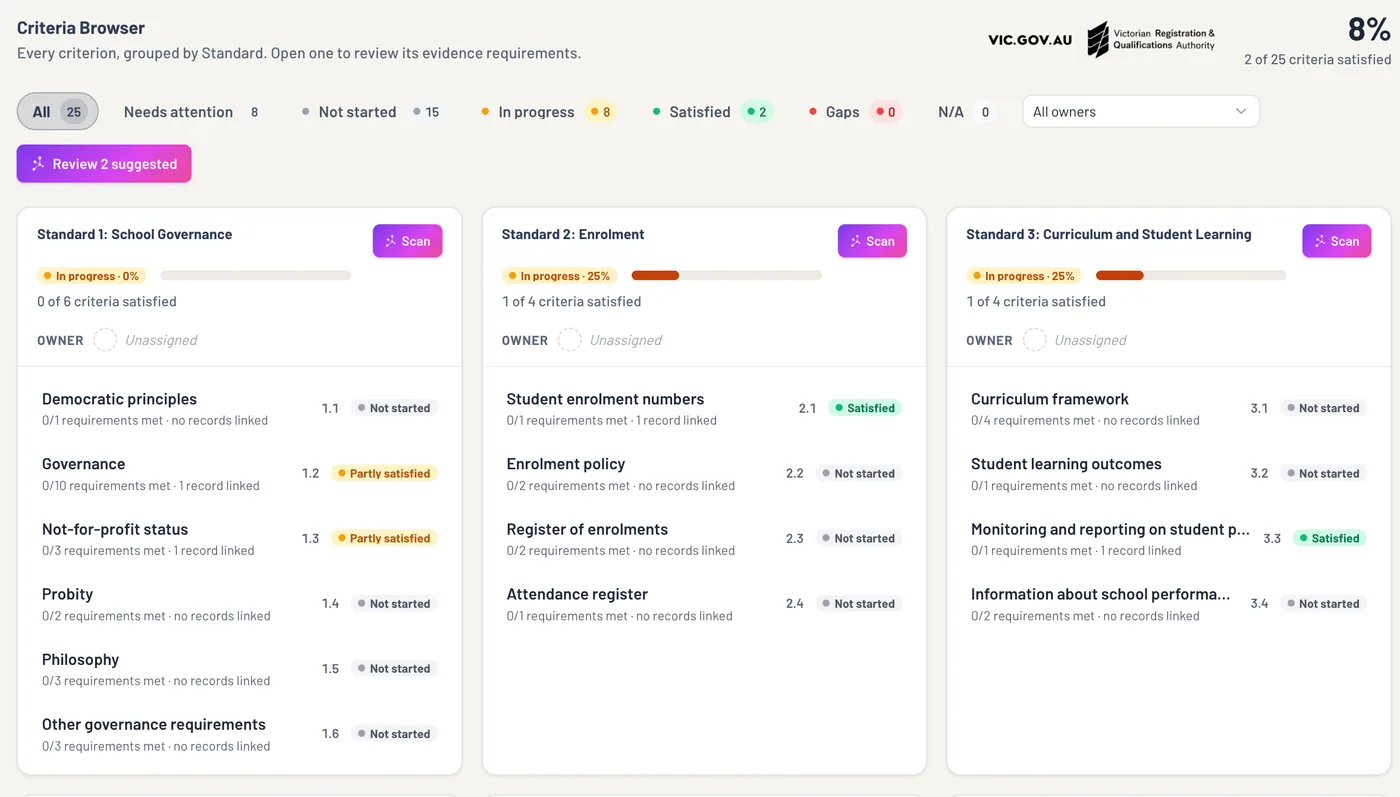
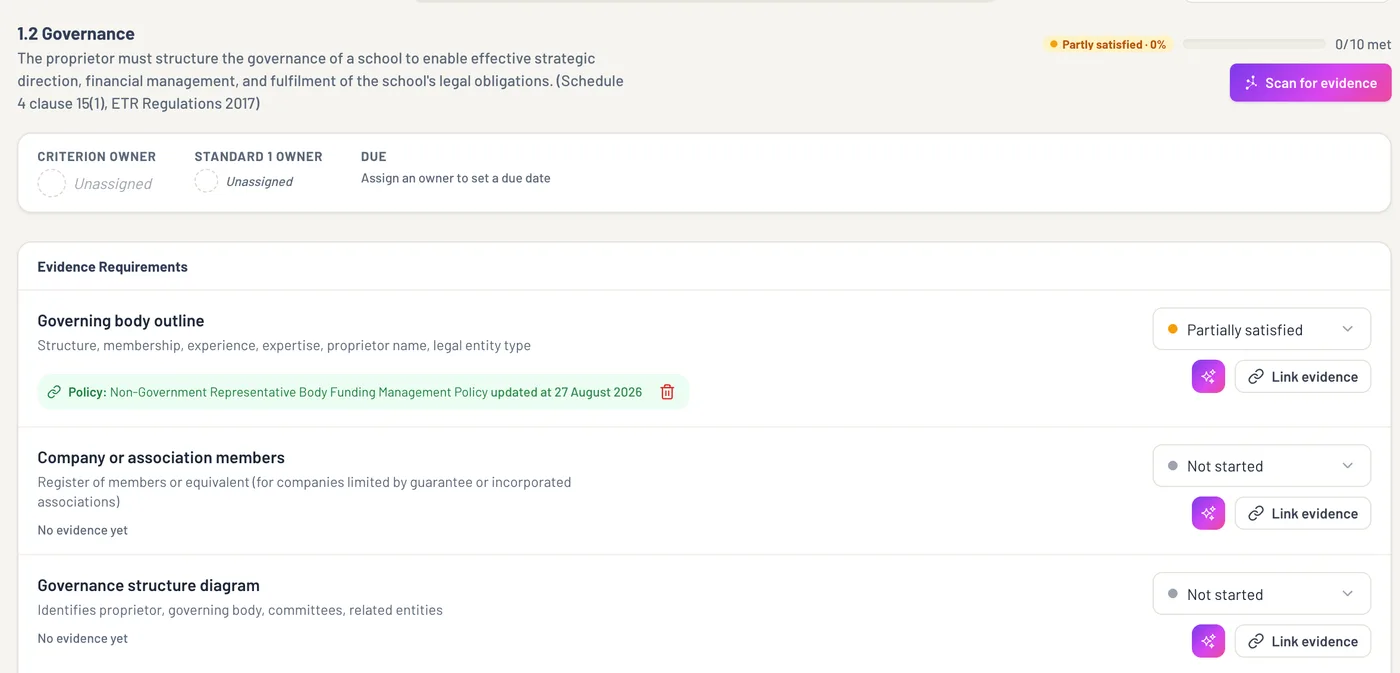
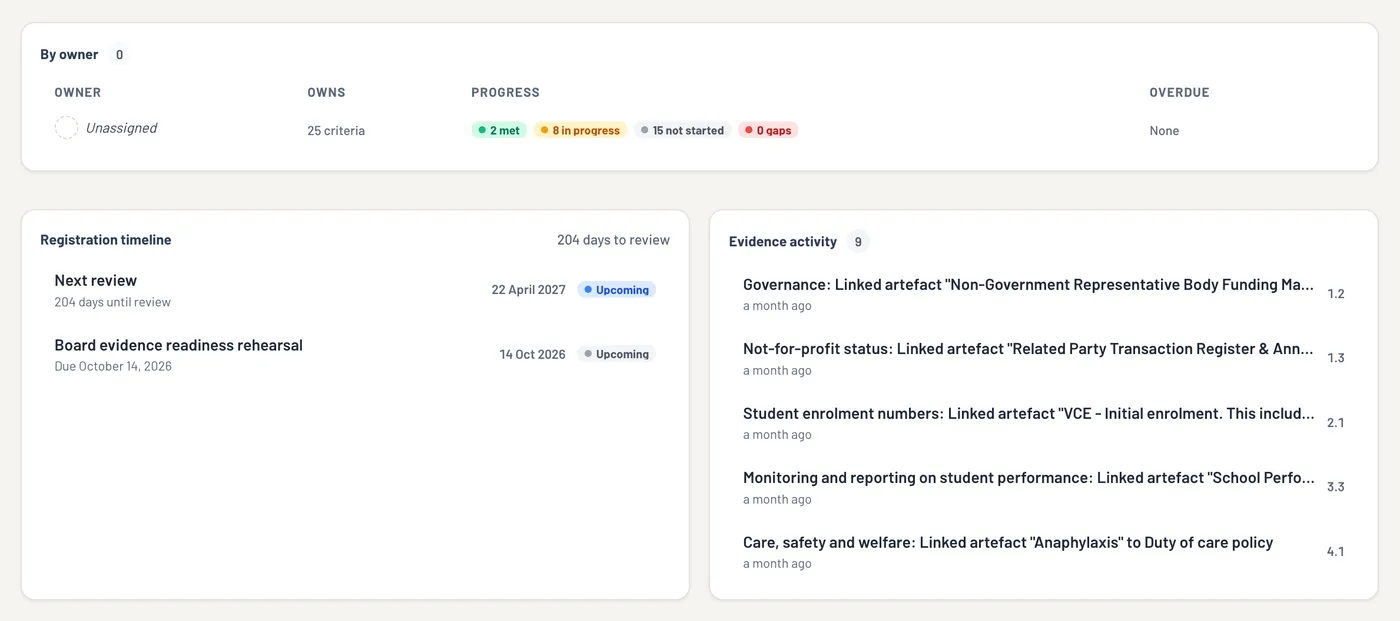
Real captures · Regulatory Readiness · demo school.
EthosOne's Regulatory Readiness module is school registration and review software for independent schools in New South Wales.
NESA inspects schools on cycles of up to five years.

What we keep hearing
It is eleven weeks to the NESA review. The self-assessment template has been opened by six people and grown each time. The evidence it points to is in a shared drive, two inboxes and a policy library, and the only complete map of where it all lives is in the business manager's head. The board has asked whether the school is ready, and the honest answer is "we will get there".
This is the room where the answer is a number, and the number moves.
The problem
The framework is the regulator's, and the evidence is the school's. In NSW, NESA reads the school through 24 criteria in a fixed hierarchy. The school holds its evidence by who made it and where it was saved. Every review begins by rebuilding the bridge between the two, by hand, from a template that was last touched at the previous review.
A self-assessment is a snapshot, and the review is a moving date. The template says what was true on the day it was filled in. Between that day and the review a policy is revised, a certificate lapses and an owner leaves, and nothing in the template notices. The school walks in defending a position it no longer holds.
"Ready" has no owner. A criterion that is nobody's is everybody's, and it is the one the reviewer opens. Without a named owner, a due date and a status that only that person can set, readiness is a feeling the principal has rather than a record the board can read.
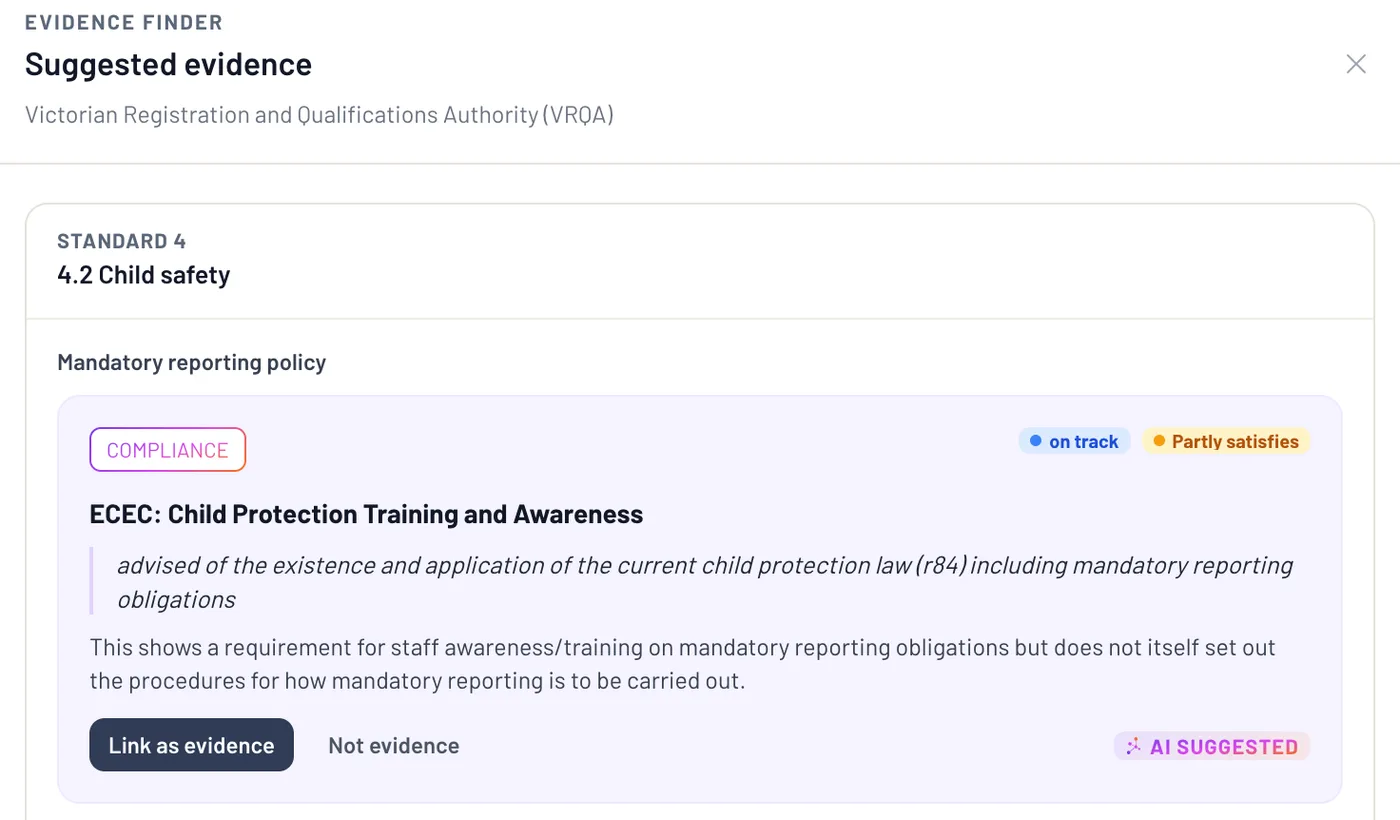
Four views, one picture. Each one reads from the same live records.
 01
01Regulation home
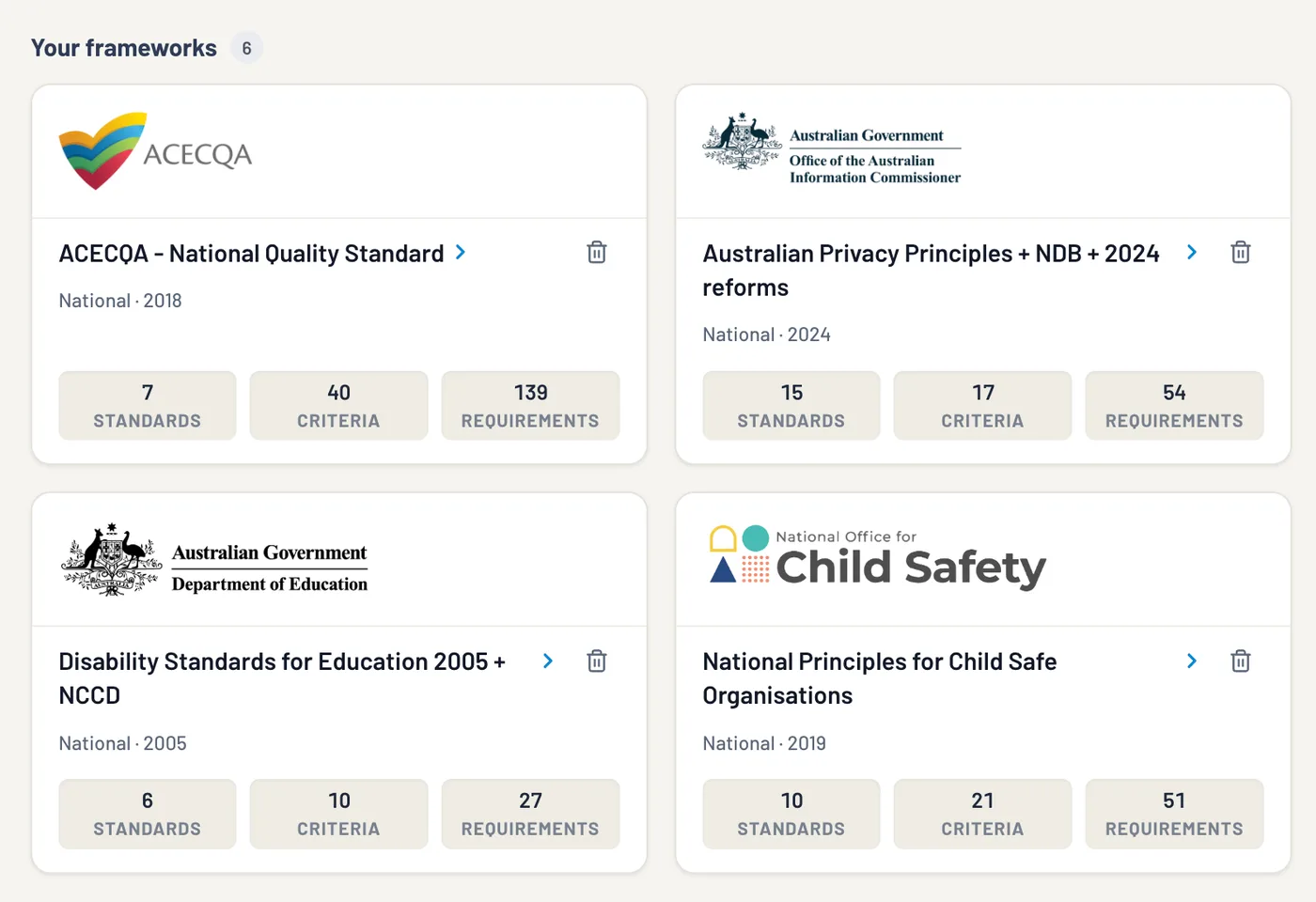
The catalogue holds frameworks by sector. NSW schools activate the NESA Registration and Accreditation Manual and the national frameworks that also apply to them, an ELC activates the National Quality Standard beside it, and none are conflated.
 02
02Readiness Dashboard
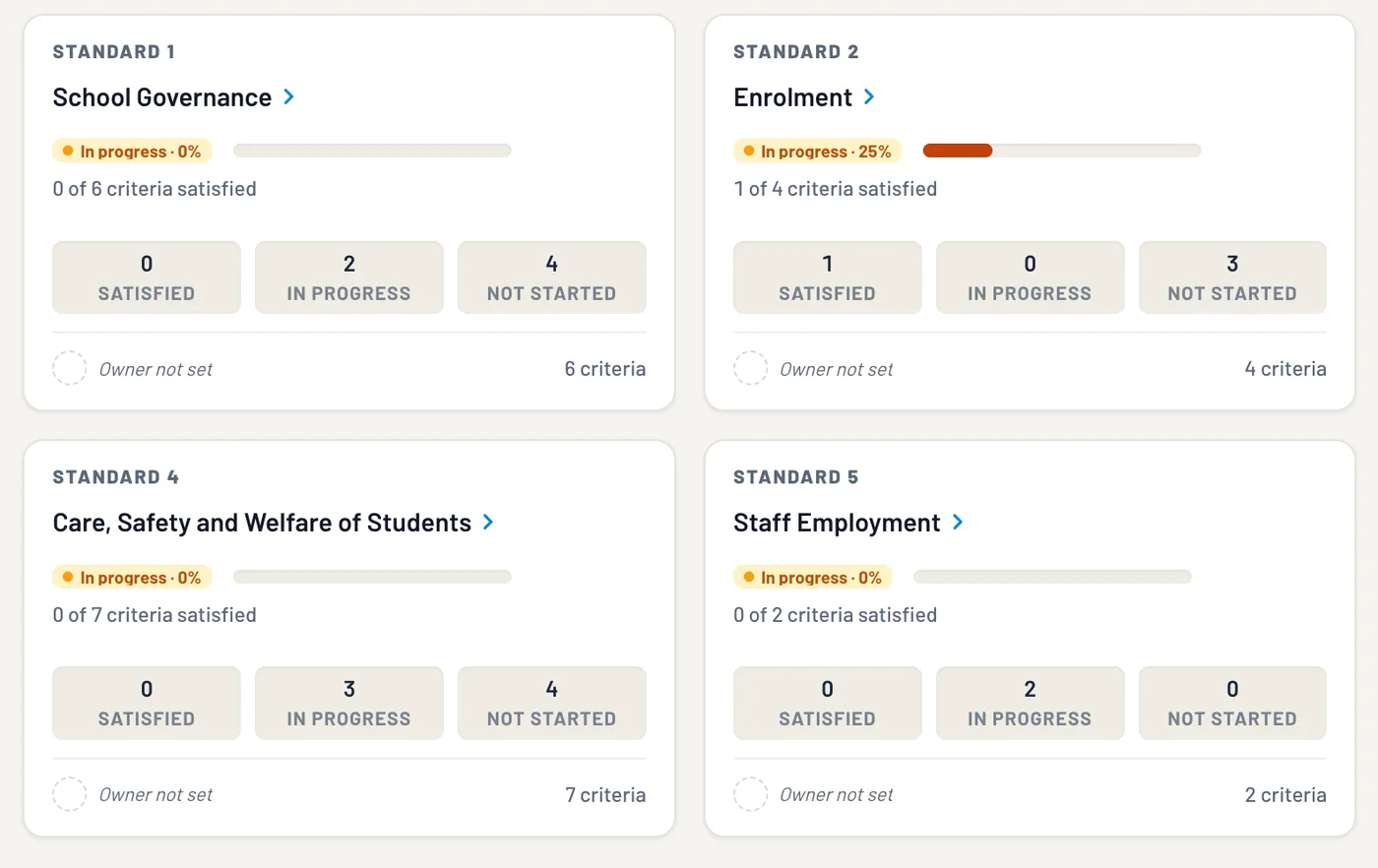
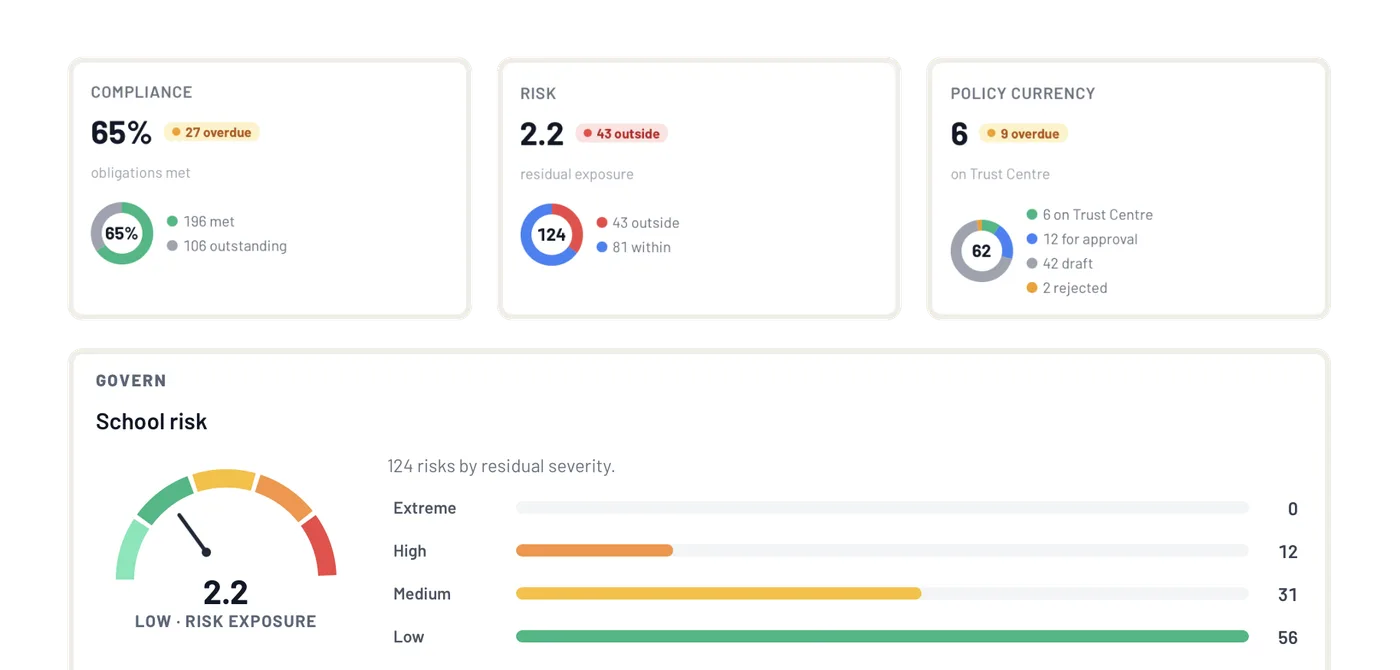
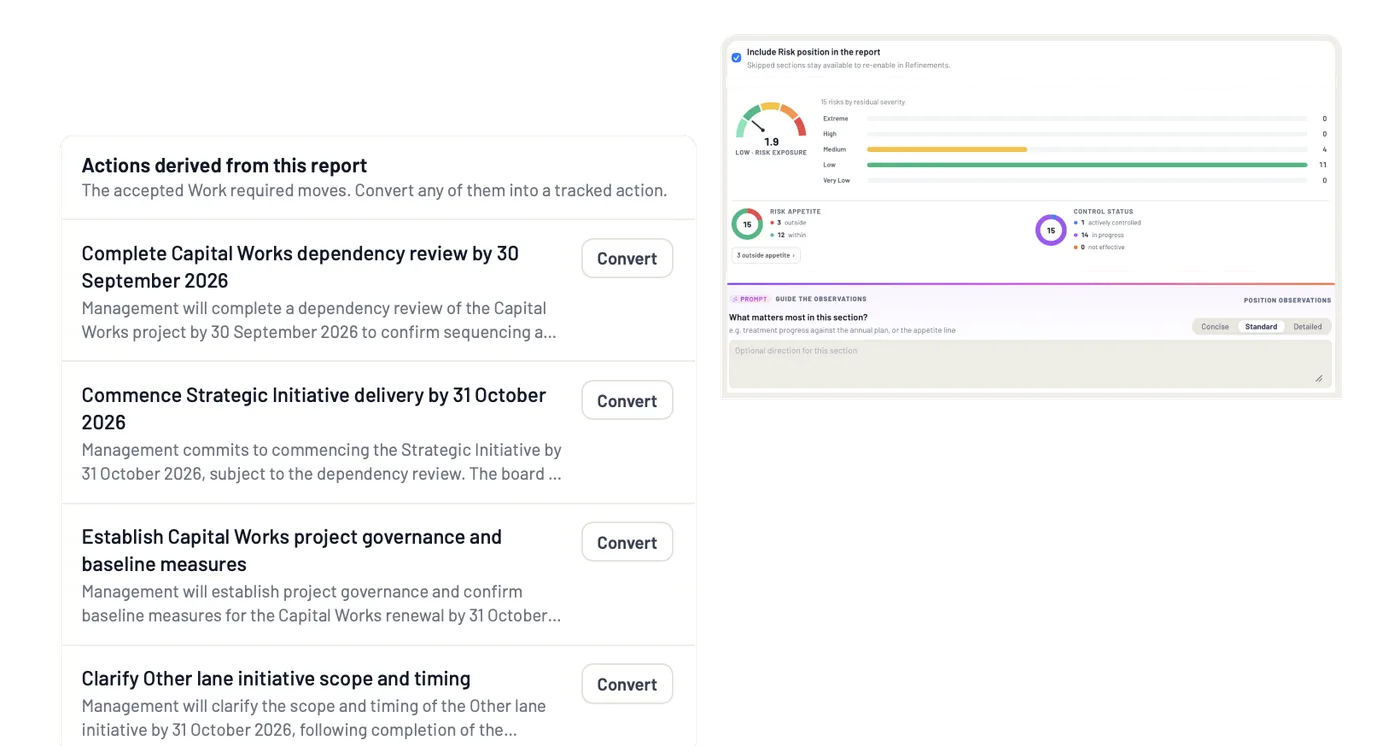
Days to the review, the mix of standards and criteria by status, and the material gaps, each status tracing to a requirement, a compliance item and accepted evidence. The board sees a number that moves, and the plan that moves it.
 03
03Criteria Browser
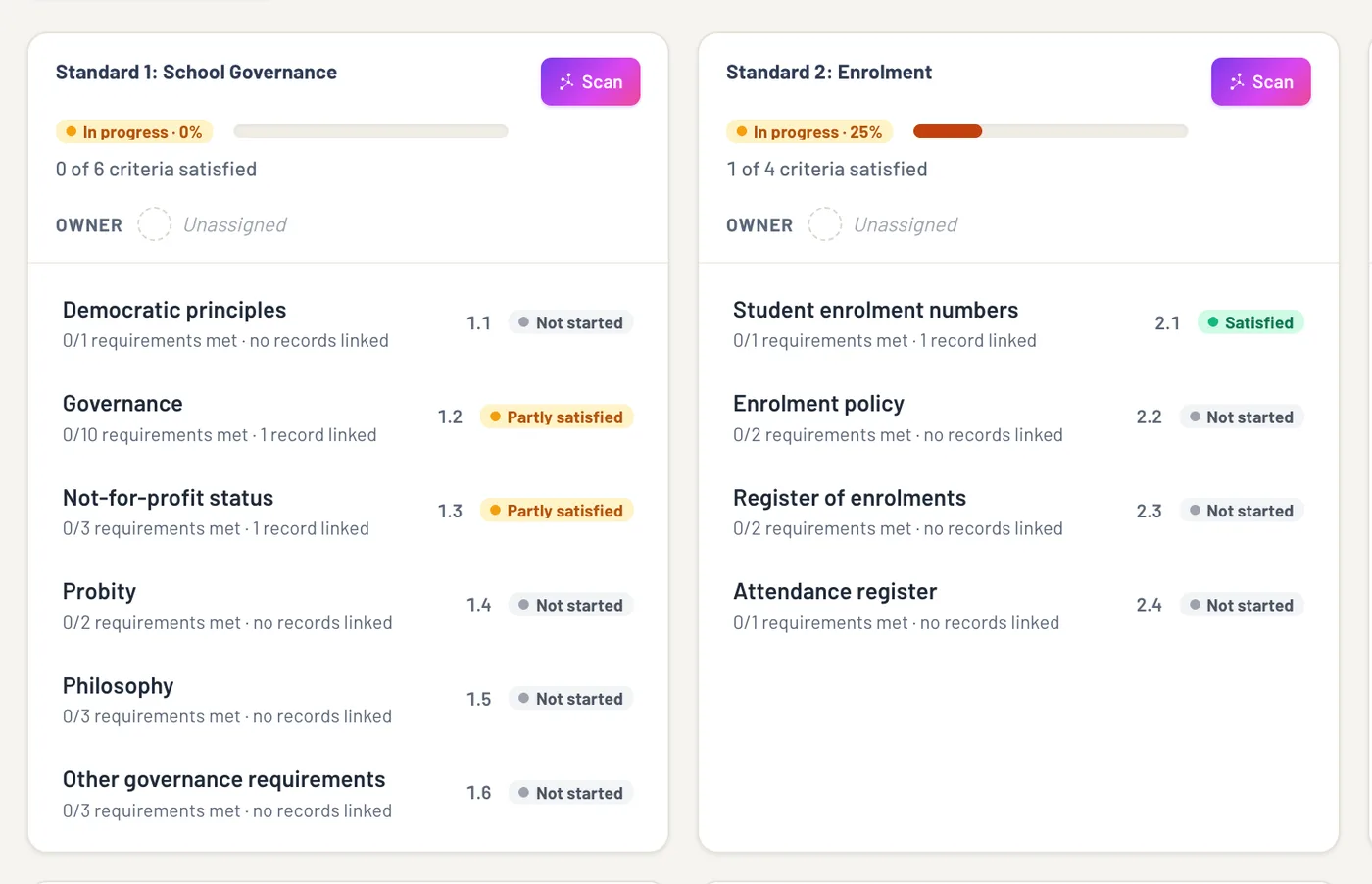
The 11 standards, 24 criteria and 152 requirements exactly as NESA structures them, with Satisfied, Partially satisfied and Gap on every row and search that reaches a requirement and its evidence state. The framework, the jurisdiction and the entity stay visible all the way down.
 04
04Criterion detail
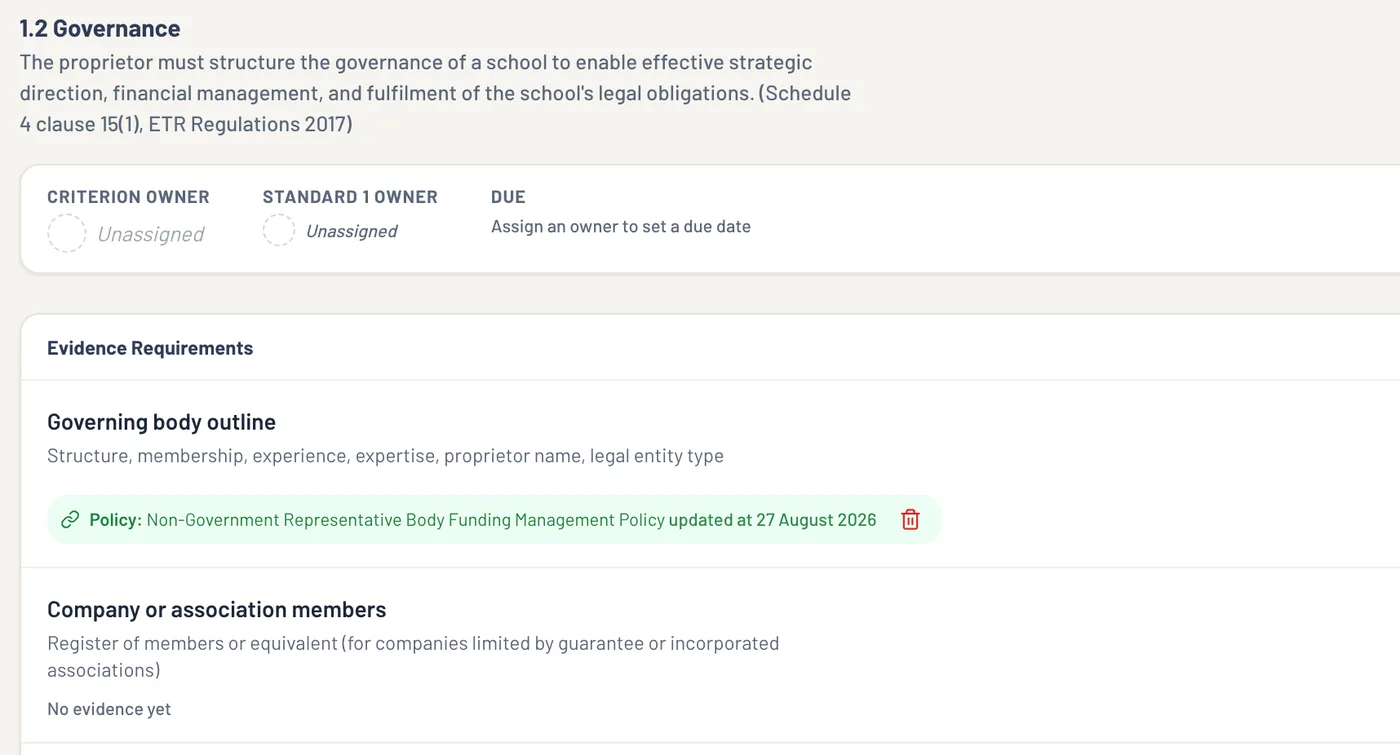
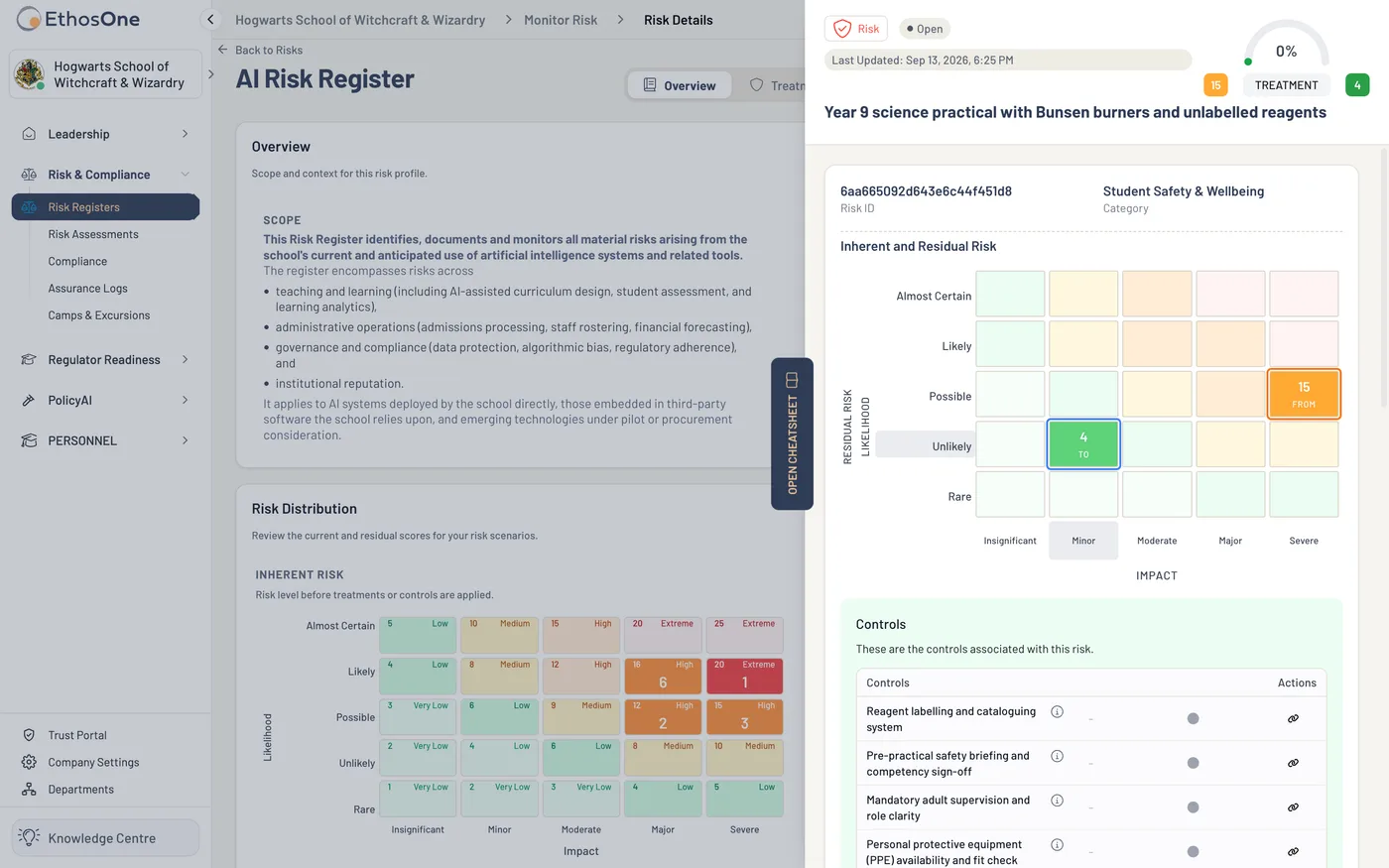
Open a criterion to read the requirement, link the artefacts that answer it, name the owner, add notes and set the status, with the source document a click away. Every change lands on the criterion's timeline, dated, so a reviewer can see why the position changed and what happens next.
Run at any scale. From one campus to a diocese, with every entity reporting the same way.
- Switch
- from your existing platform, for a low cost
- 25
- policy domains help you make sense of the policies you have, and the ones you need
- Every regulator
- in Australia and New Zealand supported
- Safe
- data, processing and AI based in Sydney and Melbourne via AWS
Coverage spans the eight Australian states and territories, with Commonwealth law applying across all of them, and separately New Zealand. Domain figures come from the PolicyAI Research Atlas.
Your framework, loaded
The facts the platform holds for NSW, as at the date on this page.
The regulator
NSW Education Standards Authority.The framework
NESA Registration and Accreditation Manual: 11 standards, 24 criteria and 152 requirements, loaded in the regulator's own hierarchy.
Coverage
Manual coverage across the eleven NESA sections, including governance, curriculum, premises and child safety.
The cycle
NESA inspects schools on cycles of up to five years.
Adjacent obligations
the ACNC governance standards, the National Principles for Child Safe Organisations, the Disability Standards for Education and the Privacy Act obligations the OAIC regulates. Each is a framework of its own in the catalogue, so the national obligations sit beside the State ones rather than inside them.
Early learning
An early learning service attached to the school is assessed against the National Quality Standard by the NSW regulatory authority under the National Law; it activates the NQS in the same catalogue, beside the school's framework, and the two stay comparable without a fake universal percentage.
A framework record without a source or an effective date is labelled unverified and kept out of every authoritative readiness claim. A registration date that passes with no renewed record is flagged as an expiry, not rolled forward.
Before the review
The next milestone
NESA inspects schools on cycles of up to five years. Put the exact date in the readiness dashboard and the runway counts down from it.
What a reviewer asks for
Against each standard: the policy or procedure, evidence it is applied (records, registers, logs, training), the person accountable, when it was last reviewed, and how the governing body oversaw it.
Five artefacts to keep current
- The risk register, with owners and review dates.
- The compliance calendar, with the evidence linked to each obligation.
- The policy library, each policy dated, current and acknowledged.
- The child safety records: working-with-children checks, reportable conduct, training.
- The board's own record: minutes, resolutions and the pack that shows oversight.
The template
The school self-assessment template, scored for NSW.
The association
The Association of Independent Schools of NSW (AISNSW) is the sector body most NSW independent schools belong to. It is not the regulator, and EthosOne has no commercial relationship with it. Its compliance calendar is in the profile library, ready to load: the AISNSW calendar.
Your policy library, read against New South Wales law
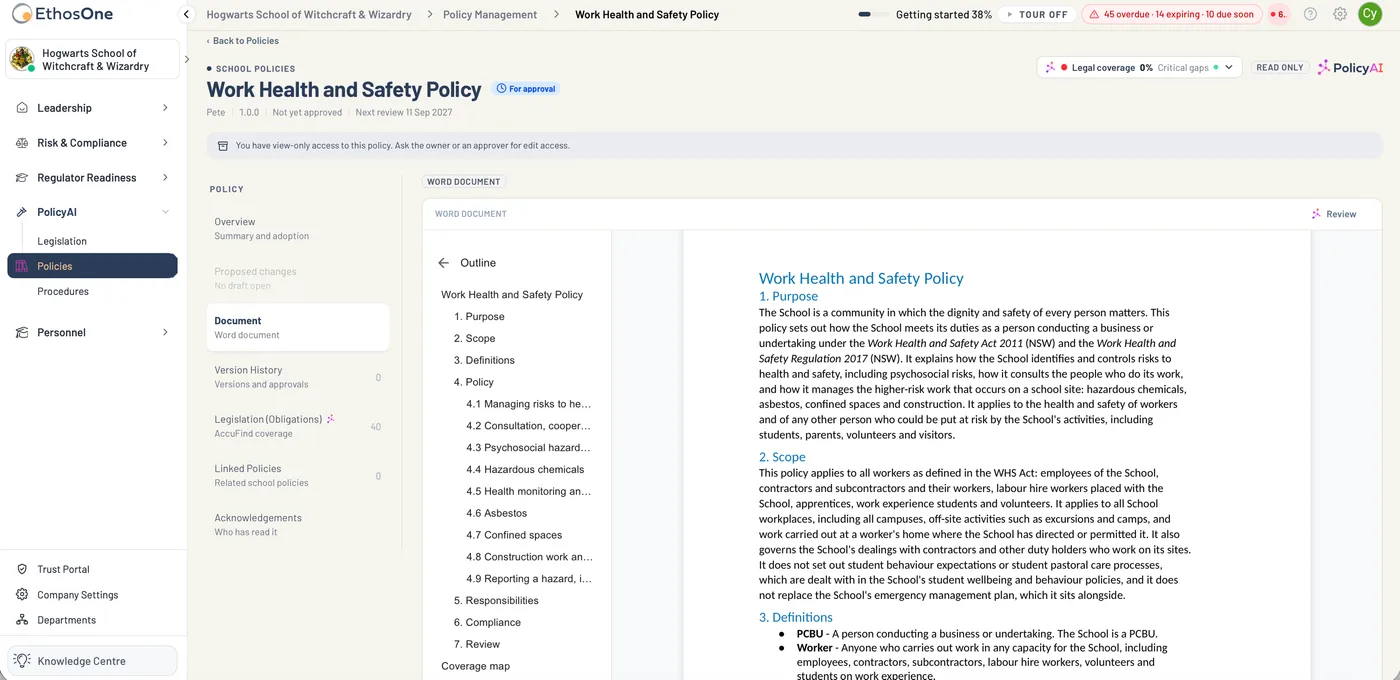
The criteria say what NESA expects to see. The policies say what the school has committed to do. PolicyAI reads the school's policy library against the obligations beneath the criteria, with the source Act and section on every obligation, and names the paragraph that is missing. When an obligation changes, the criteria it supports are on the change record, so the readiness position and the policy position move together.
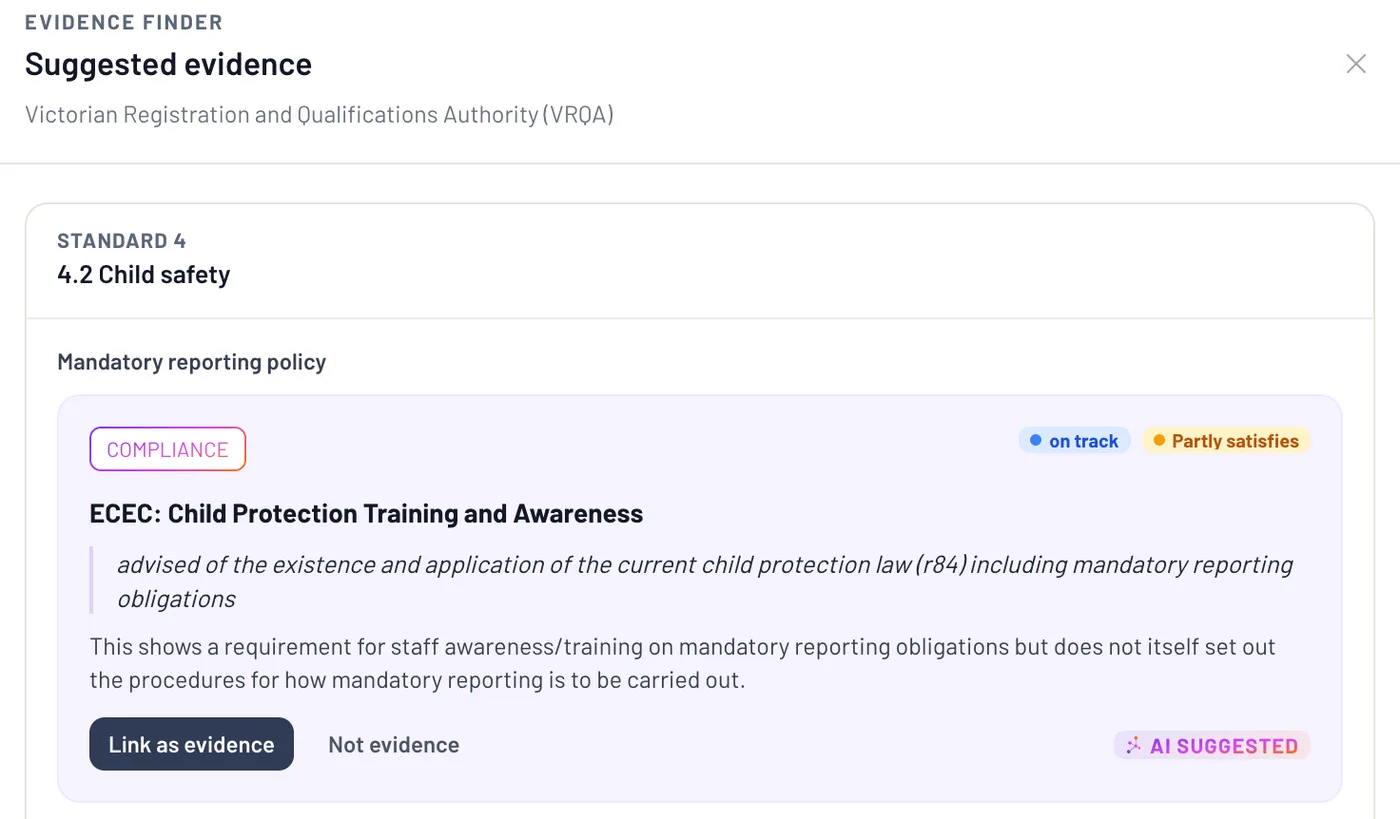
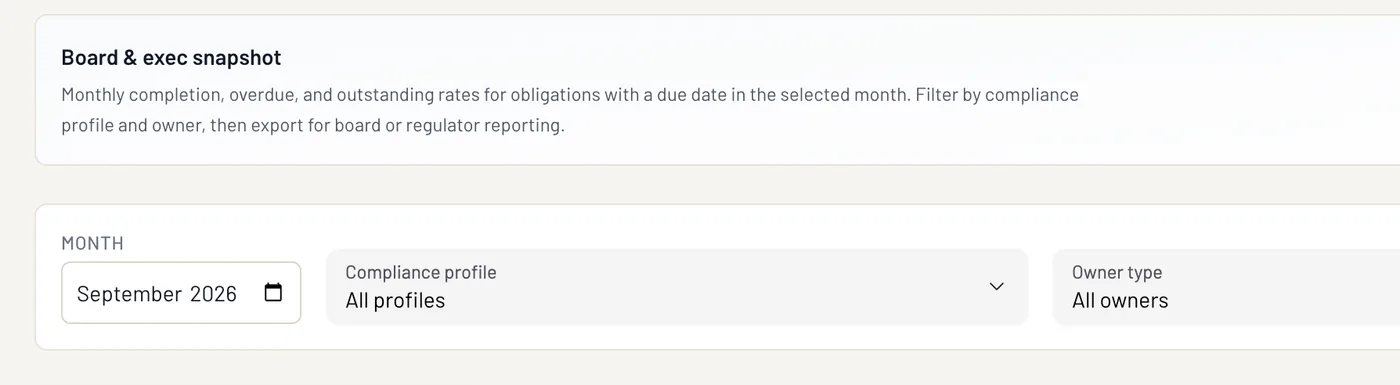
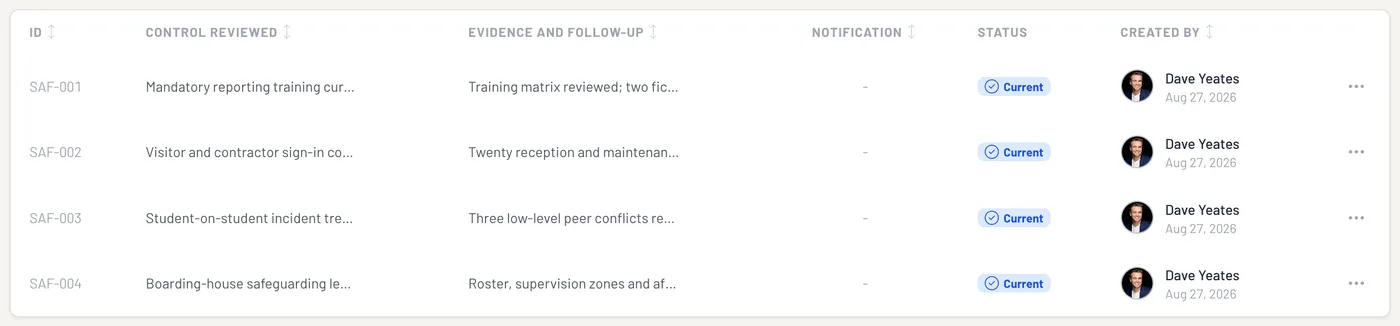
Regulatory Readiness is what makes the accountability spine regulator-defensible. The obligation register in PolicyAI supplies the source, a criterion states what NESA requires, the compliance calendar carries the recurring work, assurance logs and policies hold the evidence, and the risk register shows the controls the criteria rely on. Readiness rolls up through Reporting into the board pack. Before a cycle begins, the school self-assessment tool gives leaders a framework-mapped read on where the school stands. The Regulatory Readiness hub holds every State and NZ framework.
What it does not do
- It does not treat an activated framework as proof of compliance. A criterion is satisfied when a person says so and the evidence is linked.
- It does not give legal advice, interpret NESA's intent or invent a review date. The date is entered by the school and the criteria are the regulator's text.
- It does not duplicate the compliance calendar inside Regulation. The recurring work stays where it is run and is linked from the criterion.
- Stored in AustraliaAWS Sydney and Melbourne, one database per school
- AI stays in the country tooHosted in Sydney and Melbourne; never trained on your content
- Published, not describedOur policies in the Trust Centre · How we handle your data
Proof
EthosOne is the ASBA Risk and Compliance Branch Partner 2026. This is a commercial sponsorship, not an endorsement.
“School governance and risk is a complex area without a clear solution, a time-poor disconnect with governance and risk management that relies on Frankenstein models of electronic and paper-based reporting and measuring.”
 David RuggieroPrincipal, Blackfriars Priory School
The seven we are asked every time.
Still weighing something up? Thirty minutes with us, on your own registers, answers the rest.
Book your school a demo01What is covered by the NESA Registration and Accreditation Manual, and how often is the review?
Manual coverage across the eleven NESA sections, including governance, curriculum, premises and child safety. EthosOne loads the NESA Registration and Accreditation Manual as 11 standards, 24 criteria and 152 requirements, each with an owner, linked evidence and a status a person sets. NESA inspects schools on cycles of up to five years.
02How fast can NSW schools be ready for the NESA review?
Most schools reach a confident readiness state in a single term. The framework is loaded on day one, the review date sets the runway, and the material gaps are the work.
03Our evidence is in SharePoint, Google Drive and a policy library. Do we migrate it?
No. Keep it there. EthosOne links to the file, the URL or the EthosOne record that answers the criterion. You connect rather than migrate.
04Who needs to be involved?
Typically the principal, the business manager and one or two subject leads. Each owns the criteria that are theirs. The platform carries the mapping and the runway; people sign off the work.
05Which frameworks does an NSW school activate beside the NESA Registration and Accreditation Manual?
The national obligations that also apply to it: the ACNC governance standards, the National Principles for Child Safe Organisations, the Disability Standards for Education and the Privacy Act obligations the OAIC regulates. Each is a framework of its own in the catalogue, with its own criteria and its own readiness, so an NSW school's position on child safety or disability access is read once and answers both the State framework and the national one.
06We also run an early learning centre. Is that the same review?
No, and the platform does not pretend it is. An early learning service attached to the school is assessed against the National Quality Standard by the NSW regulatory authority under the National Law; it activates the NQS in the same catalogue, beside the school's framework, and the two stay comparable without a fake universal percentage.
07Regulatory Readiness, in full: what does it cover?
The module loads the NESA Registration and Accreditation Manual as the NSW Education Standards Authority structures it: 11 standards, 24 criteria and 152 requirements, each a record that holds its owner, its linked evidence and a status that only a person can set. Alongside the State framework sit the national obligations NSW schools also answer (the ACNC governance standards, the National Principles for Child Safe Organisations, the Disability Standards for Education and the Privacy Act obligations the OAIC regulates), and the readiness dashboard reads across all of them with the runway to the review date. Regulatory Readiness is a Focus module at $5,000 a year on top of Core, with no per-user fees, so every person who owns a criterion has a login. A reviewer asks for the same five things against each of the 11 standards: the policy, evidence it is applied, the person accountable, when it was last reviewed, and how the governing body oversaw it; every record in the module holds all five.
How ready is your school for its next review?
Free, under ten minutes, and yours to keep whether or not you talk to us.
What this page rests on
The instruments named on this page, with their standing and the day we last read them. EthosOne is here to help. It's not legal advice. AI can make mistakes.
Supporting the frameworks and compliance schools already rely on





More free templates and tools

We would be glad to loadthe NESA Registration and Accreditation Manual
Regulatory Readiness: $5,000 a year with no per-user fees.
In Regulatory readiness

Regulatory readiness
The Regulatory Readiness module; framework activated, review date set, evidence linked per criterion.

Victoria · VRQA
6 standards, 25 criteria.

Queensland · NSSAB
8 standards, 18 criteria.

South Australia · ESB
3 standards, 26 criteria.
Western Australia · DoE
15 standards, 49 criteria.

Tasmania
14 standards, 36 criteria.