







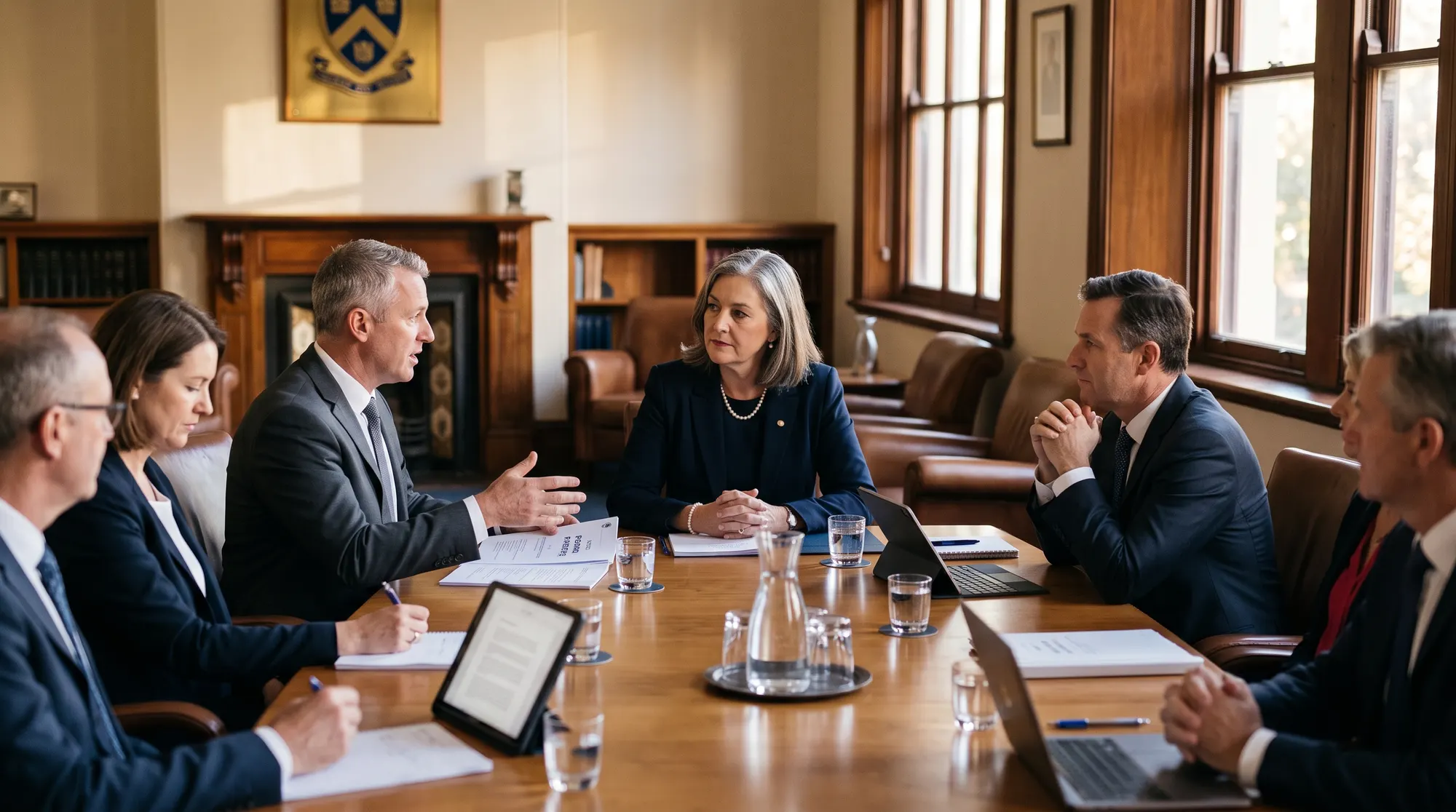
The board sees the position. The executive owns it.
Advisory for chairs, principals and executives on what reaches the board and how accountability is made visible, week by week. Ten to fourteen weeks, in the boardroom and at the executive table.
Board and risk advisory is EthosOne's consulting service for independent school boards and executives.
It has two strands. It is delivered by Pete Holliday, an executive coach and organisational psychologist, and Dave Yeates, a systems strategist, through D.Why, and it can run with or without an EthosOne licence.
What we keep hearing
The pack goes out on the Friday. It runs to a hundred pages, and the meeting on Tuesday still lands on the one item nobody prepared for. The register the board asked to discuss was written for an assessor, and reads like it. In the same term the principal describes the executive as not owning it, and the board has started asking about performance in a way it did not last year.
Those facts are related, and this is the work that makes decisions on what is true the ordinary case.

Board governance has its own five stages. The advisory leaves a school on the fourth: accountability visible weekly, and a board that governs rather than receives.
The folder
The pack is a hundred pages assembled the week before. The register was written for an assessor. Decisions and actions live in the minutes and nowhere else.
You cannot go back when the chair and the principal have read the written diagnostic of where governance sits.
The agenda
A standing agenda the pack mirrors. The line between what the board decides and what management reports, drawn once. The pack gets shorter and the meeting gets longer where it should.
You cannot go back when two packs in a row have followed the agreed agenda.
The register
Appetite set once and approved by the board. A register that is real, reviewed on a cadence rather than before an inspection. The risk assessment kept distinct from the strategic register.
You cannot go back when the board has voted the appetite statement and the register has been reviewed against it.
- This engagement lands here
The team
Role charters and an executive scorecard. Each leader's goals, actions and risks visible on a dashboard. The executive meeting runs from it without us in the room.
You cannot go back when the executive meeting has run from the dashboard without Pete in the room.
The report
The board reports against the plan at every meeting from live data. The termly executive review and the annual effectiveness review are on the calendar and happen.
You cannot go back when the board has read a pack that reports exec accountability by name for two consecutive meetings.
Ten to fourteen weeks in four bands, with the chair and the principal at the start and the executive team through the middle. The gate is the meeting that runs without us.
- Weeks 1 to 3
Diagnose
A diagnostic conversation with the chair, the principal or both, then a written read of where governance sits. For the executive: the leadership team diagnostic, the accountability map and the meeting cadence audit.
Gate. The written diagnostic is with the chair and the principal.
- Weeks 4 to 6
Design
The standing agenda and the board line. The executive operating rhythm, role charters and accountabilities, and the executive scorecard. Where the school asks for it, the appetite statement drafted for the board.
- Weeks 7 to 12
Deliver
Two to four working sessions with the board on the areas that matter most. Three leadership team workshops. Facilitated executive meetings through the first term, with an optional 1:1 coaching cycle.
Gate. The executive meeting runs from the dashboard without us in the room.
- Weeks 12 to 14
Embed
Strategic plan goals assigned per executive with actions, owners and due dates. A dashboard view per executive role. Risk owners aligned to executive accountabilities. The board pack reports it.
- Each term
Keep it
The termly executive performance review, facilitated. The annual team re-diagnostic. The annual board effectiveness review and AGM pack support.
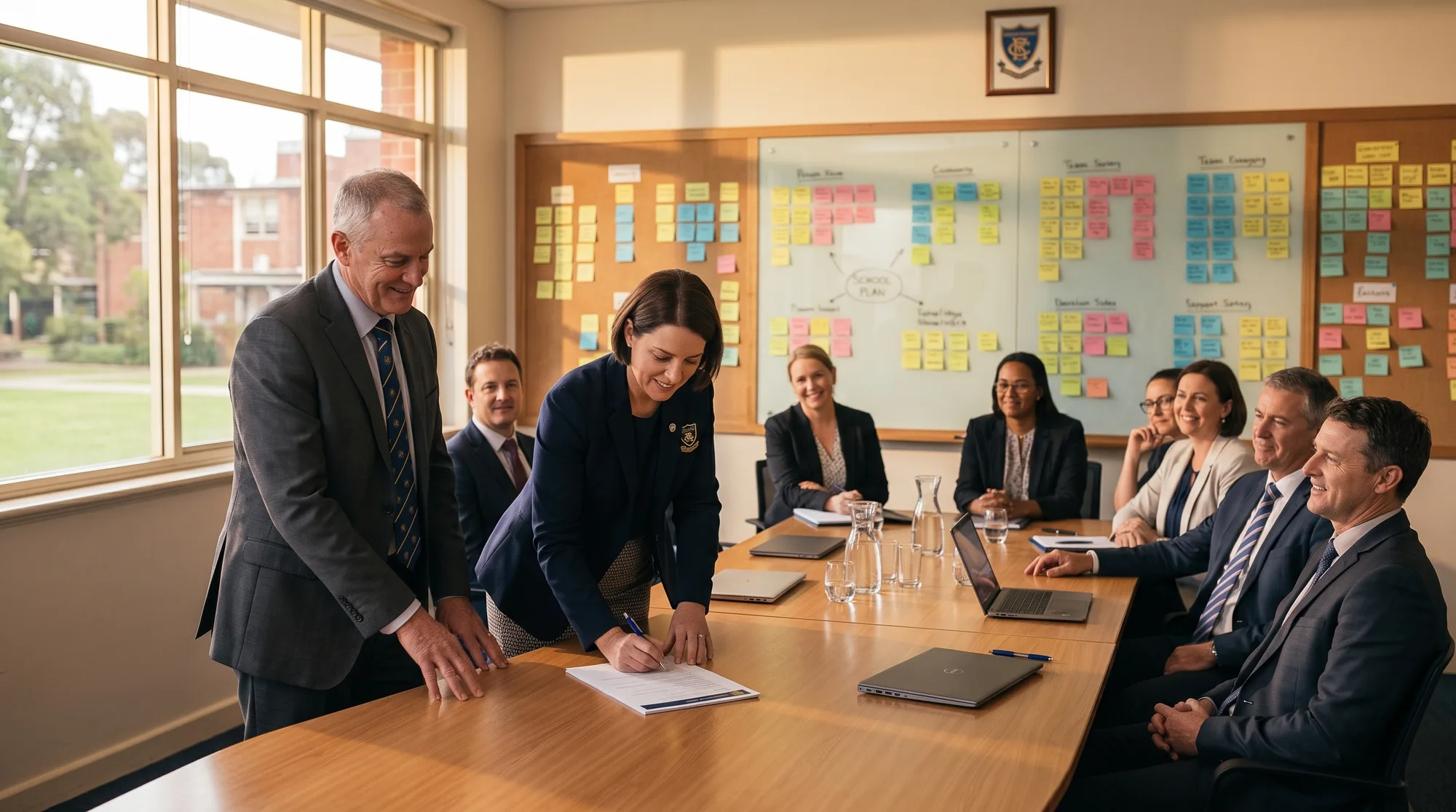
Two rooms. The boardroom, and the executive table on a Tuesday.
- With the chair: what the board sees, what it decides, and what it can stop reading.
- With the executive: who owns which goal, which risk and which action, said in the room and written in the same hour.
- With both: the appetite statement the board will vote on and the executive will be measured against.
The end of the planning day, the plan signed, the wall of notes behind them.
What you leave with
A shorter pack and a longer conversation
The position, the exceptions and the few decisions that are genuinely the board's, on a standing agenda the pack mirrors.
Accountability by name
Each executive's goals, actions and risks on a dashboard the meeting runs from, and a board pack that reports them without anyone assembling it.
A rhythm the school keeps
The termly executive review and the annual effectiveness review on the calendar, facilitated by us where the school wants it and run without us where it does not.
Two people, in the room with you.

Pete Holliday
leads the work with boards and principals. An executive coach and organisational psychologist, Pete works on how the board conversation runs, how the executive prepares for it, and how a leadership team comes to own the plan.

Dave Yeates
leads the work on risk and reporting. A systems strategist and co-founder of EthosOne, Dave works on the register, the appetite, the evidence and the pack, and on the operating rhythm the platform carries.
- Stored in AustraliaAWS Sydney and Melbourne, one database per school
- AI stays in the country tooAmazon Bedrock; never trained on your content
- Published, not describedTrust Centre · ISMS policy · How we handle your data
“School governance and risk is a complex area without a clear solution, a time-poor disconnect with governance and risk management that relies on Frankenstein models of electronic and paper-based reporting and measuring.”
 David RuggieroPrincipal, Blackfriars Priory School
The five we are asked every time.
Still weighing something up? Thirty minutes with us, on your own registers, answers the rest.
Book your school a demo01Do we need EthosOne to use the advisory service?
No. The advisory runs with or without a licence. Where a school does hold one, the agreed agenda, appetite and register structure are configured on the platform as part of the handover; where it does not, the school keeps them as documents it owns.
02Who is in the room?
Whoever the question belongs to. Board reporting sessions usually involve the chair, the principal and the business manager; risk practice sessions add the risk owner; registration readiness adds the compliance lead. Pete or Dave leads each session, and both are present for the diagnostic and the handover.
03How is it priced?
Scoped with you. After the diagnostic conversation we set out the sessions, the written read and the handover in a short scope with a fixed price, and nothing begins until you have agreed it. No licence fee is attached.
04How long does an engagement take?
Most run across one term: the diagnostic and the written read in the first weeks, the working sessions around the board's meeting cycle, and the handover before the term ends.
05Board and risk advisory for schools, in full: what does it cover?
With the chair and the principal: board reporting (the pack, the standing agenda, the boundary between board and management), risk practice (appetite, the register as a living instrument, the risk assessment as the operational control) and registration and review readiness. With the principal's leadership team: the Executive Leadership Uplift, a ten-to-fourteen-week programme that diagnoses the team, designs its operating rhythm, role charters and scorecard, runs three leadership workshops and facilitated executive meetings through the first term, and embeds the result as goals, actions and a dashboard view per executive.

What are the AI paragraphs you are currently missing from your policies? Watch how we do it.
Free, under ten minutes, and yours to keep whether or not you talk to us.
“It meets all of the real frustrations of business directors in one place.”

“School governance and risk is a complex area without a clear solution.”

It begins with a conversation with the chair or the principal,and we would be glad to have it.
Advisory service that lifts the calibre of a school's governance, risk practice and board reporting.