








School registration and review by state: what each regulator asks, and when
Every Australian state and territory, and Aotearoa New Zealand, registers non-government schools against its own framework and on its own cycle.

Thirty minutes, your data, no slides.
School registration and review is the periodic process by which a regulator confirms that a non-government school still
Meets the standards for registration. In New Zealand the Ministry of Education registers private schools and ERO reviews them. EthosOne loads each framework so evidence links to every criterion.
What a registration review is, and why the map matters
A registration review asks one question in many forms: can the school show, criterion by criterion, that it meets the standard? The evidence is nearly always already in the school; the policy library, the WHS register, the board minutes and the child safety records do not vanish between cycles. What goes missing is the map that ties each of them to the criterion it satisfies, so the cycle restarts as a reconstruction. Business managers tell us the only complete map is in their head. The registration and review hub is where EthosOne activates your regulator's framework, sets the exact review date and links evidence to each standard and criterion.
Nine jurisdictions at a glance
The table below uses only what each state page states about its framework. Standards and criteria counts are as loaded in EthosOne; cycle wording is quoted from the page.
| Jurisdiction | Regulator | Framework | Standards | Criteria | Cycle, as the page states it |
|---|---|---|---|---|---|
| New South Wales | NSW Education Standards Authority (NESA) | NESA Registration and Accreditation Manual | 11 | 24 | NESA inspects schools on cycles of up to five years |
| Victoria | Victorian Registration and Qualifications Authority (VRQA) | VRQA Guidelines for Registration | 6 | 25 | Registration cycles run up to five years, with annual school information statements in between |
| Queensland | Non-State Schools Accreditation Board (NSSAB) | NSSAB Accreditation Review | 8 | 18 | Accreditation reviews on a five-year cycle |
| South Australia | Education Standards Board (SA ESB) | SA Registration Framework | 3 | 26 | Reviews registration at least once every five years, with interim reporting in between |
| Tasmania | Office of the Education Registrar | Standards for Registration | 14 | 36 | Registration runs in cycles of up to five years |
| Northern Territory | NT Department of Education | NT Non-Government School Registration Standards (NGSRS) | 20 | 58 | Reviewed on cycles of up to five years |
| Australian Capital Territory | ACT Education Directorate | ACT Education Directorate Standards | 4 | 26 | Reviewed on cycles of up to five years |
| Western Australia | WA Department of Education | WA Registration Standards for Non-Government Schools | 15 | 49 | Reviewed on cycles of up to five years |
| Aotearoa New Zealand | New Zealand Ministry of Education | Private school registration criteria | 8 | 11 | ERO typically reviews registered private schools on cycles of up to three years |
Each of the eight Australian pages also lists adjacent obligations the framework sits beside: the ACNC, the National Principles for Child Safe Organisations, the Disability Standards for Education and the OAIC, with the CCYP added for Victoria. The New Zealand page lists the National Principles for Child Safe Organisations.
Run at any scale. From one campus to a diocese, with every entity reporting the same way.
- Switch
- from your existing platform, for a low cost
- 25
- policy domains help you make sense of the policies you have, and the ones you need
- Every regulator
- in Australia and New Zealand supported
- Safe
- data, processing and AI based in Sydney and Melbourne via AWS
Coverage spans the eight Australian states and territories, with Commonwealth law applying across all of them, and separately New Zealand. Domain figures come from the PolicyAI Research Atlas, refreshed weekly.
New South Wales: NESA
The NESA Registration and Accreditation Manual loads as 11 standards, 24 criteria and 152 requirements, covering the eleven NESA sections including governance, curriculum, premises and child safety. NESA inspects schools on cycles of up to five years. The NESA review readiness page carries the framework and its own readiness consult form.

Victoria: VRQA
The VRQA Guidelines for Registration load as 6 standards, 25 criteria and 75 requirements, paired with the Victorian Child Safe Standards and Ministerial Order 1359. Registration cycles run up to five years, with annual school information statements in between.
- 6standards
- 25criteria
- 75requirements
Queensland: NSSAB
The Non-State Schools Accreditation Board conducts accreditation reviews on a five-year cycle. The NSSAB Accreditation Review loads as 8 standards, 18 criteria and 100 requirements, covering governance, curriculum, financial viability, student welfare and reporting. The NSSAB review readiness page is the Queensland page.

South Australia: Education Standards Board
The SA Registration Framework is the leanest at the top: 3 standards (School Governance; Student Learning and Assessment; Student Safety, Health and Welfare) carrying 26 criteria and 75 requirements. The ESB reviews a school's registration at least once every five years, with interim reporting in between. The SA ESB review readiness page holds the South Australian framework.

Tasmania: Office of the Education Registrar
Tasmania's Standards for Registration load as 14 standards, 36 criteria and 131 requirements, spanning governance, learning, student welfare and operations. Registration runs in cycles of up to five years. The Tasmanian review readiness page carries the Office of the Education Registrar framework.

Northern Territory: NGSRS
The NT Non-Government School Registration Standards are the largest set in the table: 20 standards, 58 criteria and 184 requirements, from governance and curriculum to facilities and child protection. NT registration is reviewed on cycles of up to five years. The NT NGSRS review readiness page carries the Department of Education framework.

Australian Capital Territory: Education Directorate
The ACT Education Directorate Standards load as 4 standards, 26 criteria and 107 requirements, covering governance, education and welfare, registration conditions and reporting. ACT registration is reviewed on cycles of up to five years. The ACT review readiness page is the page for Canberra schools.

- Stored in AustraliaAWS Sydney and Melbourne, one database per school
- AI stays in the country tooAmazon Bedrock; never trained on your content
- Published, not describedTrust Centre · ISMS policy · How we handle your data
Western Australia: Department of Education
The WA Registration Standards for Non-Government Schools load as 15 standards, 49 criteria and 139 requirements, covering governance, education programs, staffing, student welfare and facilities. WA registration is reviewed on cycles of up to five years. The WA review readiness page holds the Western Australian framework.

Aotearoa New Zealand: Ministry of Education
The Ministry of Education's private school registration criteria load as 8 standards, 11 criteria and 50 requirements, with ERO conducting on-site reviews. ERO typically reviews registered private schools on cycles of up to three years. The New Zealand review readiness page is the page for Aotearoa.

Staying ready between cycles
Continuous readiness is a fair question rather than a slogan, and the answer rests on three moves. Map: choose your authority and the standards, criteria and requirements load with their hierarchy intact. Link: attach evidence to each criterion as a file, a URL or an existing EthosOne artefact, so a policy update flows to every criterion that references it. Close: named owners, due dates and a status per criterion, with a 90-day readiness check run the term before submission. Auto-mapping proposes candidate evidence with a confidence and a reason, and you accept or reject each one. The first term is the biggest lift; every cycle after that is incremental. Pete Holliday's article, Could your school really be continuously registration-ready?, makes the case in full.
Self-assessment before the assessor's
A self-assessment is only useful if it mirrors the framework the reviewer will use. The school self-assessment tool maps a school against those criteria, shows the gaps and who needs to act, and offers a six-question readiness check that runs in your browser with no login. For a school with an ELC, the ACECQA self-assessment does the same against the National Quality Standard, mapped to all 7 Quality Areas, 18 Standards and 58 Elements with an exportable evidence snapshot for the Quality Improvement Plan. If you would rather start on paper, the school self-assessment template is a free maturity self-assessment with a scoring sheet and a board summary.

Obligations connected to source
A framework criterion rarely stands alone; beneath it sit obligations set by legislation and the guidance of the state and national associations of independent schools. EthosOne ties each obligation to that source and keeps the link live through AccuFind, so when a regulation or guidance changes the connected obligations are flagged for review and the owner is notified. The recurring work those obligations create belongs in a calendar with an owner, a due date and an evidence column, which is what the free school compliance calendar template gives you. How the mapping works is set out on school compliance connected to the associations.

The pages in this guide
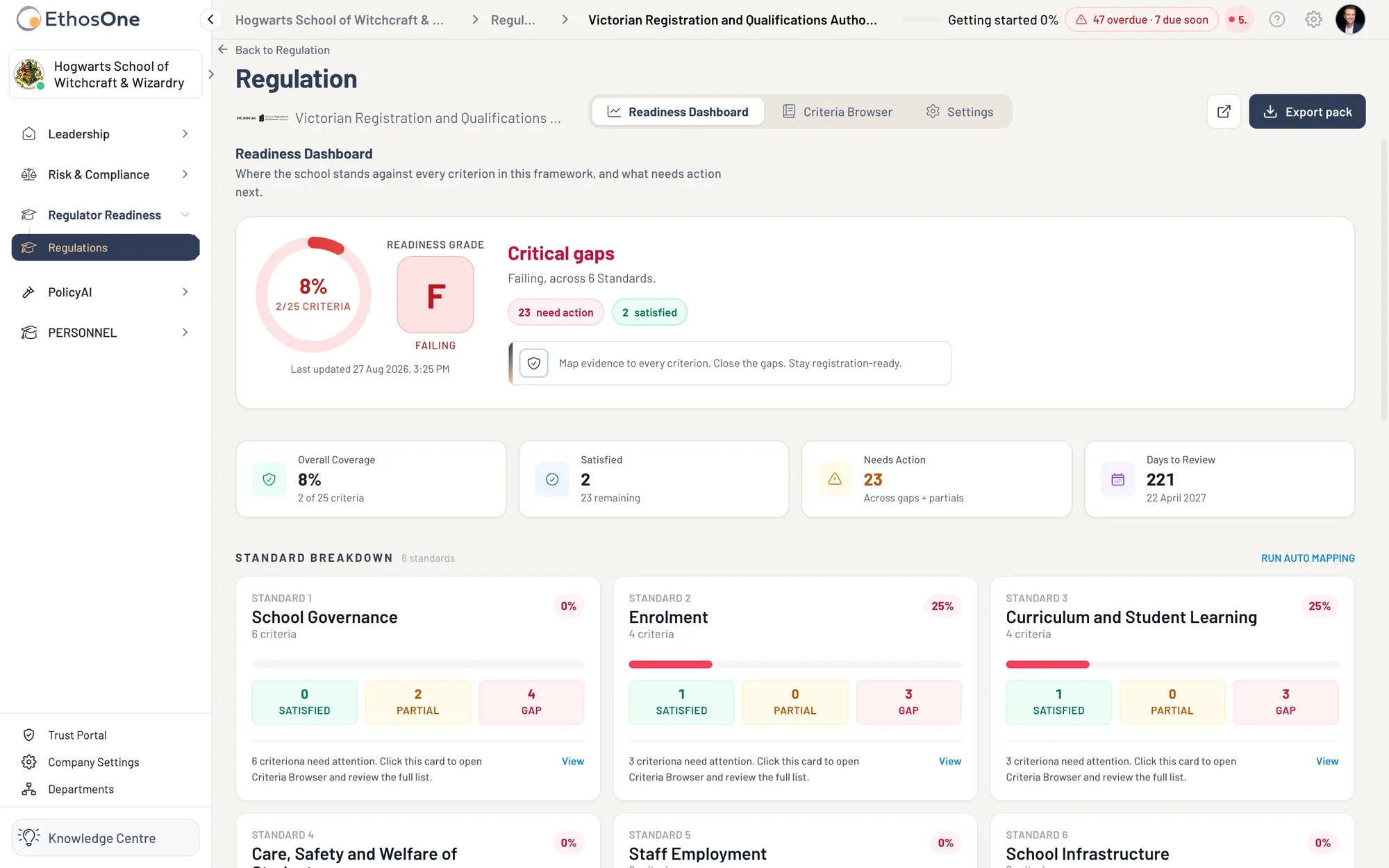
School registration and review hub
The Regulatory Readiness module; framework activated, review date set, evidence linked per criterion.
New South Wales
11 standards, 24 criteria.

Victoria
6 standards, 25 criteria.
Queensland
8 standards, 18 criteria.
South Australia
3 standards, 26 criteria.
Tasmania
14 standards, 36 criteria.
Northern Territory
20 standards, 58 criteria.
Australian Capital Territory
4 standards, 26 criteria.
Western Australia
15 standards, 49 criteria.
Aotearoa New Zealand
8 standards, 11 criteria.
School self-assessment tool
Framework-mapped self-assessment with a six-question readiness check.

ACECQA self-assessment
The NQS self-assessment for a school ELC.

School compliance connected to the associations
How each obligation traces to source.

Could your school really be continuously registration-ready?
Readiness as a state, not a project.

School self-assessment template
Free maturity self-assessment with scoring sheet and board summary.
School compliance calendar template
Free calendar of obligations by month with owner, due date and evidence.
The 18 we are asked every time.
Still weighing something up? Thirty minutes with us, on your own registers, answers the rest.
Get in contact01Does it cover our state's requirements?
Yes, for every Australian state and territory and for New Zealand. NESA, the VRQA, NSSAB, the SA Education Standards Board, Tasmania's Office of the Education Registrar, the NT Department of Education, the ACT Education Directorate, the WA Department of Education and the New Zealand Ministry of Education each have their framework loaded as standards and criteria, and each has its own readiness page in this guide. An early learning centre activates the National Quality Standard beside the school's framework.
02How often is an independent school reviewed?
It depends on the regulator. The eight Australian pages in this guide each state cycles of up to five years, with Victoria adding annual school information statements and South Australia adding interim reporting between reviews. The New Zealand page states that ERO typically reviews registered private schools on cycles of up to three years.
03Do we have to move our evidence into EthosOne?
No. A criterion links to an uploaded file, an existing EthosOne artefact or an external URL, so evidence that already lives in SharePoint, Google Drive or your policy library is linked rather than migrated. One artefact can serve every criterion that relies on it.
04Does a readiness score mean we are compliant?
No. Readiness is a traceable preparation posture, and every status traces to a requirement, a compliance item and accepted evidence. Where a framework has no source or effective date, EthosOne labels it unverified and leaves it out of authoritative readiness claims.
05How is the review date handled?
You set the review milestone to the exact year, month and day, and the runway is calculated from that date. If a registration date passes with no renewed record, EthosOne flags the expiry rather than rolling the date forward.
06We have a school and an ELC. Do they share one framework?
No. Each entity activates the framework that applies to it, the school on its state framework and the ELC on the National Quality Standard, and group regulation shows every entity as its own row with its own status and review date rather than one averaged percentage.
07How long does the first pass take?
Activating your framework and setting the review date is the work of a session. Blackfriars Priory School went from demo to live in under a month.
08Who registers independent schools in New South Wales?
The NSW Education Standards Authority (NESA) registers non-government schools in New South Wales under the NESA Registration and Accreditation Manual, and inspects schools on cycles of up to five years. EthosOne loads that manual, 11 standards and 24 criteria, on the NSW readiness page.
09Who registers independent schools in Victoria?
The Victorian Registration and Qualifications Authority (VRQA) registers non-government schools in Victoria under the VRQA Guidelines for Registration. Registration cycles run up to five years, with annual school information statements in between. EthosOne loads those guidelines, 6 standards and 25 criteria, on the Victoria readiness page.
10Who accredits independent schools in Queensland?
The Non-State Schools Accreditation Board (NSSAB) accredits non-state schools in Queensland, with accreditation reviews on a five-year cycle. EthosOne loads the NSSAB Accreditation Review, 8 standards and 18 criteria, on the Queensland readiness page.
11Who registers independent schools in South Australia?
The Education Standards Board (SA ESB) registers non-government schools in South Australia under the SA Registration Framework, and reviews that registration at least once every five years, with interim reporting in between. EthosOne loads that framework, 3 standards and 26 criteria, on the SA readiness page.
12Who registers independent schools in Tasmania?
The Office of the Education Registrar registers non-government schools in Tasmania under the Standards for Registration, in cycles of up to five years. EthosOne loads those standards, 14 standards and 36 criteria, on the Tasmania readiness page.
13Who registers independent schools in the Northern Territory?
The NT Department of Education registers non-government schools in the Northern Territory under the NT Non-Government School Registration Standards (NGSRS), reviewed on cycles of up to five years. EthosOne loads those standards, 20 standards and 58 criteria, on the NT readiness page.
14Who registers independent schools in the ACT?
The ACT Education Directorate registers non-government schools in the Australian Capital Territory under its own standards, reviewed on cycles of up to five years. EthosOne loads those standards, 4 standards and 26 criteria, on the ACT readiness page.
15Who registers independent schools in Western Australia?
The WA Department of Education registers non-government schools in Western Australia under the WA Registration Standards for Non-Government Schools, reviewed on cycles of up to five years. EthosOne loads those standards, 15 standards and 49 criteria, on the WA readiness page.
16Who registers private schools in New Zealand?
The New Zealand Ministry of Education registers private schools under the private school registration criteria, and ERO typically reviews them on cycles of up to three years. EthosOne loads those criteria, 8 standards and 11 criteria, on the New Zealand readiness page.
17What does Regulatory Readiness cost?
Regulatory Readiness is a Focus module at $5,000 a year on top of Core at $15,000 a year, with no per-user fees and every module $45,000 a year all in. Licences run from January 2027.
18School Registration and Review by State: AU and NZ Guide, in full: what does it cover?
In Australia the regulator is state-based: NESA in New South Wales, the VRQA in Victoria, NSSAB in Queensland, the Education Standards Board in South Australia, the Office of the Education Registrar in Tasmania, the NT Department of Education, the ACT Education Directorate and the WA Department of Education. Australian cycles run up to five years; ERO reviews typically run up to three.
How ready is your school for its next review?
Free, under ten minutes, and yours to keep whether or not you talk to us.

We would be glad tomap your regulator's framework
Guide to school registration and review across nine AU and NZ jurisdictions, with regulators, frameworks and cycles.