








WHS obligations for schools: the assessment that matched the activity, and the trail that proves it
The register tells the board what the school worries about, and the risk assessment is what actually protected the students on Thursday.

Thirty minutes, your data, no slides.
A school's work health and safety obligations require it to manage the risks of each activity it runs
And to be able to show that it did. Regulators and courts look for the assessment that matched the activity. EthosOne keeps the register and the assessments distinct, linked and evidenced.
The duty, and the difference between a register and an assessment
Every WHS matter we have followed in Sector Signal this year has turned on the same question: was there an assessment that matched the activity, and did the people on the ground know what it said. A register that lists "excursions" as a risk does not answer it. An assessment that names the creek crossing, the ratio, the weather call and who makes it does. The register is strategic, rated against appetite and owned at leadership level; the assessment is the analysis of one thing on one day, with its hazards, the safeguards in place and the person responsible for each. Coordinators tell us the honest reason assessments do not get written: it takes an hour they do not have, and the template is longer every time someone opens it. That is a tooling problem rather than a competence problem, and it is the argument of our story The risk assessment is the control.
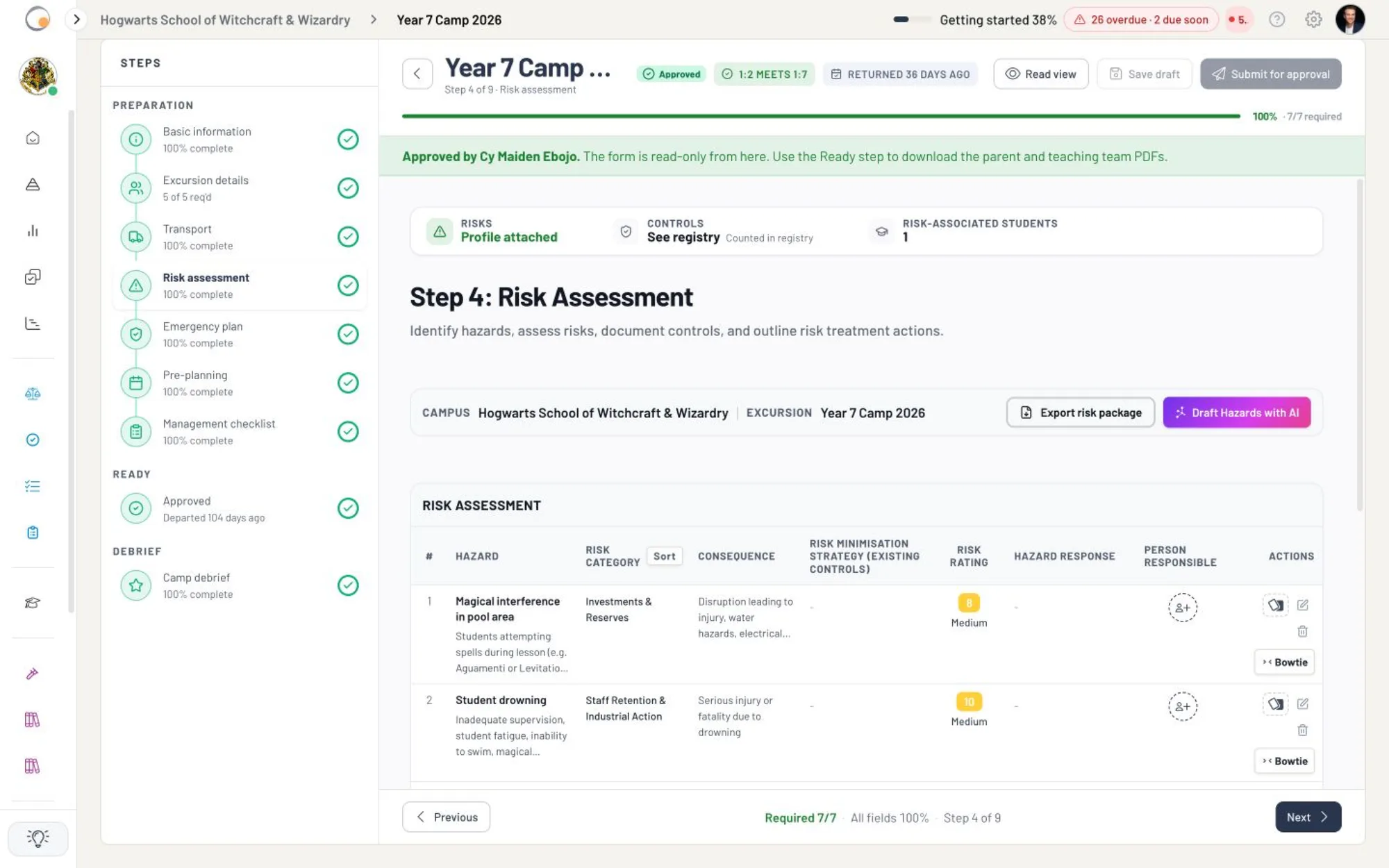
In EthosOne, assessments live in their own module, in folders by operating context, with statuses from Draft and In review through Approved, Review required, Expired and Superseded. Each hazard records a cause, a consequence, a matrix rating, a response and a responsible owner. Approval fixes an immutable version with the approver, the time and a validity date, and a high or critical hazard without an adequate response or owner makes the assessment unapprovable. The embedded helper drafts the hazards, safeguards and bow-tie text from a description of the activity while you are still in ratio, and a person selects, edits and approves. It is the school risk assessments module.

Excursions and camps
An excursion is where the two documents meet the day. Boards must be able to demonstrate that risk assessments were completed, controls considered, approvals documented, evidence retained and policies followed, which is why camp management is a governance function rather than an operational workflow; the case is made in Camp and excursion management tools. In EthosOne an excursion or camp is planned in a nine-step workspace, from basic information and supervision through consent, venue, transport and medical to the linked risk assessment, approval, departure and closure. Approval uses the exact current version of the operational assessment rather than a checklist score, a required-items preflight lists every unmet requirement with its owner, and an incident or a material variation on the day requires a post-activity review. That is duty of care excursion management.
A completed form says someone thought about the risks; a system says the right person approved at the right level, medical conditions were checked against the activity's risk profile, and the group left with a printed pack that makes the first 90 seconds of an emergency manageable. That argument is in The PlanCheckGo transition is a good time to ask a harder question. To start on paper, the free Risk Assessment Template holds 15 pre-built hazard rows, an approval sheet and a post-debrief record at school assurance.

Run at any scale. From one campus to a diocese, with every entity reporting the same way.
- Switch
- from your existing platform, for a low cost
- 25
- policy domains help you make sense of the policies you have, and the ones you need
- Every regulator
- in Australia and New Zealand supported
- Safe
- data, processing and AI based in Sydney and Melbourne via AWS
Coverage spans the eight Australian states and territories, with Commonwealth law applying across all of them, and separately New Zealand. Domain figures come from the PolicyAI Research Atlas, refreshed weekly.
Hazards and bow-ties
A hazard register lists what could go wrong. A bow-tie shows, for the most serious events, what causes it, what prevents it, and what limits the harm if prevention fails: the single event in the middle, its causes on the left with the preventive controls between them, its consequences on the right with the mitigating controls between them. The register is the breadth; the bow-tie is the depth, applied to the few risks where the board needs the control logic in full. In EthosOne a Bowtie report PDF is generated from any assessment and versioned with it, and when the venue or the cohort changes after approval the assessment becomes review-required without the approved version being erased. The free, ISO 31000 aligned hazard register and bow-tie worksheet, with a worked school example, is the school hazard assessment template.
Incidents, near misses and the assurance trail
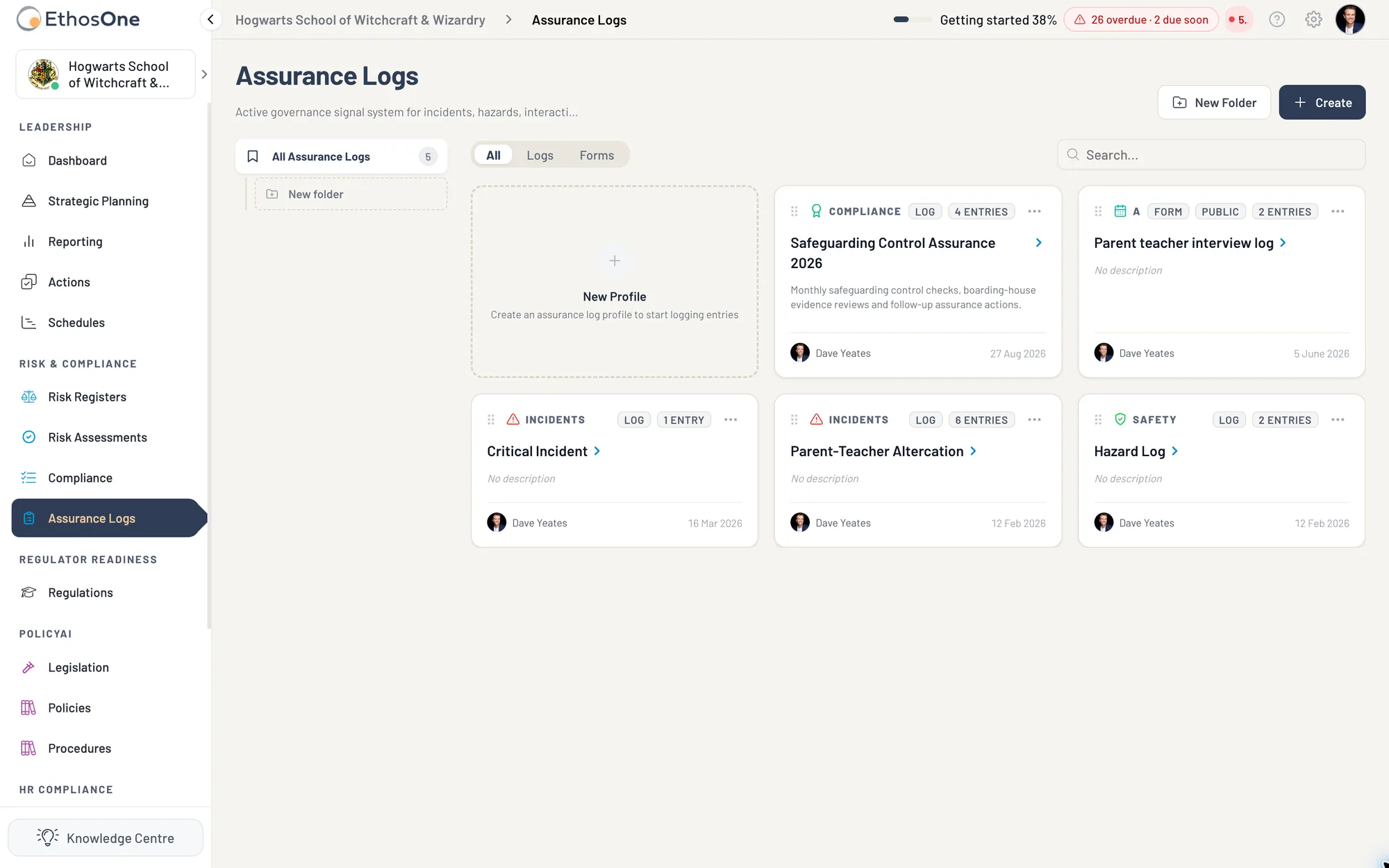
Sector Signal's August issue put the year's through-line plainly: regulators stopped assessing documents and started assessing the trail. A policy is a statement of intent; a trail is a record of conduct. For a school that means critical incidents, WHS events, near misses, injuries and routine assurance checks each need a register shaped to the school, with a history nobody can quietly rewrite. In EthosOne an assurance lead builds a log profile with typed fields, chooses an internal Assurance Log or a public Form, and every entry receives a profile-derived identifier and a history of every edit: the event, who made it, when, and the values before and after. Reminders and expiry sit on any entry, and a public form lets a contractor, parent or visitor submit without seeing inside. That is assurance logs and forms.
- 2025,require psychosocial hazards
- 2025managing psychosocial hazards
- Stored in AustraliaAWS Sydney and Melbourne, one database per school
- AI stays in the country tooAmazon Bedrock; never trained on your content
- Published, not describedTrust Centre · ISMS policy · How we handle your data
Enforceable undertakings, and what a regulator looks for
The August issue (3 August 2026) reported four matters with one fact pattern: South Australia laid its first industrial manslaughter charges over a death where, on the allegations, an external technician had put a safety concern in writing two days beforehand; a Melbourne builder was fined $400,000 for failing to have a competent person verify someone else's welding documentation; Fenner Dunlop was fined $212,500 after SafeWork NSW noted the risk controls "are well known"; and Central Queensland University signed an Enforceable Undertaking after self-reporting underpayments caused by payroll configuration and manual processes. In the safety matters the control existed; nobody checked it on the day, and nobody could show that they had. Two turned on failing to verify a third party's documents, which is the position a school occupies during capital works or grounds maintenance. It is Stop assessing documents. Start managing the trail.
Issue 07 (24 August 2026) put it as "the rules did not change, the checking did", reporting that regulators are resourced to look and publishing what they find, and that the findings are things a school believes it has and cannot usually evidence on demand; it is The rules did not change. The checking did. The pattern began early: issue 01 (3 May 2026) covered reportable conduct schemes and state reporting obligations stacking up, in What the past fortnight tells us about risk in independent schools, and issue 03 (31 May 2026) reported three regulators saying schools cannot outsource accountability, in The end of the outsourced school.
Where an undertaking or a regulator engagement follows a WHS incident, EthosOne provides the system that evidences its commitments over time: each commitment tracked as an obligation with a named owner, evidence captured in the assurance logs as it happens, and progress reported on the cadence the undertaking sets, with the school's legal adviser in the loop. We do not give legal advice.

Group-wide roll-outs
Business managers tell us the assessment for the camp was excellent and the one for the woodwork room was a photocopy from another school. WHS leads tell us they can write a good assessment; what they cannot do alone is get it to every site, keep it current and show the record when asked. A group-wide roll-out sets one standard for assessments, hazards and forms, adopted at every campus: the library is built once and shared, each site assesses its own activities against it, and the group sees which assessments are approved, which are in draft and which activities have none. Staff complete forms from a phone at the activity, feeding assurance logs that preserve who recorded what and when. The programme is delivered by EthosOne with the school's WHS lead, who owns the standard and the sign-off, and with incident response and enforceable undertakings it is scoped with you on Responding to WHS obligations.

The pages in this guide
The risk assessment is the control
The story.
Responding to WHS obligations
The programme for roll-outs, incidents and undertakings.

School risk assessments
Hazards, responses, approval and the Bowtie report.
Duty of care excursion management
The nine-step workspace.
Assurance logs and forms
Incident and near-miss registers with a history and public forms.
Risk Assessment Template
Free, one activity assessed and signed, with a library of twenty controls

School hazard assessment template
Free hazard register and bow-tie worksheet.
The PlanCheckGo transition
What excursion oversight should do.
Camp and excursion management tools
Camps as a governance function.

Sector Signal issue 01, 3 May 2026
Reportable conduct and state reporting.
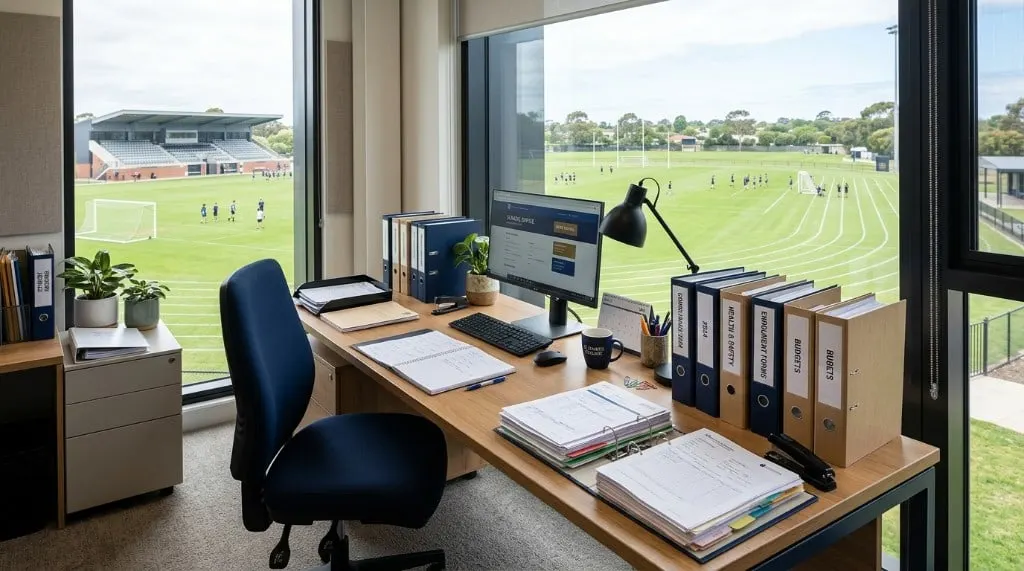
Sector Signal issue 02, 17 May 2026
The compliance cascade.
Sector Signal issue 03, 31 May 2026
The end of the outsourced school.

Sector Signal, 14 June 2026
Psychosocial safety as a board risk.
Sector Signal issue 05, 12 July 2026
1 July moved the burden of proof.
Sector Signal issue 06, 3 August 2026
Prosecuted for the gap between the document and the day.

Sector Signal issue 07, 24 August 2026
The rules did not change, the checking did.
The seven we are asked every time.
Still weighing something up? Thirty minutes with us, on your own registers, answers the rest.
Get in contact01What is the difference between a risk register and a risk assessment?
A register is the school's list of strategic risks with ratings, owners and treatments, kept for board oversight. A risk assessment is the analysis of one activity, site or item, with its hazards, safeguards and sign-off. Regulators look for the assessment that matched the activity, and EthosOne keeps the two in separate modules.
02Do we need a risk assessment for every excursion?
A school's WHS duties require it to manage the risks of each activity it runs, and an excursion or camp is the clearest case. Most state guidelines and school insurers expect an activity-specific assessment approved before departure.
03Are psychosocial hazards a WHS matter for a school?
As Sector Signal reports it, yes. From December 2025 managing psychosocial hazards is a core work-safety obligation, bullying is named as a psychosocial hazard, and in NSW the code of practice became a legal compliance benchmark on 1 July 2026. The issues describe the expectation as a register with a named owner and regular board reporting, not a folder.
04What does a regulator look for after an incident?
In the matters Sector Signal followed in August 2026, the control existed and nobody could show it had been checked on the day. Principals tell us the first request after an incident is for the assessment, and the second is for proof the staff involved had seen it.
05Can AI write a school risk assessment?
It can draft one from a description of the activity, with hazards, safeguards and bow-tie text, using your school's context. A person still selects, edits and approves. Frontier AI, hosted via Amazon Bedrock in AWS Sydney.
06How long does it take to get started?
Blackfriars Priory School went from demo to live in under a month. Risk assessments, camps and excursions and assurance logs are all part of the Risk and Compliance Focus module at $5,000 a year on top of Core, with no per-user fees.
07WHS Obligations for Schools: The Complete Guide, in full: what does it cover?
The risk register is the board's summary of the school's exposure; the risk assessment for a specific activity, excursion, camp or site is the operational control, the document that shows the hazards were identified, the controls chosen and the people on the ground knew what to do. Since 1 July 2026, section 26A of the WHS Act 2011 (NSW) has made every approved code of practice a legal compliance benchmark.

We would be glad to show youan assessment drafted from an activity description
WHS obligations for schools: the register, the assessment that matched the activity, hazards, incidents and the trail.