








The board year: how a school board's meetings, packs and decisions run as one cycle
A school board's year is a rhythm rather than a series of events: a standing agenda, a handful of meetings, the sub-committees between them, a pack for each.

We would be glad to start with a presentation to your board.
The board year is the cycle an independent school board runs on: most boards meet around six times a year
With finance and risk sub-committees in between, against a standing agenda and a reporting calendar that sets the standing items for each meeting and the governance obligations that fall due through the year.
The year as a cycle
Independent school boards are mostly volunteers carrying real legal and fiduciary responsibilities: financial stewardship, risk oversight, compliance, child safety governance, strategic direction, and the appointment and supervision of the principal.
The pack
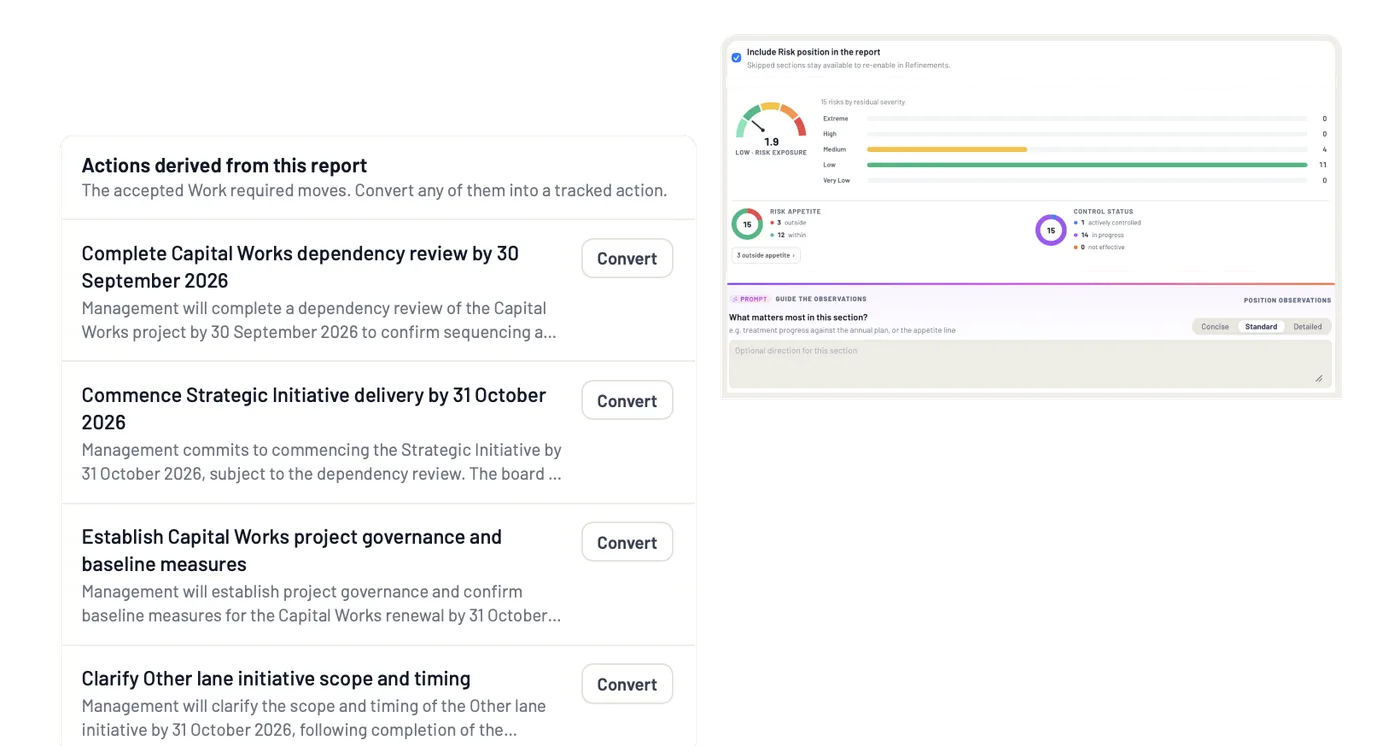
A good school board pack can be read in ten minutes, and the skill is leaving things out so the board sees the position, the exceptions and the few decisions that are genuinely theirs. The standing sections run front summary, strategy, objectives, risk position, emerging risks, compliance, policy updates, assurance, data and cyber, and the decisions and actions register, each opening with what the board must decide or note. In EthosOne a board report is created against a named governing body, reporting period and organisation scope; sections are allocated to the people who own the sources and contributed from live risk, compliance, policy and strategy records with the as-at time recorded; review checks for placeholders and contradictions; approval is tied to a content hash; and publication creates one immutable pack that never silently refreshes. The hub is school board governance software, and the one-page report that leads with the decision, then the position, the exceptions and the recommendation, is the free school board report template.

Run at any scale. From one campus to a diocese, with every entity reporting the same way.
- Switch
- from your existing platform, for a low cost
- 25
- policy domains help you make sense of the policies you have, and the ones you need
- Every regulator
- in Australia and New Zealand supported
- Safe
- data, processing and AI based in Sydney and Melbourne via AWS
Coverage spans the eight Australian states and territories, with Commonwealth law applying across all of them, and separately New Zealand. Domain figures come from the PolicyAI Research Atlas, refreshed weekly.
The meeting
A meeting runs from the evidence rather than from a folder. The secretary schedules a governed meeting with governing body, date, chair, secretary and recurrence, publishes one immutable agenda with presenters, time allocations and papers attached, and in session records attendance and declared conflicts while the quorum indicator recalculates. Until quorum is established, formal voting is unavailable and the product says so. From any item the secretary creates an action with an owner and a due date that carries its source meeting, and after the close the draft minutes are generated from the structured record, reviewed and approved. Principals tell us the weekend before a meeting used to go to assembling the same sections from the same six sources as last term; the point of a governed meeting is that the pack, the agenda and the minutes share one record. It is board meetings, resolutions and file vault.
Resolutions
A resolution is an exact formal proposition and its recorded outcome, and it is not a meeting note. Chairs tell us the question that catches them is not "did we decide?" but "what precisely did we decide, and when does it lapse?" The register keeps one row per resolution with reference, governing body, meeting, mover, seconder, the exact text, outcome (Carried, Lost, Withdrawn or Rescinded), votes, resulting actions and a review date, and an amendment or rescission is a later resolution linked to the original so the original text never changes. In EthosOne the proposed text is fixed before the vote opens, the meeting decision and the register entry share one identity, and time-bound decisions surface in upcoming governance work before they expire. The free register, seeded with thirteen resolutions a school board typically makes in a year, is the school board resolutions template.

The risk appetite conversation
A risk appetite statement is the board saying, in advance, how much risk it is willing to carry in each category, so management knows where the line is before a decision rather than after. Without one, every risk is judged on the day by whoever is in the room; with one, management acts inside agreed limits and escalates only what crosses them. Appetite is how much risk the board wants to take in a category; tolerance is the boundary that, once crossed, requires escalation. The conversation belongs early in the board year, because the register is then read against the appetite at every meeting rather than once a year, and a residual score that sits above appetite says so. The free appetite statement by category with tolerances and escalation triggers, and the one-page risk position, are the school risk appetite statement template.
The registration review in the board's calendar
The review is the one governance obligation that arrives on a date the board knows years ahead, and it belongs in the reporting calendar from the day the date is known rather than in the term it falls due. What the board needs from it is the material gaps and the decisions, without criterion overload: which standards are satisfied, partial or a gap, who owns each gap, and the runway to the review. Our advisory practice works with boards on exactly this, mapping the school's obligations to the evidence it already holds, finding the gaps while there is time to close them, and setting up the self-assessment so the next review is a confirmation rather than a scramble. That, with board reporting, risk practice and AI governance, is the board and risk advisory service, which runs with or without a licence and across one term.
What a chair should see each meeting
Accessibility in a board context does not mean simplification; it means clarity. A director should be able to understand the risk posture quickly, see policy currency without searching, see compliance status structured and clear, trace actions and keep context between meetings. A chair's view each meeting is therefore short: the risk position against appetite with any residual above it named, the exceptions in compliance and policy, the open actions from prior resolutions, the file each paper relies on in its exact governed version, and the few decisions being asked. That last part matters for the file: a policy PDF attached to three meetings with nobody sure which is current is the failure the file vault exists to end, with immutable versions, linked records and an activity ledger of who uploaded, downloaded or accessed what. The chain from register to decision, link by link, is set out in board-ready governance, and the case for scaffolding first-time directors is made in Accessibility for private school boards.
- Stored in AustraliaAWS Sydney and Melbourne, one database per school
- AI stays in the country tooAmazon Bedrock; never trained on your content
- Published, not describedTrust Centre · ISMS policy · How we handle your data
The board and management boundary
The board governs; the principal leads operations. When governance information is fragmented, principals compensate with time and energy, reporting becomes narrative-heavy, context has to be re-explained each meeting, and boards drift into operational detail because they cannot see the status between meetings. None of that reflects poor leadership; it reflects insufficient infrastructure. A clear boundary is drawn in the pack itself, which separates what the board decides from what management reports, and in a reporting rhythm that gives the board live visibility between meetings so the reactive request stops. Principals tell us the shift is from assembling documentation to interpreting insight. How that lands for the principal is in School board engagement for principals, and why spreadsheets, shared drives and goodwill are no longer enough is in Governance infrastructure for independent schools.

Two ways to find out where you stand
The free Your next five edits drafts five paragraphs against the obligations of the school's State, with the provision beside each one, no login. For a board with a meeting, an audit or a registration deadline in view, the Board-Ready Audit is a governance diagnostic delivered partly in-platform and partly with expert facilitation, credited in full against Core on upgrade. Either is a fair first step before the board year begins, and what a board gets from EthosOne across the year is summarised on for school boards.

The pages in this guide
School board governance software
The Board Engagement hub; packs, meetings, resolutions, vault and committees.
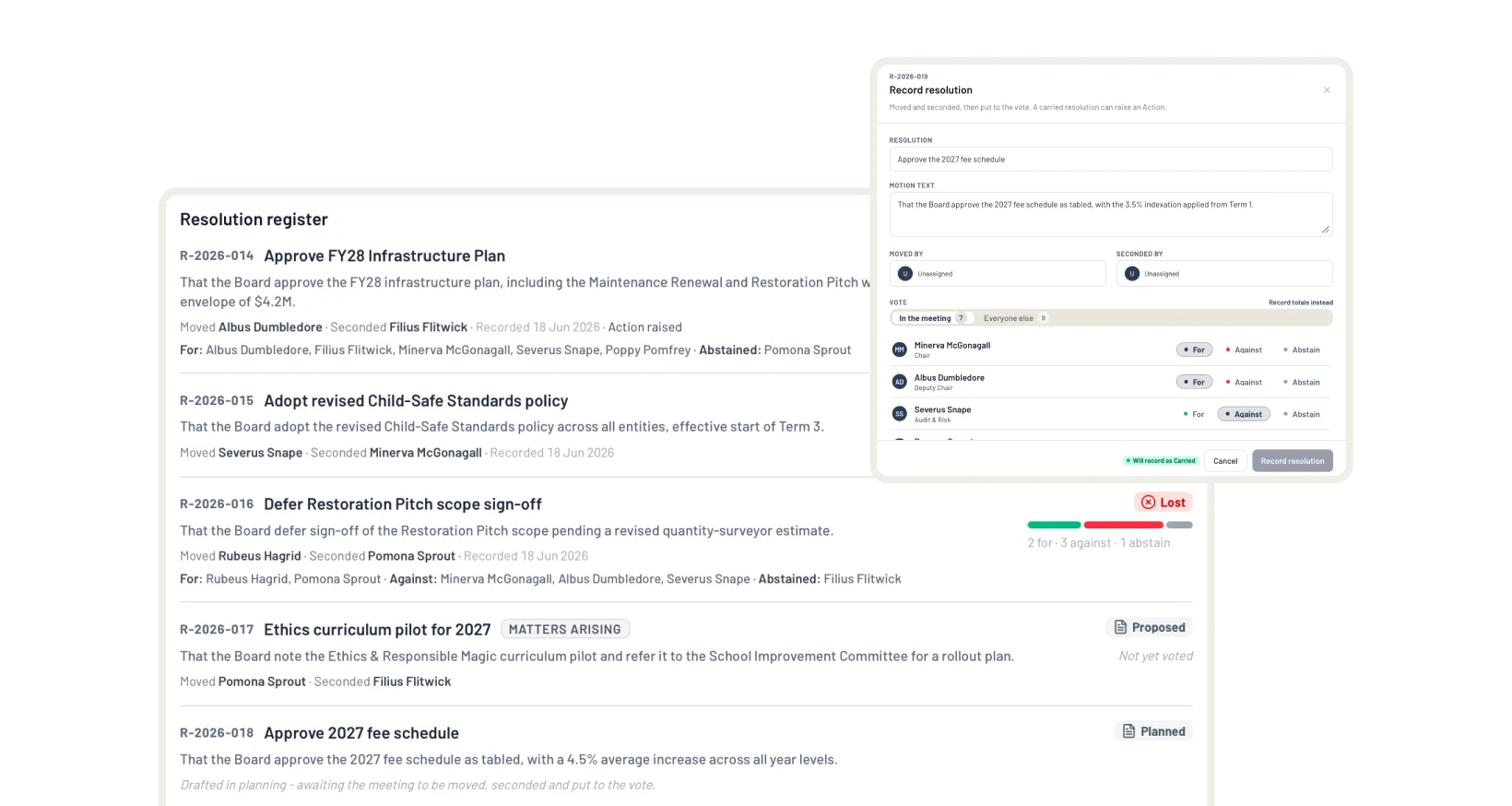
Board meetings, resolutions and file vault
The governed meeting from agenda to approved minutes.
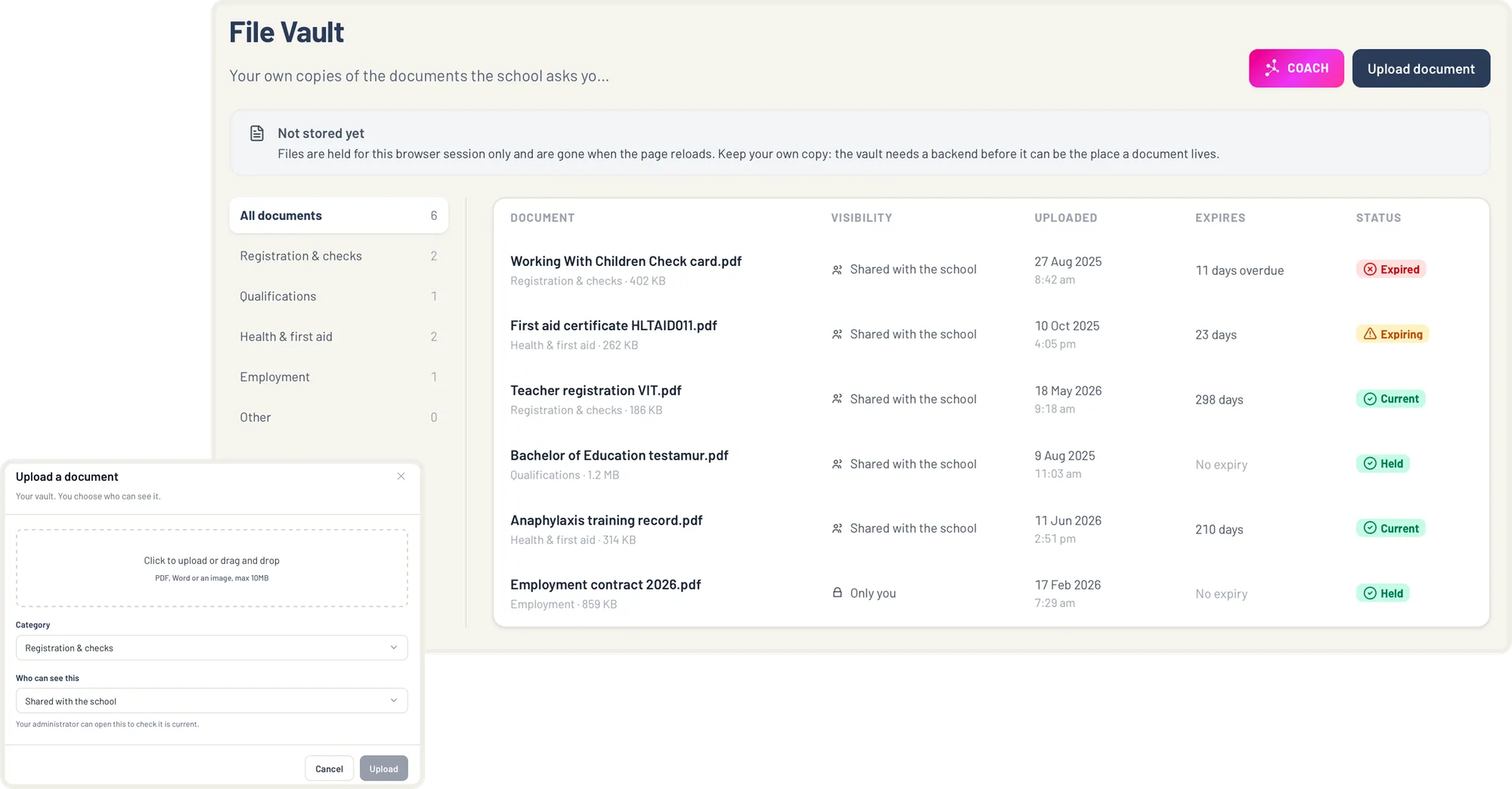
File vault
Board papers and evidence stored once, versioned and access-checked.

Board-ready governance
The accountability spine from register to decision.

For school boards
What a board gets, at a published price.
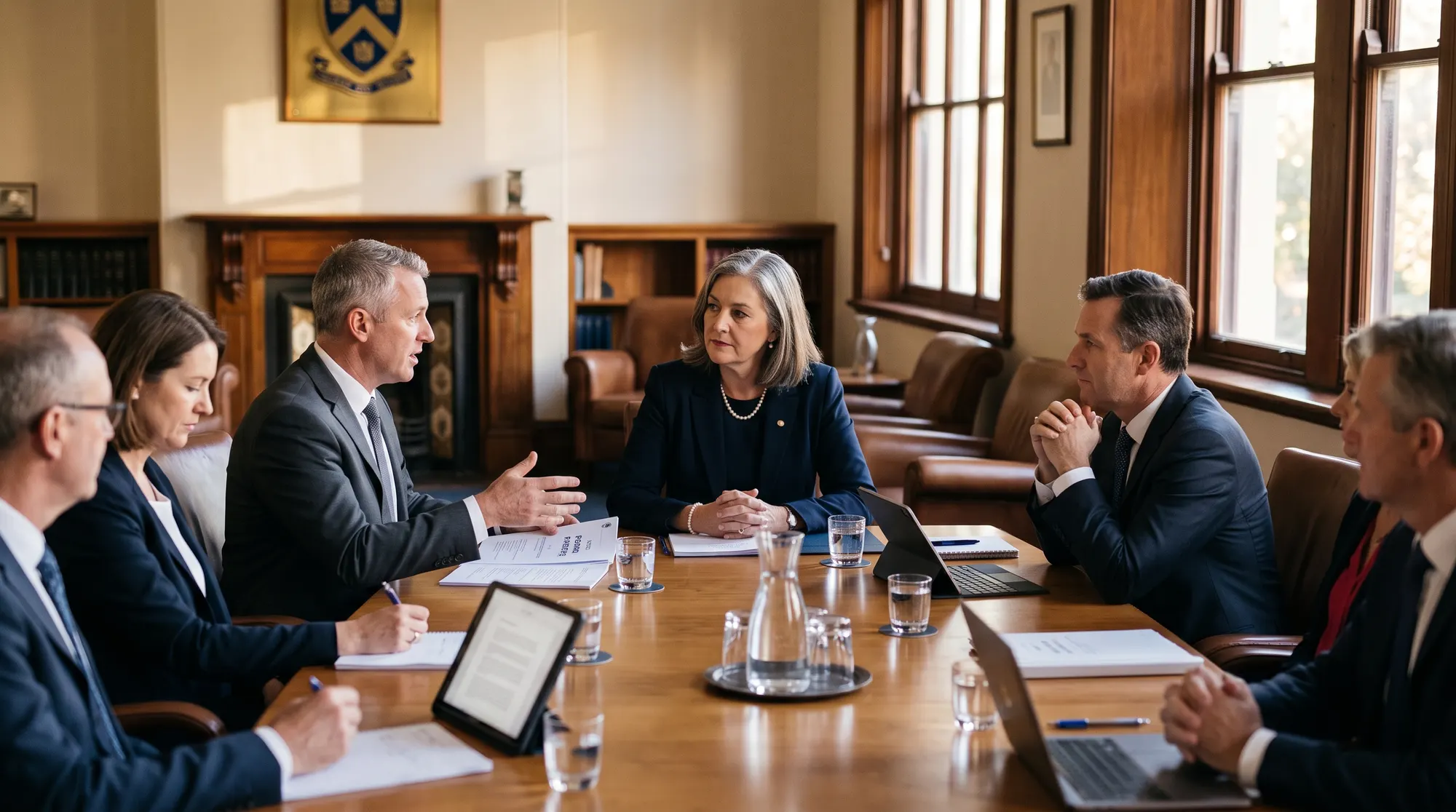
Board and risk advisory
The consulting service on reporting, risk, review and AI.

School board pack template
Pack template, board and reporting calendars, standing agenda.
School board report template
The one-page report and the board-versus-management boundary guide.
School board resolutions template
The register with thirteen seeded resolutions.

School risk appetite statement template
Appetite by category and the one-page position.
Board management for independent schools
From volunteers to structured governance.
School board engagement for principals
Roles, rhythm and reduced tension.

Accessibility for private school boards
Governance first-time directors can use.
Governance infrastructure for independent schools
Why goodwill is not enough.
Try Draft with AI.
Regulators rarely ask a school for a new document. They ask for a paragraph in one the school already holds. Answer five questions and watch PolicyAI draft each paragraph against the provision it rests on, with your school's name written in.

Board-Ready Audit
The facilitated governance diagnostic, credited against Core.
The eight we are asked every time.
Still weighing something up? Thirty minutes with us, on your own registers, answers the rest.
Take the AI maturity assessment01How often should a school board meet, and on what?
Most independent school boards meet around six times a year, with finance and risk sub-committees in between. A reporting calendar sets the standing items for each meeting and the governance obligations that fall due through the year, so the board stays ahead of its responsibilities.
02What should a school board pack contain?
A front summary on one page, then strategy, objectives, risk position, emerging risks, compliance, policy updates, assurance, data and cyber, and the decisions and actions register. Each section opens with what the board must decide or note, and a director should be able to read the whole pack in ten minutes.
03What is the difference between a resolution and a minute?
The minutes record the meeting: who attended, what was discussed and what was decided. A resolution is the exact formal proposition that was voted on and its outcome. The minutes reference the resolution by number and the register references the meeting, so a reader can go from either to the other.
04Can a published pack change after the board has read it?
No. Publication makes the contents an immutable version, approved against a content hash with its sources and as-at time recorded. Corrections go into a later version, and History keeps both.
05Does every board member need a paid seat?
No. Board Engagement is a Premium module at $10,000 a year on top of Core at $15,000, with no per-user fees and every module $45,000 a year all in, so every director, committee member and contributor can have a login. Licences run from January 2027.
06Why should the board set appetite rather than just review risks?
Without a stated appetite, every risk is judged on the day by whoever is in the room. With one, management can act inside agreed limits and escalate only what crosses them, and the board sees the current position against its stated appetite at every meeting.
07Is our board data kept in Australia?
Yes. Databases and infrastructure are onshore, and frontier AI is hosted via Amazon Bedrock in AWS Sydney. The helper drafts resolution wording and minutes from the meeting's structured facts; the approval decision is human and the helper cannot alter a published pack.
08The Board Year: A Governance Calendar for School Boards, in full: what does it cover?
Each meeting has a pack a director can read in ten minutes, every decision is a resolution in its exact words, and the risk register is read against an appetite the board set in advance. EthosOne's Board Engagement module, a Premium module at $10,000 a year with no per-user fees, holds the packs, meetings, resolutions and file vault in one place.

What are the AI paragraphs you are currently missing from your policies? Watch how we do it.
Free, under ten minutes, and yours to keep whether or not you talk to us.
“It meets all of the real frustrations of business directors in one place.”


“School governance and risk is a complex area without a clear solution.”



We would be glad to startwith a presentation to your board.
The board year for independent schools: standing agenda, the pack, the meeting, resolutions, appetite and the review.