










School policy management, connected to the law
Know what your policies actually cover.
PolicyAI reads your policy library against the law that binds your school, names the duties nothing covers yet, and drafts the missing sections with the provision beside each one.
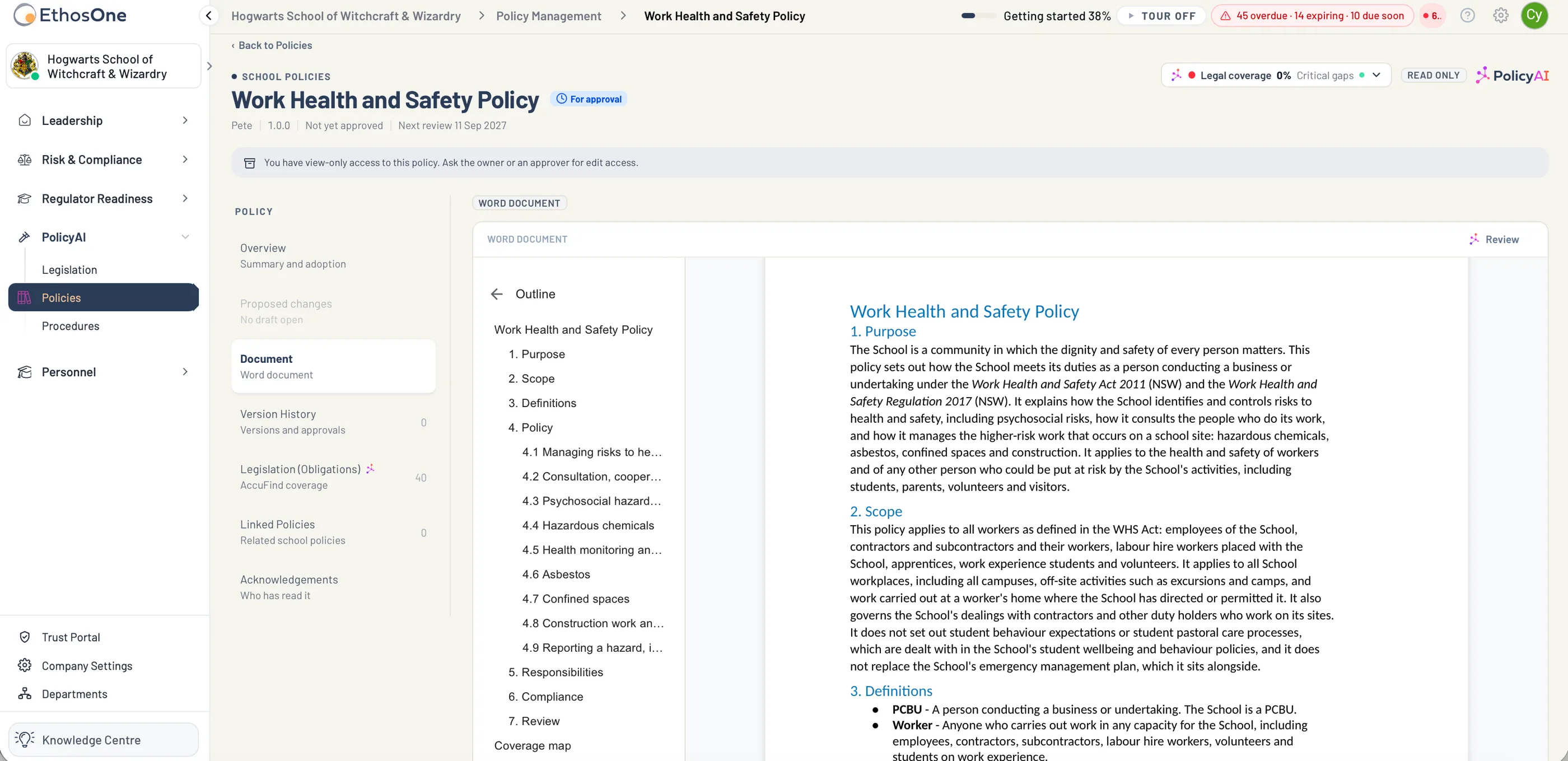
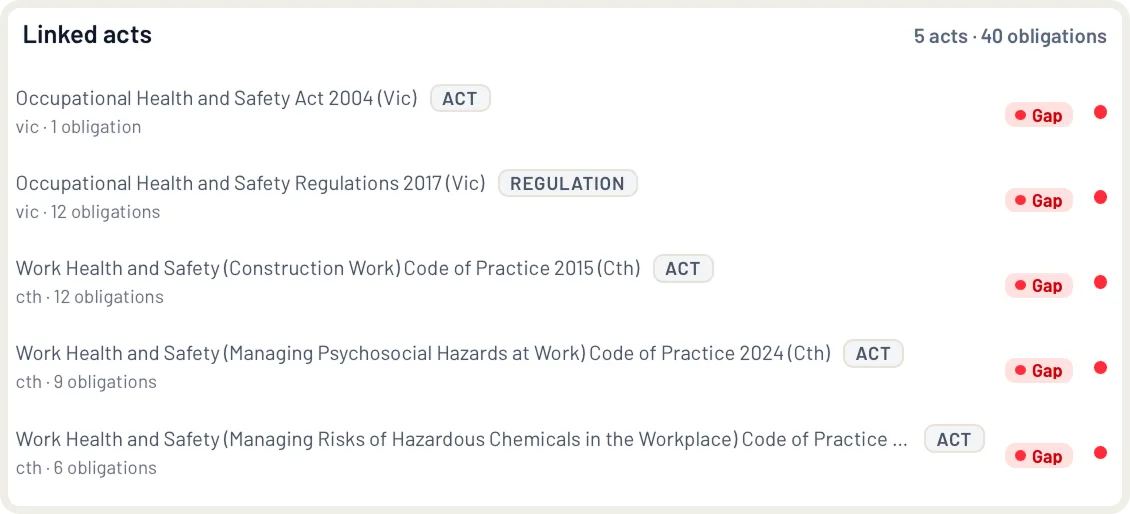
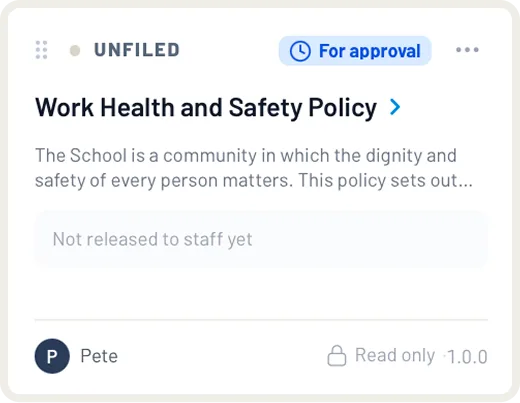
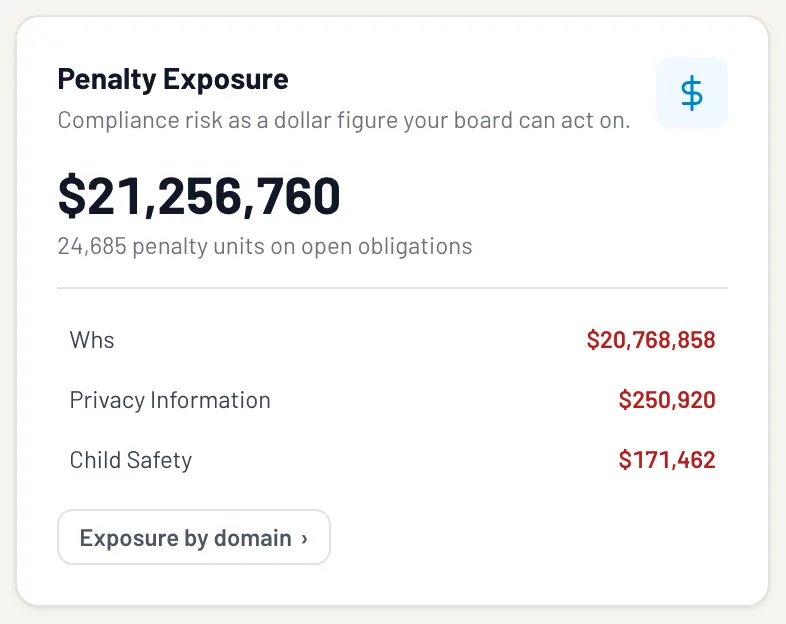
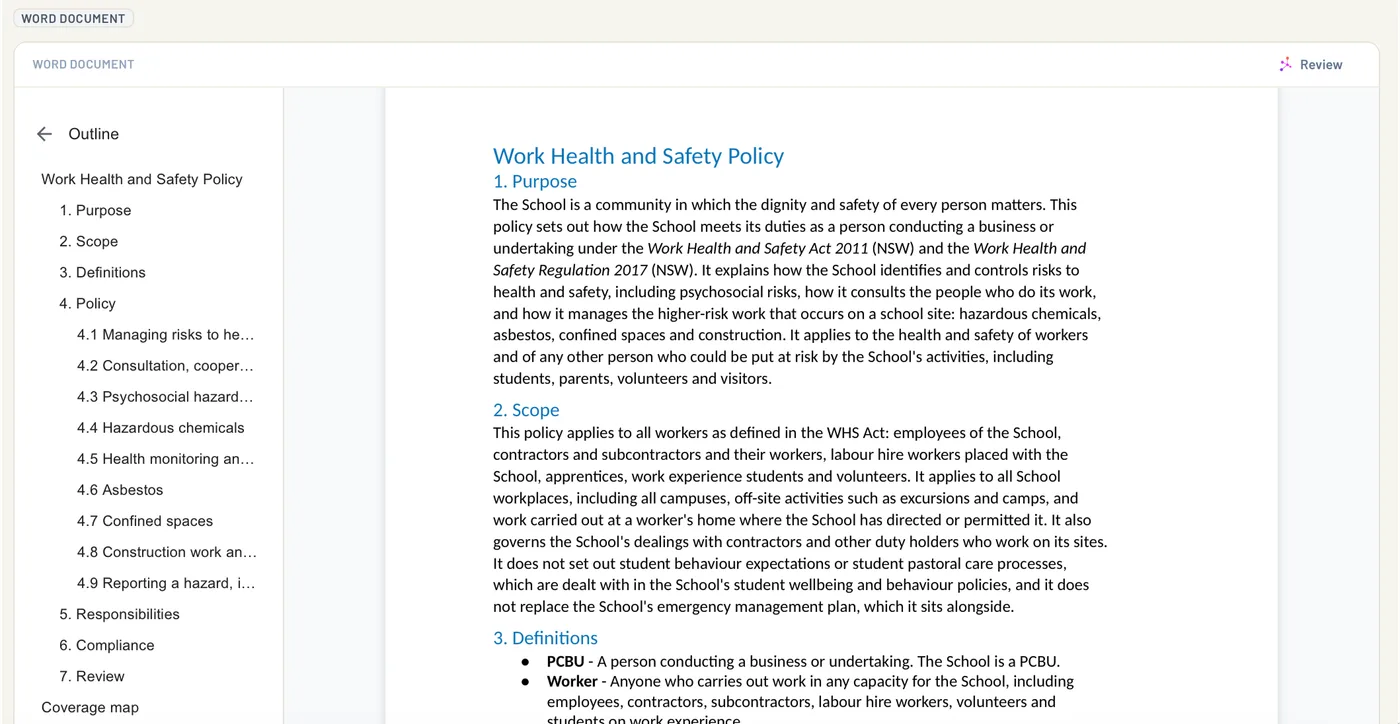
Real captures · PolicyAI · demo school.
PolicyAI is EthosOne's compliance intelligence for a school's policy library, in beta from September 2026.
It holds the Acts, regulations and obligations that apply to a school, scoped by a profile of country, state, sector and school type, and reads the policy library against them.
The problem
The library is a folder, not a position
A school can list its policies. It cannot usually say which duty each one answers, which duties nothing answers, or who last decided that a policy still covered what it claimed to. The folder holds documents. A regulator asks about obligations.
The law moves and the news arrives sideways
A regulation changed in March. Somebody read the newsletter in April. A colleague mentions it at a network meeting in September as though everyone knew. Somewhere in that year the policy still has to be true, and the person who owns the response has to find out from something better than a hallway.
Fluent is not the same as checkable
Somebody demonstrates an AI tool that answers a compliance question with a citation, and the room nods. Then a business manager asks where a particular number came from, and the answer is a paraphrase of a paraphrase. The question underneath is not whether the tool is clever. It is whether anyone can check it before the board is told.
PolicyAI works inside the wider school policy management lifecycle, with accountable people retaining review and approval.

What we keep hearing
It is the Thursday before a registration visit. The policy folder on the shared drive holds forty-one documents, a third of them last reviewed by someone who has since left, and the child safety policy was opened in March and not since. The question the assessor asks is not whether the school has a policy. It is which obligation each policy answers, and who signed that off. Nobody in the building can answer it from the folder.
This is the room where they can.
Nine views, one picture. Each one reads from the same live records.
 01
01Legislative intelligence
A guided profile records the country, state, sector, school type and operating conditions, and the applicable catalogue follows what you save. Choose which national and state catalogues are in scope, with source counts beside each.
 02
02Auto-drafted policies
Tell PolicyAI which school you are and it drafts the policy against the provisions it rests on, with the provision beside each paragraph and the school’s own name written in. What arrives is a version to approve or send back, not a template to reconcile by hand, and the source of every paragraph is on the page beside it.
 03
03Pre-drafted changes
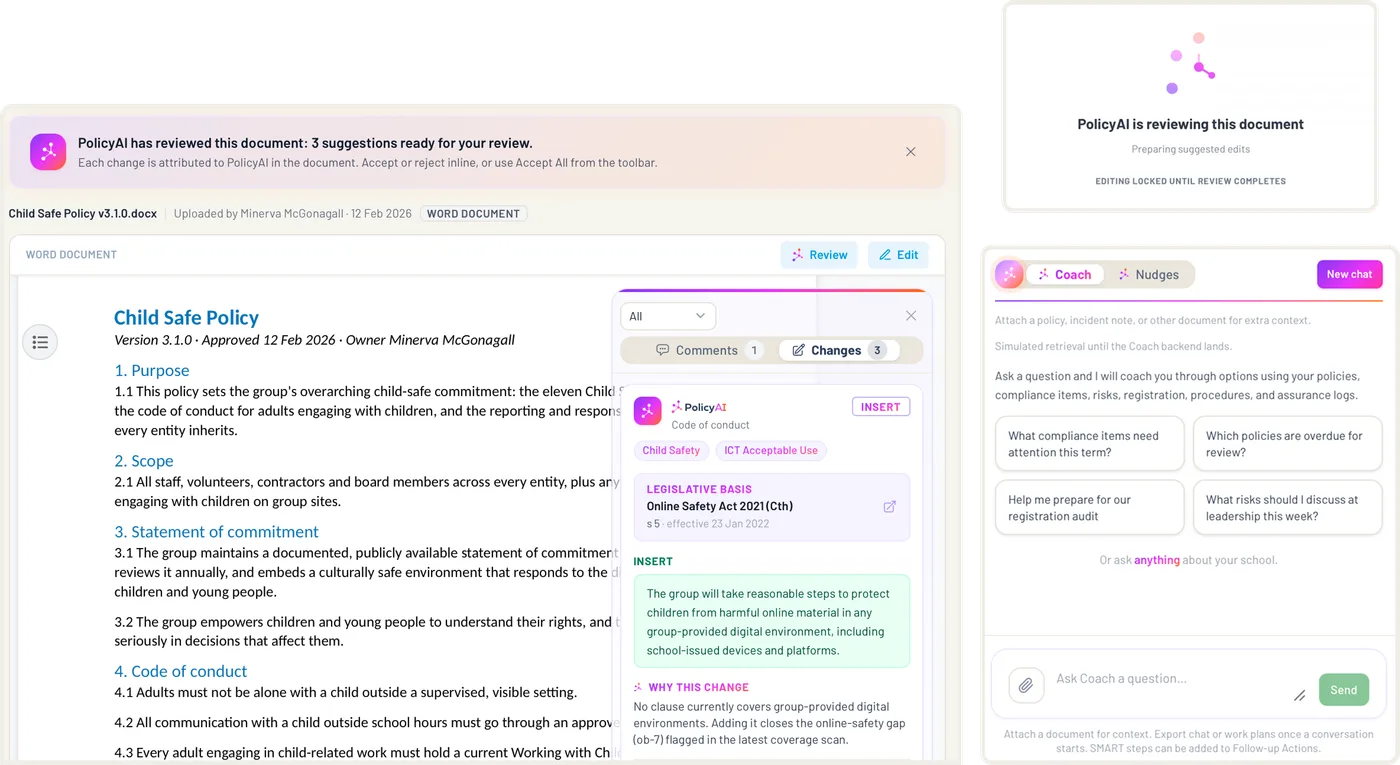
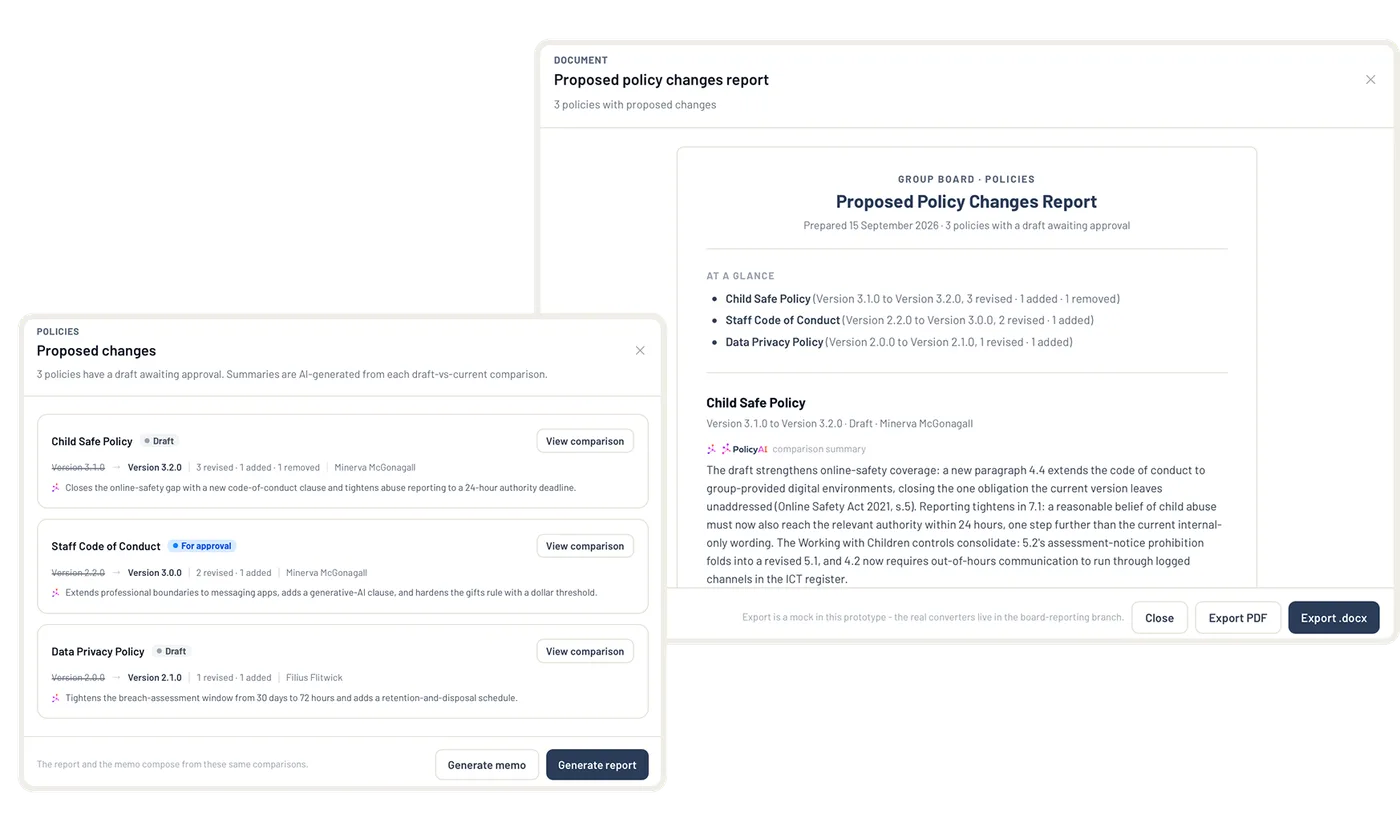
When an obligation moves, the paragraph that answers it arrives already rewritten against the new wording, with the old version kept beside it. The comparison is the starting point rather than the amendment, so the question a leader answers is whether to accept the change, not what the change was.
 04
04Policy planning
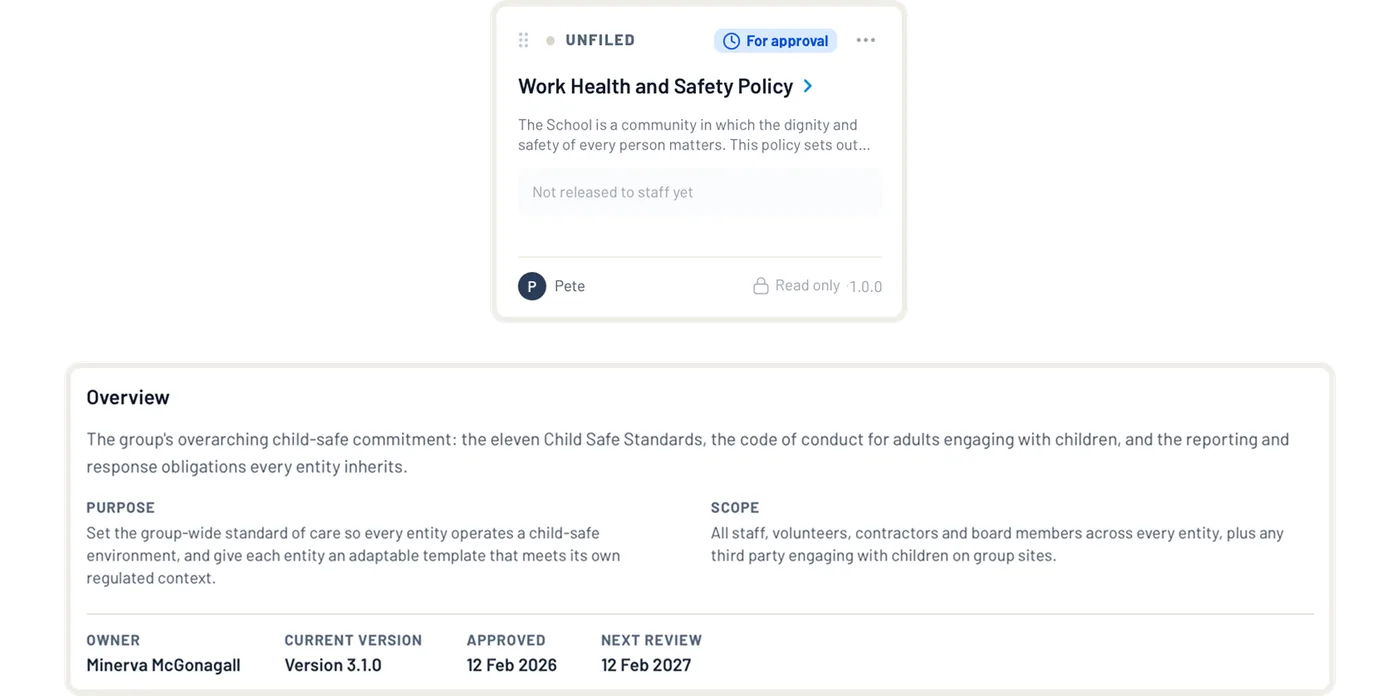
The policies the school is expected to hold, each with its owner, its next review date and the obligations that depend on it, read forward as a plan rather than backwards as a register. A review that is coming is visible while there is still time to do it properly.
 05
05Upcoming changes
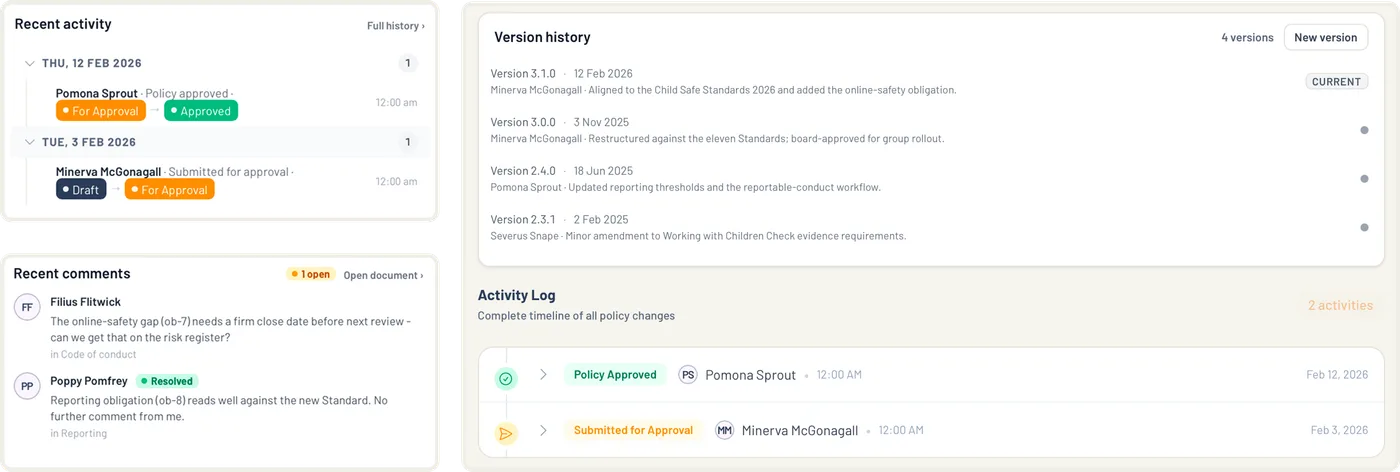
Changes that have passed but are not yet in force, with the date they commence and the policies they will touch. The work is visible before the obligation lands, so a school prepares for a date it already knows rather than discovering it after.
 06
06Ask Policy AI
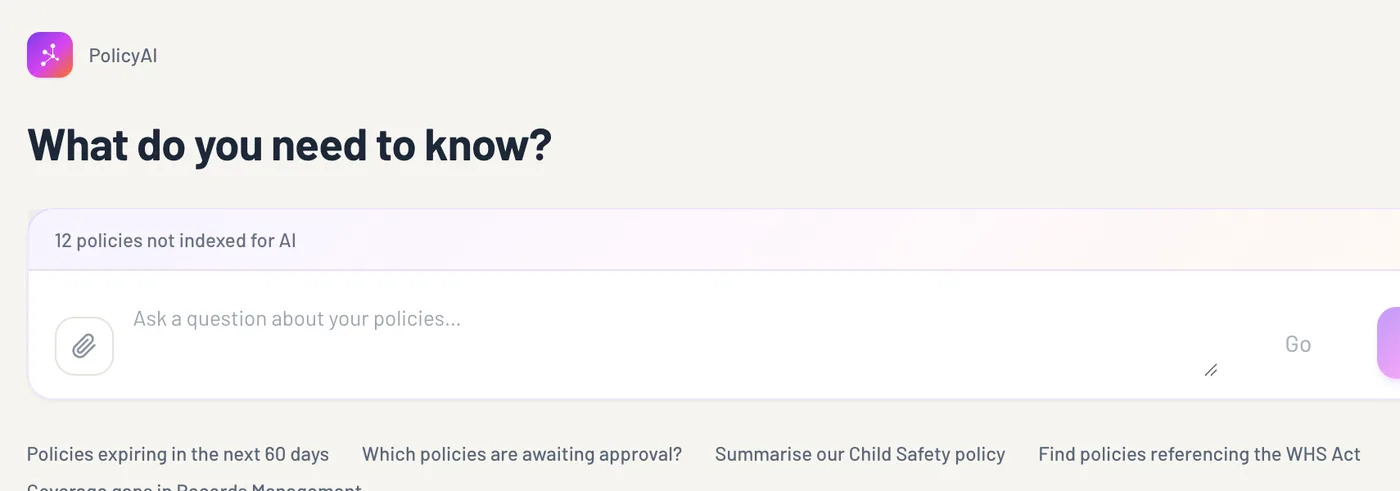
Plain-language questions put to the whole library instead of opening documents one at a time. Which policies are awaiting approval, which expire in the next sixty days, which reference the Work Health and Safety Act, what the child safety policy actually says.
 07
07Duties across 25 domains
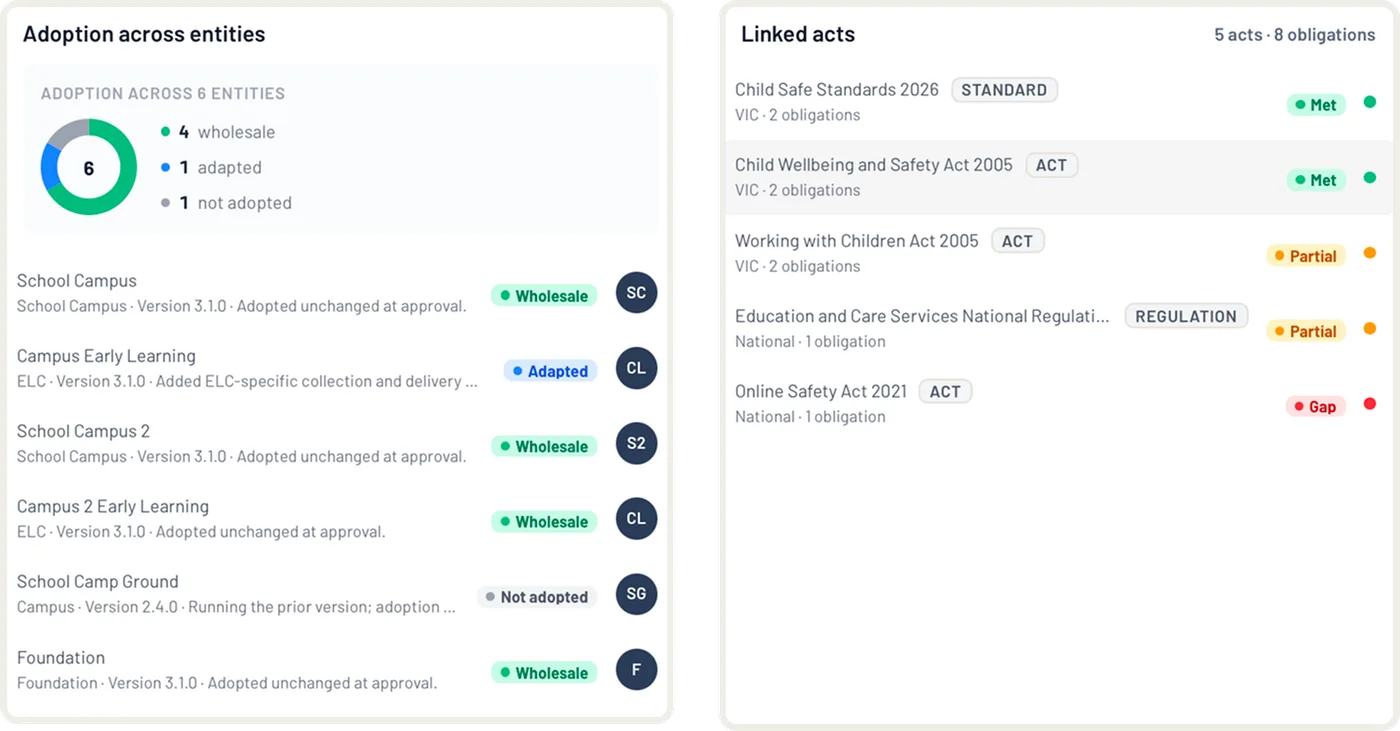
Obligations are organised into governable operating domains, each card carrying its grade, coverage and exposure. Within a domain, pick an Act and filter its obligations by status, verb and owner.
 08
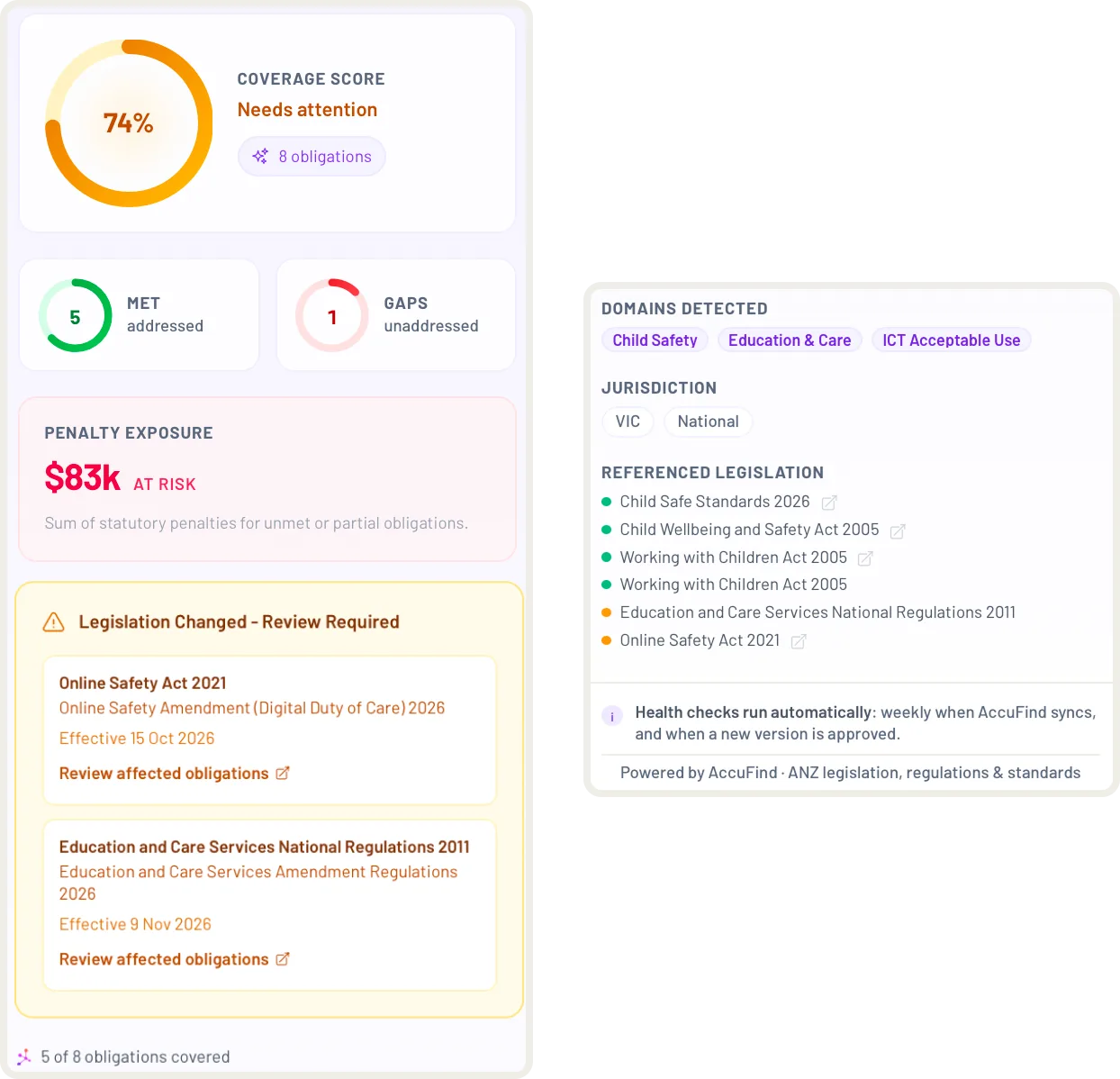
08Health check
Guided questions assess a domain's completeness and quality, with a score and an explanation of how it was reached. The output is a review record and an improvement queue, and it is careful never to pretend legal certainty.
 09
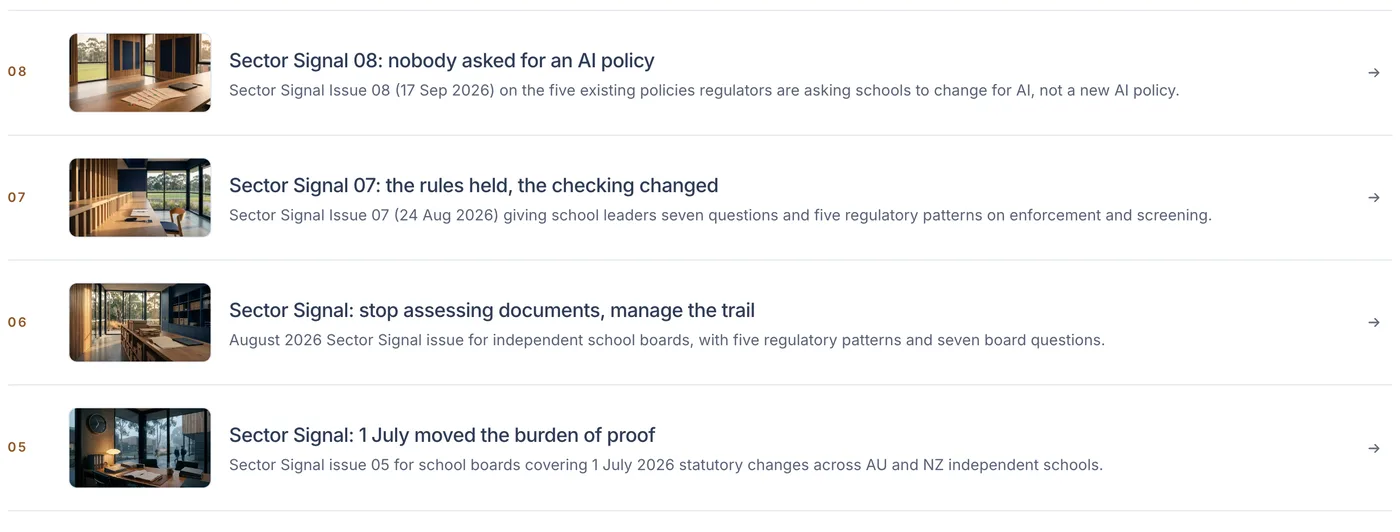
09Legislative change
Our team watches legislative change for the sector and reports it in the Sector Signal: what moved and what it means for schools, read on the web and emailed to customers. The corpus behind PolicyAI is updated annually.
What it does not do
- It does not give legal advice, and it does not stand in for the school's own advisers on a contested question.
- It does not accept a policy as covering a duty without the wording that does it and a named reviewer behind it.
- It does not present a modelled figure as the school's total exposure. Where a dollar figure is shown it is the priceable portion of exposure, and the page says which duties it covers.
- It does not dress a policy expectation up as legislation. Uniforms and mobile phones are policy-evidenced views, never statutes.
- It does not invent an obligation. No duty exists in the corpus without a pinpoint provision in a named consolidated instrument.

It meets all of the real frustrations of business directors in one place.
Nick MillerDirector of Business, Blackfriars Priory School
School governance and risk is a complex area without a clear solution.
David RuggieroPrincipal, Blackfriars Priory School
Demo to live in under a month. One South Australian school, one term, board-ready.
Blackfriars Priory SchoolCase study
The seven we are asked every time.
Still weighing something up? Thirty minutes with us, on your own registers, answers the rest.
Try Draft with AI.01What is PolicyAI?
EthosOne's compliance intelligence for a school's policy library, in beta from September 2026. It holds the obligations that apply to the school, reads the library against them, scores each as met, partial or unmet, watches for legislative change and drafts the sections a policy is missing.
02What is AccuFind, and is it a separate product I need to buy?
EthosOne's legislative intelligence partner: a sovereign Australian legal-data store holding the consolidated legislation of the Commonwealth, every state and territory, and New Zealand as versioned, addressable data. It is the legislative layer underneath EthosOne, not a separate product. Schools licence EthosOne, and the contract, data and support stay with EthosOne.
03Which jurisdictions are covered?
New South Wales, the ACT, Victoria, Queensland, Tasmania, South Australia, the Northern Territory and Western Australia, with Commonwealth law across all eight, and New Zealand as a separate national jurisdiction. Duties are resolved to your school's jurisdiction and the kind of school it is.
04Is this legal advice?
No. It is legislative intelligence: what the law says and where it says it, with your school's own applicability decision recorded beside it, who reviewed it, why, when and when it is next due. What to do about it in your school is a decision for your leadership, and where it is genuinely contested, for your lawyer.
05What does 99.56 per cent verified mean?
For each in-scope duty, the provision at its address was fetched from the legal store, the duty's own words were found in it, and the instrument's identity was confirmed separately. The remainder is named individually with reasons rather than hidden in a rounding.
06Could the AI invent an obligation?
No duty exists in the corpus without a pinpoint provision in a named consolidated instrument, and every row is re-verified against that provision. A row that cannot be verified is marked, not published as fact.
07PolicyAI, in full: what does it cover?
Coverage is scored domain by domain as met, partial or unmet, every finding points back to the provision it came from, legislative change is watched by our team and reported in the Sector Signal, and the section a policy is missing is drafted for a named person to review. It runs on AccuFind legislative intelligence, the consolidated primary-source law of the Commonwealth, every Australian state and territory, and New Zealand, processed in AWS Sydney, and EthosOne holds the exclusive partnership on the school-facing legislative landscape built from that store. Every duty is keyed to a pinpoint provision and 99.56 per cent are verified against the text of the law. PolicyAI is a Premium module at $10,000 a year on top of Core, inside the $45,000 cap, for principals, business managers and boards.
Run at any scale. From one campus to a diocese, with every entity reporting the same way.
- Switch
- from your existing platform, for a low cost
- 25
- policy domains help you make sense of the policies you have, and the ones you need
- Every regulator
- in Australia and New Zealand supported
- Safe
- data, processing and AI based in Sydney and Melbourne via AWS
Coverage spans the eight Australian states and territories, with Commonwealth law applying across all of them, and separately New Zealand. Domain figures come from the PolicyAI Research Atlas.
- Stored in AustraliaAWS Sydney and Melbourne, one database per school
- AI stays in the country tooHosted in Sydney and Melbourne; never trained on your content
- Published, not describedOur policies in the Trust Centre · How we handle your data
PolicyAI answering the prompt “Draft me an AI Acceptable Use Policy.”, then working through: Reading the AI-engaged obligations; Matching privacy, records, child safety; Drafting against your existing library.
Solutions for every school’s AI challenge.
There is no AI-specific legislation in force in Australia or New Zealand. The duties your school already carries are the ones AI engages.
Governing AI, before your board asks again.
“The board asked what our position on AI is, and we did not have one.”
An AI policy is not a new rulebook, it is a lens over duties your school already carries: privacy, records, discrimination and child safety, engaged by an AI-shaped set of facts. Which is why a downloaded template does not survive contact with a regulator.
We have tagged the duties AI activity in a school engages, so the conversation starts from the obligations you already hold rather than from a blank page. Almost none of them say “AI”.
Try Draft with AI.Five paragraphs against the obligations of your State, with the provision beside each. Free, no login.