



The principal isn't the problem. The role is.
Australian principals now work 53.9 hours a week, and more than half seriously considered leaving last year. The sector's response has mostly been to look after the person.

I spent the last decade advising leadership teams at organisations like BHP and Walmart through large transformations. When I started working with school leaders, I expected the pressure to be smaller. It isn't smaller. It's worse designed.
What the data is telling us
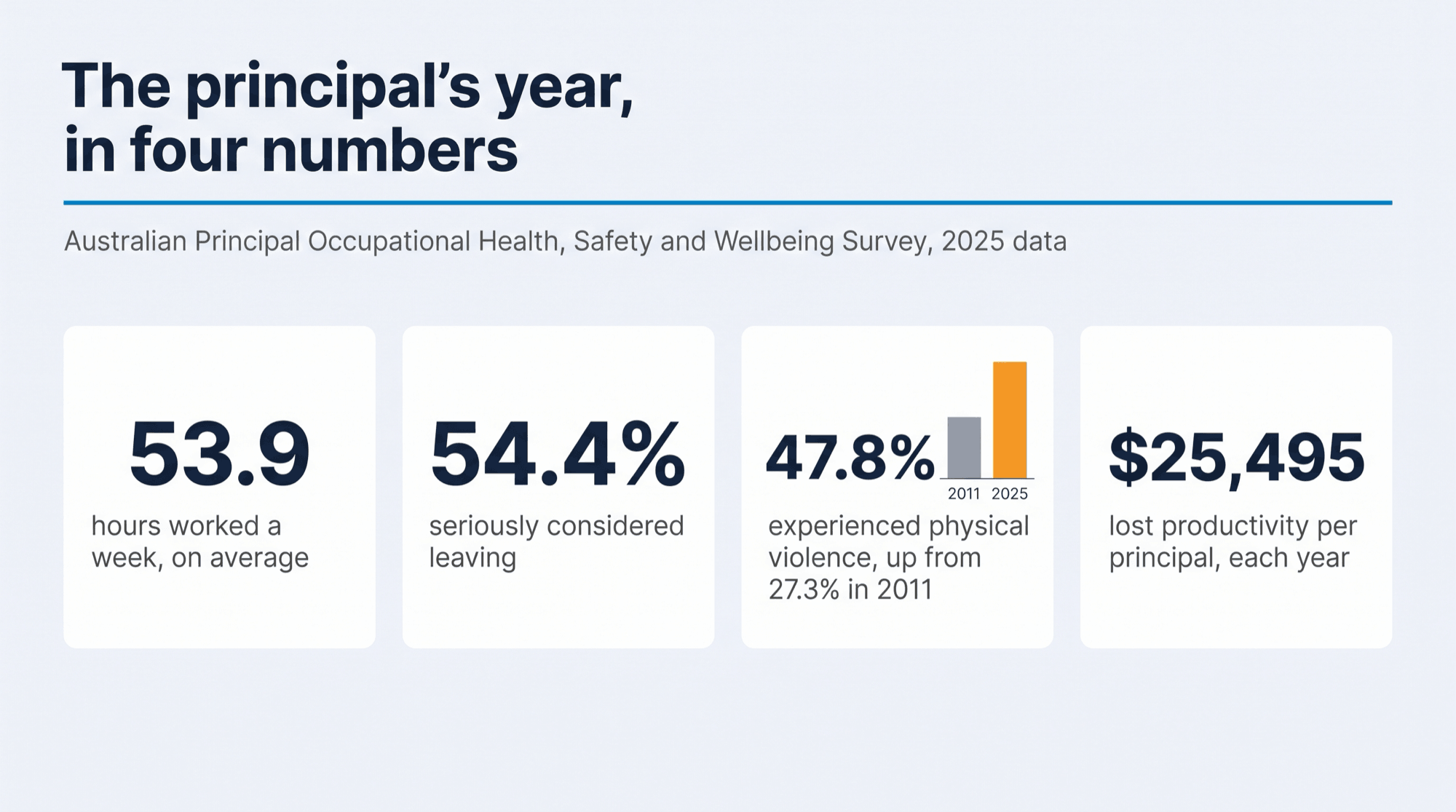
The Australian Principal Occupational Health, Safety and Wellbeing Survey has tracked principals for fifteen years. Its 2025 data, released in March, is stark. Principals average 53.9 hours a week. 54.4 per cent seriously considered leaving. Physical violence against principals rose from 27.3 per cent in 2011 to 47.8 per cent. Lost productivity runs to about $25,495 per principal each year.
Look at what principals rank as their top two sources of stress: the sheer quantity of work, and lack of time to focus on teaching and learning. Not students. Not parents. The shape of the work itself.
The insurers see the same thing from the other end. Aon's 2026 survey of 306 independent schools found serious mental health claims average 35.7 weeks off work and $67,400, against 7.4 weeks and $16,300 for other serious claims.
A role problem, not a person problem
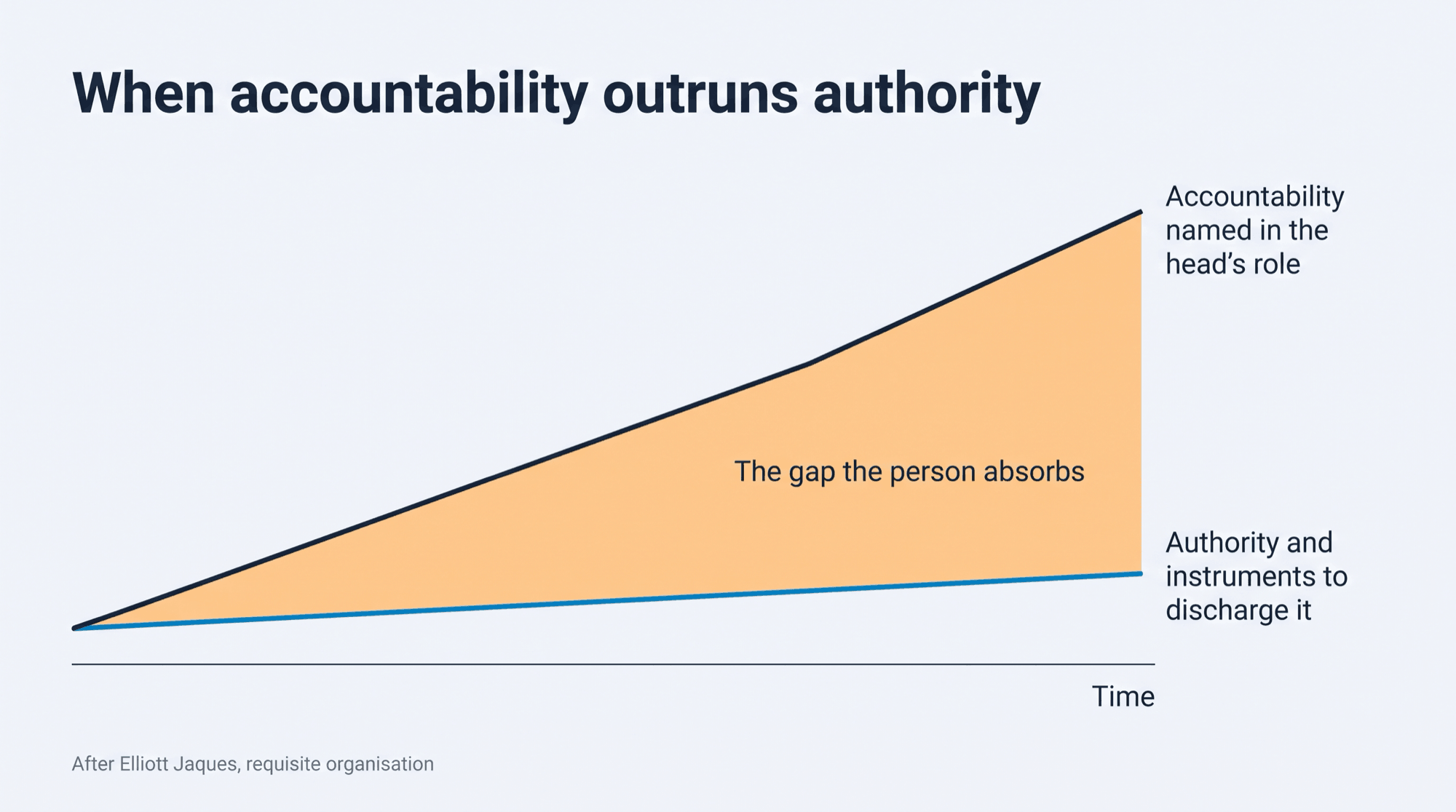
Elliott Jaques, whose requisite organisation work shaped how many large companies design roles, made a simple observation. Organisations hold together when the accountability in a role matches the authority to discharge it. When the two drift apart, people absorb the gap personally, and no amount of capability closes it for long.
Schools are drifting fast. AITSL's red tape review found principals feel compelled to take on every responsibility directed at them, because delegation frameworks in legislation are unclear. New laws increasingly name the head personally: Queensland's Reportable Conduct Scheme sets deadlines and a fine for the head of the organisation, not the school.
So accountability is concentrating in one role, while the authority and the instruments to discharge it stay scattered. They sit in a business manager's spreadsheet, a deputy's inbox and a board's annual calendar. In requisite terms, that's a role designed to fail, filled by people who mostly don't.
The second stressor tells the same story. "Lack of time to focus on teaching and learning" is role displacement: the work the role exists for, crowded out by work it was never scoped for.
Four places to look
An integral lens asks you to look at any problem from four sides. What a person experiences inside. What they do. What a group shares and means. And the systems and structures everyone works within.
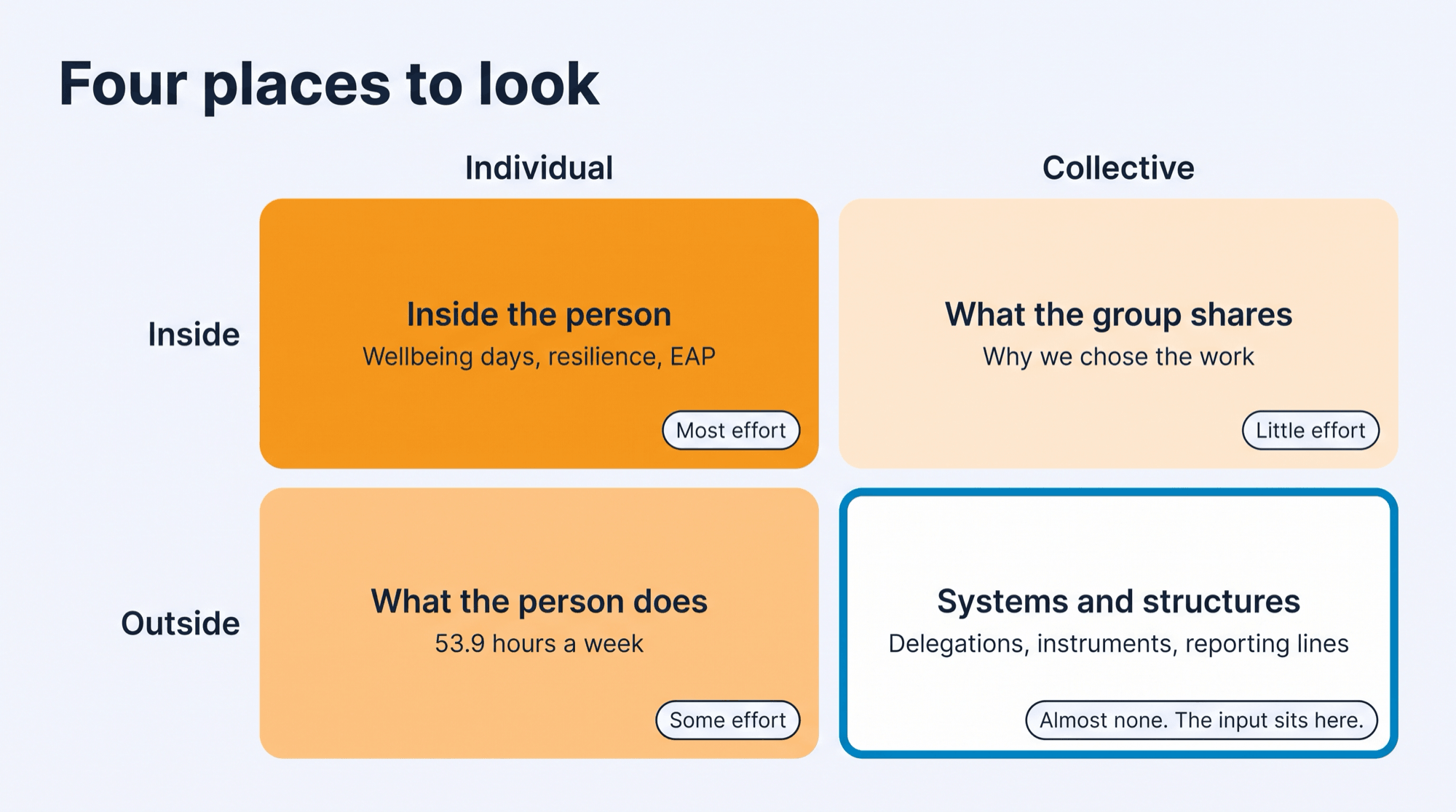
| Look at | What the evidence shows | Where effort usually goes |
|---|---|---|
| Inside the person | Anxiety and depression rising since 2023 | Heavily: wellbeing days, resilience training, EAP |
| What the person does | 53.9 hours a week | Some: time management, prioritisation coaching |
| What the group shares | A gap between why people chose the work and what fills the week | Little |
| Systems and structures | Delegations, instruments, reporting lines, a growing queue of obligations | Almost none |
The support in the first row matters, and I'd never argue against it. But it treats the response. The input sits in the last row, and that's where almost nobody is working.
The law has already moved
Victoria's psychological health regulations took effect on 1 December 2025 with no transition period. Employers must eliminate psychosocial risks or, where they can't, reduce them by changing work design, systems and management practices.
Read that closely. The regulation puts the control in the design of work, not in the individual's capacity to cope. For a board, that's a quiet but significant reframe. A principal's workload isn't a private wellbeing matter. It's a hazard the employer has to control, and for the principal, the board is the employer.
Aon found only 61 per cent of schools have clear accountability lines for psychosocial risk. The question for the other four in ten is uncomfortable but simple: who owns the risk sitting in the head's office?
What a board can do this term
Change the inputs, then watch what changes in the response.
- Map the head's accountabilities against their actual authority to delegate. Where they don't match, redesign the delegation, not the person.
- Name an owner for every psychosocial hazard on the register, including the load on the head.
- Count the inputs: obligations, reports and approvals landing on the head each term, tracked beside the wellbeing survey.
- Find the duplicated reporting AITSL identified and design it out rather than staffing it.
- Compare the role description with what actually fills the week, and treat the gap as a design defect.
The air, not the canary
Emeritus Professor Philip Riley of ACU calls the principal "the canary in the coal mine". It's the right image. When the canary struggles, nobody sends it on a resilience course. You fix the air.
Pete Holliday is a master executive coach and co-founder of EthosOne. He spent a decade advising ASX and S&P listed companies including BHP and Walmart on transformation, and studied organisational psychology with postgraduate work in adult development and human complexity.
References
Every date and figure above was checked against these sources on 1 October 2026.
- Australian Catholic University: Violence against principals nearly doubles in 15 years as workload soars
- The Educator: Mental health crisis in independent schools is now a board-level risk
- Australian Institute for Teaching and School Leadership: Review to reduce red tape for teachers and school leaders
- Queensland Family and Child Commission: What is the Reportable Conduct Scheme
- Premier of Victoria: New regulations start today to protect workers
The four we are asked every time.
Still weighing something up? Thirty minutes with us, on your own registers, answers the rest.
Get in contact01How many hours do Australian principals work?
On average 53.9 hours a week, according to the 2025 data from the Australian Principal Occupational Health, Safety and Wellbeing Survey, released by ACU in March 2026.
02Is principal workload a work health and safety issue for the board?
In Victoria, the psychological health regulations in force since 1 December 2025 require employers to control psychosocial hazards through work design, systems and management practices. For the principal, the board is the employer, so the load on the head is a hazard the board has to control.
03What can a school board do about principal burnout?
Change the inputs: match the head's accountabilities to their authority to delegate, name an owner for the load on the head as a psychosocial hazard, count the obligations and reports landing on the role each term, and design out duplicated reporting rather than staffing it.
04Why isn't wellbeing support enough?
Wellbeing support treats the response to the load. The input sits in the design of the role and the systems around it, which is where the regulation now places the control.
Discover more about EthosOne
Related article · Read the 2026 landscape as a leader, not an auditor · View→
Article by Dave Yeates reading the 2025 to 2026 obligations for schools as a design brief, with five questions for the next board meeting.
For school boards · View→
Meetings, resolutions, papers and a secure file vault, with a board pack built from live evidence.
Guide · WHS obligations for schools · View→
WHS obligations for schools: the register, the assessment that matched the activity, hazards, incidents and the trail.
Services · Board and risk advisory · View→
Advisory service that lifts the calibre of a school's governance, risk practice and board reporting.