






Nobody asked for an AI policy. They asked for a paragraph.
When a regulator moves, it rarely asks a school for a new document. It asks for a specific paragraph in a document already on the shelf: the malpractice policy, the behaviour policy.
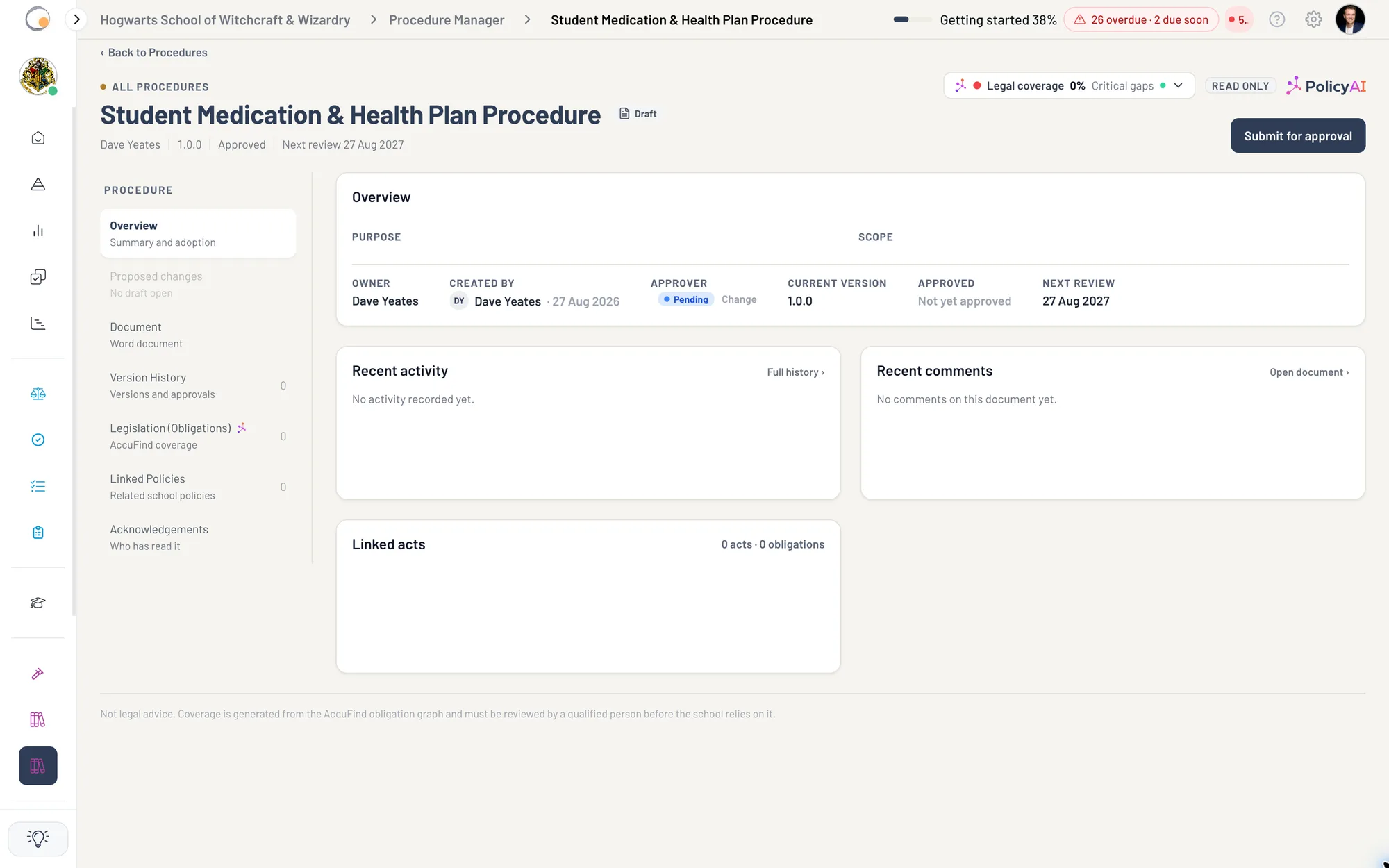
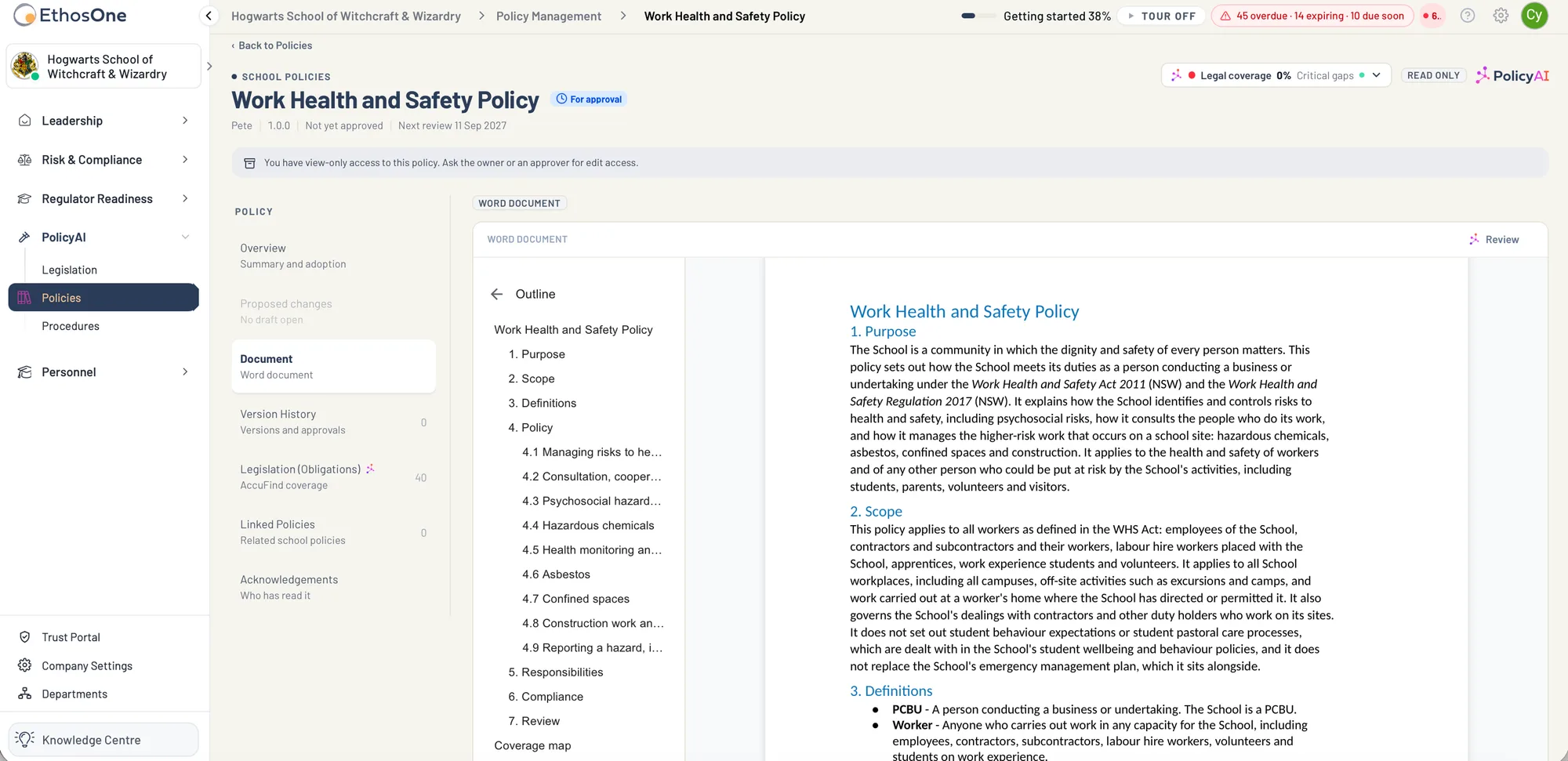
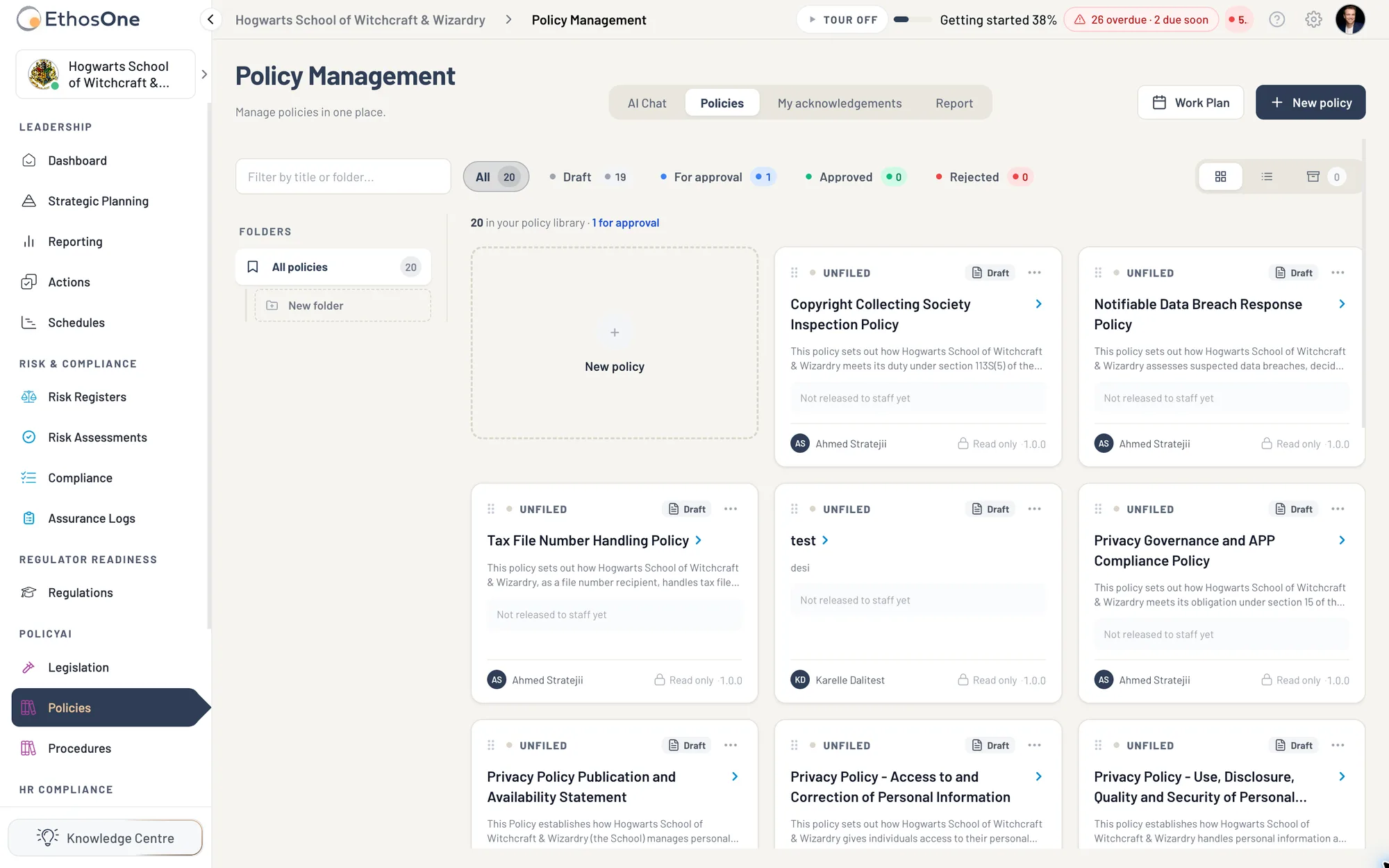
Real captures · PolicyAI · Hogwarts demo tenant.
Your next edits is EthosOne's free check on a school's policy library
Reframed around what to do next rather than what could go wrong. The State chosen picks which offence sits behind the deepfake edit. It takes about two minutes, needs no login, and the paragraphs are yours whether or not you ever speak to us.

What we keep hearing
Schools wait for the updated template. It arrives from a legal firm or a subscription service, and it arrives as words: correct, generic, and without the ethos of the school that has to adopt them. Then someone sits with two documents open, the new template on one side and the school's own policy on the other, and hand-pastes the paragraphs that matter into the policy that already exists, one at a time, hoping nothing was missed.
We are here to do a little better.
How it works
Five questions
Your school and its State, whether it runs senior secondary assessment, whether any system makes or helps make decisions about students, whether vendors hold student data, and which of the target documents it holds. Answers, not an upload, and nothing leaves your browser until you ask for the report.
The law on the left, your documents on the right
For each edit that applies to your school, the provision behind it appears on the left as it is stored, with its type (a must, an offence, a direction, guidance or a bill), its status, the version it was read at, and one line on why it is an edit rather than a new document. On the right, each of your documents receives its paragraph, drafted against that provision with your school's name written in. Every draft ends with the same line: here to help, not legal advice, AI can make mistakes.
Your next policy
Where an edit belongs in a document you do not hold yet, the finder names the document to write next and gives you the paragraph as its first clause.
The report
Every edit, every obligation in the same breakdown and every paragraph drafted, as a PDF ready to paste, with the provision each was read from and the version it was read at.
Nobody asked for an AI policy. They asked for a paragraph.
When a regulator moves, it asks for a paragraph in a document you already hold, not a new policy. Answer five questions and watch PolicyAI draft each paragraph against the provision it rests on, with your school's name written in.
- 1NSW Education Standards AuthorityOfficial Notice 29/26, 31 August 2026Before Term 4 2026 for HSC courses; Term 1 2027 for Preliminary
- 2eSafety CommissionerSchool imagery advisory, 28 July 2026No statutory deadline; the criminal offences already apply
- 3Office of the Australian Information CommissionerPrivacy and Other Legislation Amendment Act 2024, Schedule 1 Part 1510 December 2026
- 4AICD and the Australian Signals DirectorateDirector's Guide to AI Governance v2, 29 June 2026; frontier AI board guidance, 3 August 2026Now. The Mathspace breach of 3 September 2026 is the sector's worked example
- 5The board's owneSafety research, 3 August 2026; National AI Centre guidance; the NZ Online Safety Bill, 24 August 2026Before the board next meets
What the free answer includes, and what it does not
The paragraphs are free, complete and unblurred. Each is drafted the way PolicyAI drafts inside the product: against the obligation it answers, with the provision beside it, verified against the text of the law, and read by a person before it is offered. AI can make mistakes, which is why the provision sits beside every paragraph and the last page of the report says what to check before anything is pasted.
The paid answer is the one no free page can reach. The edits here are the ones the regulators have announced, so they are the same for every school that holds the document. A school's library carries hundreds of duties that nobody announces, and the better organised the school, the more likely its gaps are inside the policies it already holds rather than in the ones it lacks. Reading a real library duty by duty, every term, is what PolicyAI does.
Run at any scale. From one campus to a diocese, with every entity reporting the same way.
- Switch
- from your existing platform, for a low cost
- 25
- policy domains help you make sense of the policies you have, and the ones you need
- Every regulator
- in Australia and New Zealand supported
- Safe
- data, processing and AI based in Sydney and Melbourne via AWS
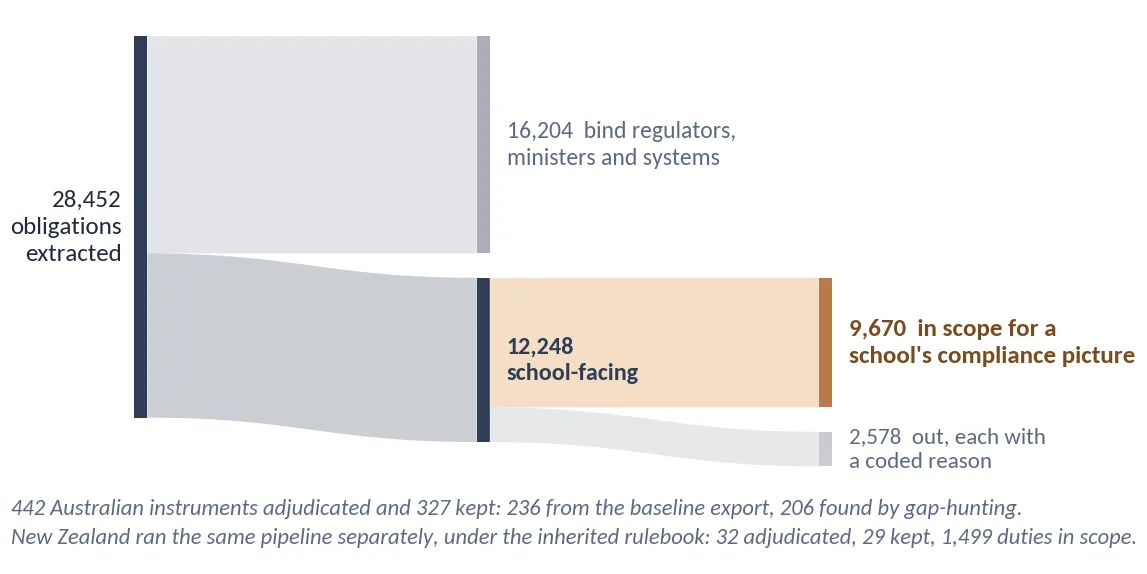
Coverage spans the eight Australian states and territories, with Commonwealth law applying across all of them, and separately New Zealand. Domain figures come from the PolicyAI Research Atlas, refreshed weekly.
What it does not do
- It does not give legal advice. Each paragraph is a draft for a named person at the school to review, adapt and approve, and says so beneath it: here to help, not legal advice, AI can make mistakes.
- It does not read the inside of your policies, so it cannot tell you a policy you hold is adequate beyond the edit it names.
- It does not need an account, and it does not hold your library.
Your next edits is the free front door to PolicyAI, which reads a real library against the duties that apply to it, every term. The obligations behind both come from the school's own profile in legislation, built on the store described on the AccuFind partnership page, and the library itself lives in policies and procedures. Every finding is checkable through how we verify.
- Stored in AustraliaAWS Sydney and Melbourne, one database per school
- AI stays in the country tooAmazon Bedrock; never trained on your content
- Published, not describedTrust Centre · ISMS policy · How we handle your data
PolicyAI answering the prompt “Draft me an AI Acceptable Use Policy.”, then working through: Reading the AI-engaged obligations; Matching privacy, records, child safety; Drafting against your existing library.
Solutions for every school’s AI challenge.
There is no AI-specific legislation in force in Australia or New Zealand. The duties your school already carries are the ones AI engages.
Governing AI, before your board asks again.
“The board asked what our position on AI is, and we did not have one.”
An AI policy is not a new rulebook, it is a lens over duties your school already carries: privacy, records, discrimination and child safety, engaged by an AI-shaped set of facts. Which is why a downloaded template does not survive contact with a regulator.
We have tagged the duties AI activity in a school engages, so the conversation starts from the obligations you already hold rather than from a blank page. Almost none of them say “AI”.
The six we are asked every time.
Still weighing something up? Thirty minutes with us, on your own registers, answers the rest.
Try Draft with AI.01Is it really free, and do I have to give you anything?
It is free and there is no login. You answer five questions and the paragraphs draft on the page, against the provisions they rest on. The report as a PDF asks who it is for, and nothing you tick leaves your browser until you ask for it.
02How is this different from PolicyAI itself?
The edits are the ones the regulators have announced, so they are the same for every school that holds the document. PolicyAI reads the policies you do hold against every duty that applies to your school and finds the ones still unmet inside them, which is the part a newsletter cannot do.
03Were the paragraphs written by AI?
They are drafted the way PolicyAI drafts: against the obligation, with the provision beside it, and verified against the text of the law, with the provision and the version recorded in the report. A person reads every paragraph before it is offered, and a person at your school reads it again before it is adopted. AI can make mistakes; the provision beside each paragraph is how you check.
04Where do the obligations come from?
AccuFind legislative intelligence, refreshed weekly and processed in AWS Sydney. Every duty is keyed to a provision you can fetch and read, and the register behind it is published openly. How we verify shows the method and the error log.
05We hold all twenty-five. Is there anything here for us?
Then every edit lands in a document you already have, which is the best position to be in: paragraphs and no new document. The duties nobody announced are the next question, and that is PolicyAI.
06PolicyAI, in full: what does it cover?
You answer five questions: the school and its State, whether it runs senior secondary assessment, whether any system helps decide things about students, whether vendors hold student data, and which of the twelve target documents it holds. PolicyAI then hands back the paragraphs the current regulatory movement asks for in those documents: the malpractice policy that must stop relying on AI detection, the behaviour and imagery policies that must name deepfakes, the privacy policy that must say where automated decisions are made, the vendor policy that makes a security advisory somebody's job, and the sentence in the risk appetite statement that says what AI may not do here. The drafting happens against the law: on the left, the provision behind each edit as it is stored, whether an Act, a bill, a regulator's direction or guidance, with why it is a paragraph rather than a new policy; on the right, the school's own documents receiving each paragraph, the school's name written in. It is drawn from the regulators' own notices as they land, so it is current by construction. It is not legal advice.
What sits behind the check

AI-native, governed for public good
Explains EthosOne's sovereign, OECD-aligned AI governance stance and PolicyAI add-on for school leaders and boards.

Policy and obligations: the chain from the Act to the evidence
Defines the chain from an Act to an obligation, a policy, a recurring compliance item and evidence, PolicyAI on top.
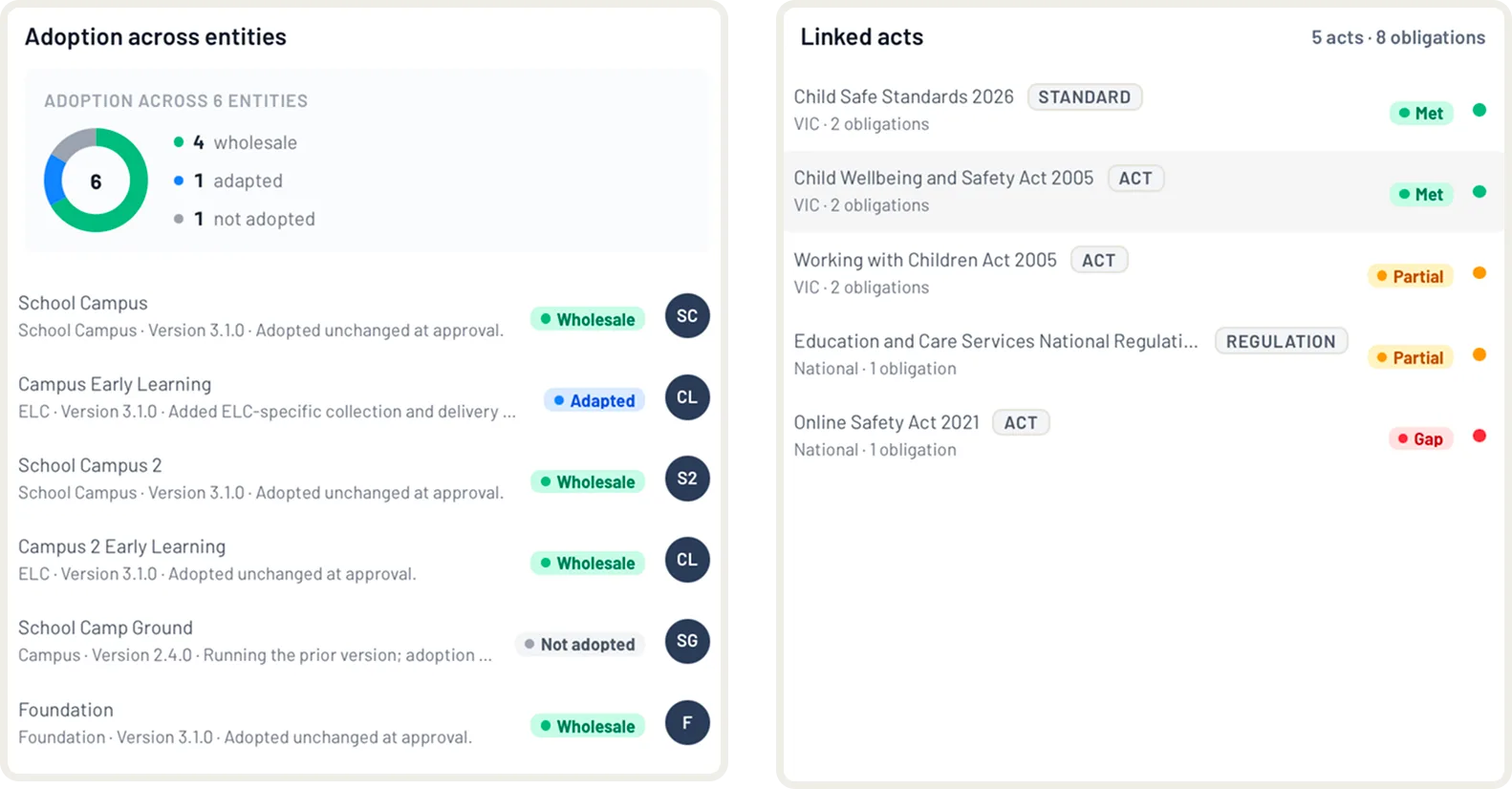
Know what your policies actually cover.
PolicyAI holds the Acts and obligations that apply to a school, reads the policy library against them, scores coverage as met, partial or unmet, watches legislative change and drafts the sections a policy is missing. Built on AccuFind, verified against the text of the law, checkable by anyone in about a minute.

Draft your edits, then bring one of those documents to usand we will read it with you, duty by duty
Regulators rarely ask a school for a new document. They ask for a paragraph in one the school already holds. Answer five questions and watch PolicyAI draft each paragraph against the provision it rests on, with your school's name written in.